How two Nottingham men ended up on opposite sides of the Russia-Ukrain | World | News

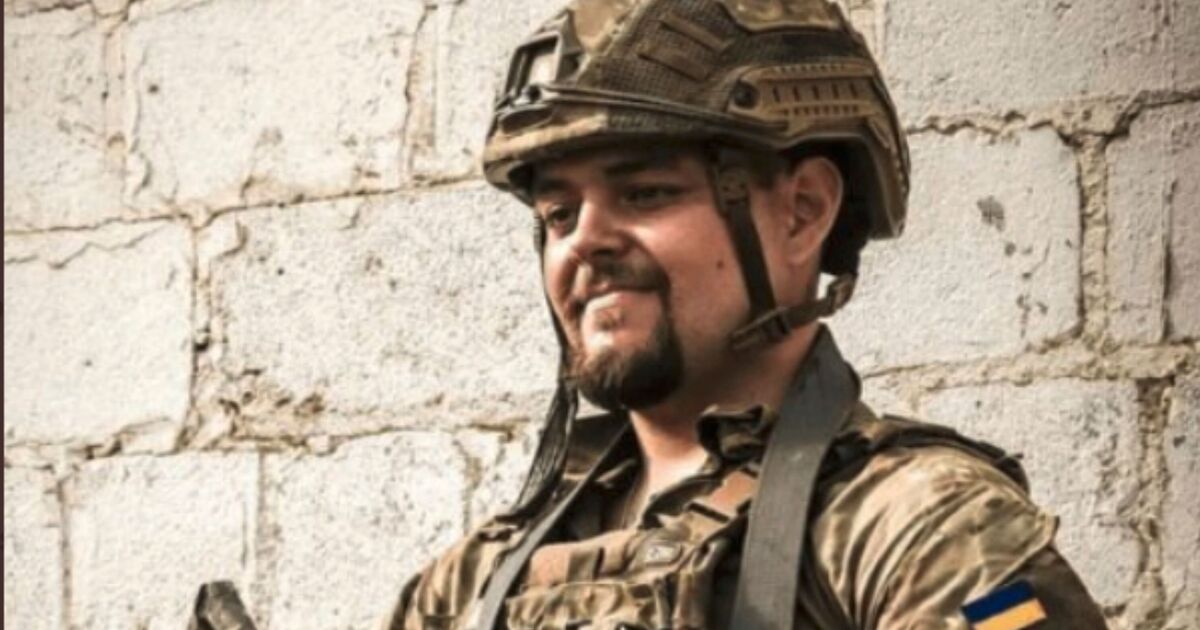
Briton Aiden Aslin was captured by Russian forces in Mariupol (Image: Twitter)
IT WAS the heavily-accented Russian voice that Aiden Aslin heard first. A nasal warble echoing down the corridor of a filthy prison block in Ukraine’s occupied Donetsk region. “Oh my God, please don’t be who I think this is,”he muttered. Aslin, from Nottingham, was still recovering from the torment of a mock execution and being stabbed in the shoulder by a Russian guard. Now he had something else to worry about.
A door swung open. In front of him stood a shaven-headed Russian propagandist clutching a camera and a microphone.
Just a few days earlier, Aslin had been fighting for Ukraine in the siege of Mariupol, holed up in the city’s steelworks and pummelled by Russian shells.
Food and ammunition had finally run out, forcing his unit to surrender in April 2022, two months into Putin’s full-scale invasion of Ukraine. Held captive in a labyrinth of Russian cells and interrogation rooms, he’d quickly learned that British POWs received “special” treatment.
“By this point, my mental health was the worst it had been since being in captivity. I’d managed to find a razor blade that was hidden in the window of our prison cell. And I remember I used to lay down on my bed at nighttime, just thinking of just ending my life.”
At regular intervals, guards would drag him from his cell to take part in filmed interviews with a string of hard-line Kremlin propagandists and conspiracy theorists. The 28-year-old would be accused of being a Nazi, and forced to sing the Russian anthem at the top of his lungs. It was all for the entertainment of tens of thousands of Putin supporters and oddballs online – lapping up videos of a Briton being humiliated before getting his comeuppance, they hoped, blindfolded and strapped to a pole, as he faced a Russian firing squad.
There was one person, in particular, among this sorry troupe of self-styled “independent journalists” who Aiden hoped he would never meet. It was the man standing before him that day in a Donetsk prison, and he wasn’t Russian at all. He was British. Not only that. He too was from Nottingham.
“He walked in and I was like, ‘Jesus’,” Aslin recalled. “Out of all the propagandists I could have possibly encountered, it had to be this guy. I knew straight away it was Graham Phillips.”

Aiden Aslin, right, on the flight home with other freed Britons in September 2022 (Image: Sky News)
Forty-three year old Phillips had undergone a bizarre transformation from British civil servant to Russian social media star.
“I think the only thing he mentioned was that we were both from Nottingham,” Aslin continues. “That was trying to break the ice.
“Then he went straight into the aggressive ‘oh, you’re a mercenary’ – stuff like that.”
Flitting around the frontlines in eastern Ukraine, often embedded with Russian troops, Phillips had reported triumphantly from fallen Ukrainian towns while cursing Zelensky’s government as “Nazis”. His unyielding, sometimes wild opinions had helped him amass more than 300,000 followers on YouTube. People were curious to see a Brit towing the Kremlin line.
Now, wearing a green Fred Perry T-shirt and brandishing a Canon camera, Phillips ushered a handcuffed Aiden Aslin onto a stool. Phillips was steely faced, bursting with nervous energy and excitement. Aslin was bruised, disorientated, blank-eyed.
By the strangest twist of fate, these two lads from Nottingham had found themselves together in a Russian-controlled prison, on different sides of the conflict.
One, an interrogator hoping to boost his online following; the other, a condemned man willing to do anything to stay alive.
I was there too at the time, just a few miles away on the Ukrainian side of the frontlines, reporting on the war for the BBC. I saw the video of the Brit-on-Brit interrogation and found it deeply troubling, chilling, ghoulish even.
I knew straight away that it was probably a breach of the Geneva Convention.
Any self-respecting journalist understands that you can’t interview a prisoner of war. They’re not free to speak their mind and consent is meaningless. But as I watched Phillips accuse his fellow countryman of being a mercenary, and then declare with relish, “It’s the death penalty!”, I was left wondering how two men from the same town could choose such profoundly different paths in life. I began researching a story that turned out to have the Tolstoy-esque sweep and twisty narrative that might cause a bidding war in Hollywood. It had love, war, death, patriots and traitors.
Phillips, it turned out, was a university graduate who’d once dabbled in stand-up comedy, apparently performing on the same bill as Russell Brand, before surrendering to the grind of a desk job. He’d travelled to Ukraine not as a war reporter but as an England football fan,for the European Championships in 2012. Phillips had been seduced, not just by the Byzantine domes of St Sophia’s cathedralin Kyiv, the bucolic steppes, or the bracing waters of the Black Sea, but by Ukraine’s “otherworldly women”.
He’d decided to stay on, starting a sex tourism blog, and filing occasional reports for British newspapers.
During the Maidan Revolution in February 2014, Phillips was reporting from a rally of the notoriously far-right Svoboda Party, when he observed dozens of people throwing Nazi salutes. It was an earth-shattering moment for the fresh-faced young journalist from Nottingham. When the Kremlin blamed “Nazis” for the overthrow of their puppet Viktor Yanukovych, Graham Phillips decided to take their side.

Graham Phillips ‘interviewed’ Aiden Aslin when he was a British prisoner-of-war (Image: -)
He split from his Ukrainian girlfriend, and headed for the Russian-controlled city of Donetsk. A Briton among burly balaclava-wearing separatists, he was soon given special access to Russian facilities, exclusive embeds, and even awarded Kremlin medals.
Phillips had found his tribe.
Les Scott, an old friend of Phillips who made a film with him in occupied Crimea, recalled: “I thought we were gonna have mobs chasing us. People saying, ‘Oh, you’re that propagandist’. And it was nothing like that. It was like walking around with a celebrity and that’s not an exaggeration.
“Some people were emotional, somepeople were in tears, because they said, ‘Thank you. You’re the only person who’s from a Western origin who’s telling people how we feel’. And I would guess that if you were gonna ask what drives Graham as an individual to do what he does so passionately, so provocatively, then that’s it.”
Aiden Aslin’s helter-skelter path to Ukraine was even more dramatic. Expelled from his Newark school for fighting, he’d become a carer before catching sight of gruesome Islamic State videos on social media. Scrolling through each horror he had concluded that the West needed to do more – Western liberal democracy was at stake.
“I’m off to Syria,” he declared to his shaken mum, Angela, “to fight IS.”
Untrained, and with no frontline experience, relying on Facebook for instructions, he’d crossed the border into Syria in 2015 and joined the Kurdish militia group, the YPG. Soon Aslin was armed with an AK-47, cooking meals beneath the stars, and fighting on the frontline. All around him were other foreign-born fighters from the US, Canada, and Britain. Some romantically compared themselves with the International Brigades fighting Franco in the Spanish Civil War. After two gruelling tours, Aslin’s attention had shifted to Ukraine, and what he considered the forgotten conflict there.

Journalist Paul Kenyon has reported on the war in Ukraine for the BBC (Image: -)
He packed his bags, boarded a plane for snowy Kyiv in 2018, and formally joined the Ukrainian armed forces. He was at a mortar position in the freezing countryside near Mariupol when he heard the terrifying swoosh of grad rockets four years later.
Putin’s full-scale invasion had begun.
Aslin’s surrender, two months later, had been the hardest decision of his life. He’d anticipated the beatings in custody, and the court case which saw him sentenced to death, but not the intervention of a fellow Brit in that interrogation room in Donetsk.
Both men had been fighting a conflict that wasn’t their own. They’d chosen sides in an era where opinion, fact, and fantasy dance giddy rings around even the most sober of minds. Many of us do the same, but we keep our views to boozy lunches among friends.
The difference is that these two lads from Nottingham decided to act. Today as the war nears its fifth year, Aslin finds himself on the right side of history, fighting on the frontline of Western liberal democracy against the forces of autocracy and terror. Phillips chose the latter – emboldened by his growing celebrity and the online purveyors of a similarly warped worldview.
But for each man, the cost of action has been immense. Aslin was freed in a prisoner swap and is still trying to mend the trauma he suffered on death row. Phillips insists his interview with Aslin was freely given – and conformed with international law – but his pro-Kremlin activities have seen him sanctioned by the British government.
His UK assets have been frozen and he reportedly lives in a bombed out house in Donetsk. It’s here, in this blasted backyard in a stolen Ukrainian city, that the gaseous world of social media has, for Phillips at least, taken material form, among the dying embers of another Russian winter.
Hear the full story of Two Nottingham Lads on BBC Radio 4 every Wednesday morning until January 14, or listen nowvia The History Podcast on BBC Sounds