Greenland is melting – and now it’s a global flashpoint redrawing economic map | World | News

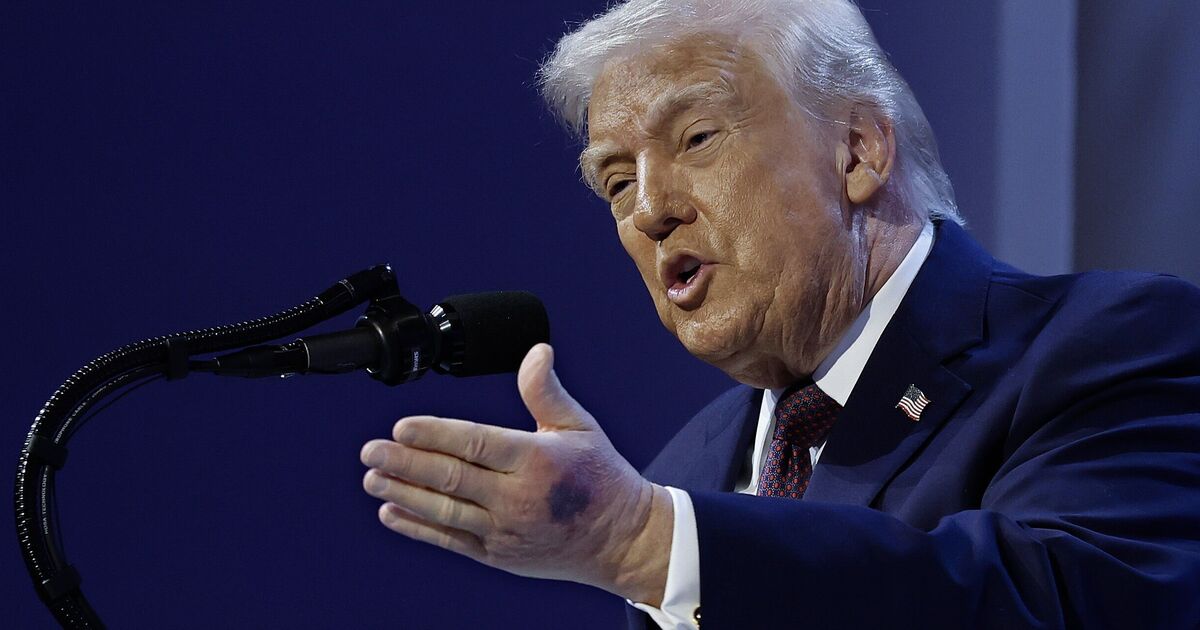
Donald Trump speaking at the World Economic Forum In Davos (Image: Getty)
Melting Arctic ice is transforming Greenland from a frozen frontier into a global trade flashpoint. New shipping routes and access to critical resources is redrawing the world’s economic map – something leaders like Donald Trump, Vladimir Putin and China’s president Xi Jinping have made no secret about. The US President this week doubled down on his threats to annex Greenland, saying only his country could secure the Arctic territory. Mr Trump called the ice mass an “undeveloped territory sitting undefended in a key strategic location between the United States, Russia and China”.
Chris Southworth, secretary general of the International Chamber of Commerce UK, said: “Climate change is physically redrawing the world’s trade map. Thinning Arctic ice is opening shipping routes that cut weeks off journeys between Asia, Europe and North America, and that shift puts Greenland at the strategic centre of a new global economic order. This isn’t theoretical anymore: it’s happening now, and it’s why the Arctic has become a flashpoint for trade, resources and power.”
He added: “Greenland matters because it sits on critical minerals, oil and gas that underpin everything from defence and energy security to batteries, semiconductors and future technologies.
“As these routes open, the Arctic connects the US, Canada, Europe, Russia and China in a tightly enclosed economic space.
“The real risk isn’t climate change alone, it’s responding to this shift with tariffs, confrontation and unilateralism, which only raises costs, destabilises supply chains and accelerates fragmentation in global trade.”
The container ship Istanbul Bridge last year became the first liner vessel to travel from China to Europe via the northern sea route, also known as the “Polar Silk Road” shortcut.
The ship travelled from Ningbo, China, to Felixstowe, UK, in about 20 days.
This route can chop off between 10 and 15 days from journeys between Asia and Europe compared to traditional routes via the Suez Canal.
Meanwhile there were 665 transits through the Bering strait, which separates Russia from the US, in 2024, a 175% rise from 242 in 2010.
Experts have also told how the shipping season is becoming longer throughout the whole region, with a big increase in shipping throughout the Canadian Arctic.
Glaciologist Martin Siegert, visiting professor at Imperial College’ London’s Grantham Institute for Climate Change, said the Arctic’s northern sea route is monitored by Russia and opened using nuclear-powered icebreaker vessels.
He added: “It hugs the coast of Siberia all the way down to western Russia, but it’s quite likely that in coming decades (in August or September) there might well be not much sea ice at all over the Arctic Ocean and that would allow ships not to go hug the coast around Siberia but go across the Arctic in that instance.”
The ice expert said this would be possible for a short time before the sea ice starts to regrow and it gets much darker in winter.
Scientists now believe the summer of 2040 will see the end of the frozen North Pole after a rapid shrinking of the ice coverage in recent years.
But Professor Siegert said: “It might well be that by 2040 we have already experienced a late summer where the sea ice is no longer over the North Pole and that’s an open route, but it might be that the next year is colder because there is variability.”
“As you traverse across the North Pole in an open water scenario, you’ll be transgressing over all sorts of different nations’ territorial waters. And so the politics of this is quite complicated.”
But Dr Alison Cook, of the Scottish Association for Marine Science, warned melting sea ice could already be hindering Canadian Arctic shipping.
She found seasonal sea ice – which thaws in summer and reforms in winter – has been shrinking quickly because of climate change.
This has released thick and centuries-old multi-year ice from further north into shipping channels, which can be more hazardous and more unpredictable, creating so-called “choke points” in existing routes.
She said: “Ship captains need to be very aware of that and it’s not free, clear access through the channel.”
Sammie Buzzard, assistant professor at the Centre for Polar Observation and Modelling at Northumbria University, stressed the importance of Greenland scientifically.
She said: “It’s one of the places we can really see changing under climate change, so it’s somewhere that should definitely be protected.”
Referring to Greenland’s ice melt, she added: “Sea level rise has impacts for everyone. If all of Greenland melted, I think the figure is about 7.4 meters of sea level rise would happen and, even though we’re not expecting anything like that to happen in our lifetimes, even really small amounts of sea-level rise can have a huge impact.
“It’s not an area we can ignore. The fact that it’s changing is obviously devastating from an environmental perspective. Polar bears going hungry and other creatures that have habitats up there. It’s people’s homes, the indigenous people who live in the Arctic, but also it is going to impact all of us.”