Inside London pub car park where ancient pagan wassailing thrives | UK | News

Wassailers perform ancient ritual in Tottenham (Image: Tim Merry)
If you stand at the bar in a London pub on any given evening it’s not uncommon to see some strange sights. But standing at Ferry Boat Inn, catching sight of a woman wearing a top hat adorned with black feathers, I feel a wave of relief wash over me. I’m in the right place. Tonight will either be brilliant or absolutely terrible. There’s no middle ground when it comes to Morris dancing in a Tottenham car park.
I’m here for the winter pagan ritual of wassailing. It’s an evening of revelry held on the 12th night of Christmas to bless apple trees in the hope of a good future harvest by throwing cider on the roots, and singing and dancing to ward off evil spirits. So popular has it become in recent years that events now run throughout January.
Growing up in Dorset, wassailing meant farms, welly boots and people who looked like they had just walked off the set of The Vicar of Dibley. It meant wax jackets, muddy fields and a comforting sense that everyone knew exactly what they were doing and why.
This, on a Saturday in January at a pub in the capital, is categorically not that. Two vans stuffed full of police officers greet me as I exit the train station. As I walk up, dodging cyclists and evening traffic, I’m starting to suspect I may have made a mistake.
Read more: I went to World Darts Championships – nothing prepared me for what happened
Read more: Britain’s best pub takes the title for a record third time
1 of 4
-

Johnny leads London Pride Morris dancers (Image: Tim Merry/Staff Photographer)
-

Two locals on their first Wassail (Image: Tim Merry/Staff Photographer)
-

Peter’s hurdy gurdy provides rustic soundtrack (Image: Tim Merry/Staff Photographer)
-

Hannah joined to learn the melodeon (Image: Tim Merry/Staff Photographer)
Soon I meet Diana and Tony, who run Black Path Morris. They’ve been doing this for 30 years. One of their members joined three months ago, and in that time they have mastered five dances.
“We just sort of met one day and went from there really,” a musician from another group – Black Horse and Standard – tells me. She is holding a fiddle, and her side’s getting the beers in.
There are five Morris sides here tonight. Black Horse and Standard, Black Swan, Black Path, Camden Clog and London Pride. The names sound like craft beers, which feels appropriate given our location.
Carol McGuiness from Black Horse is hosting. She’s a whirlwind of activity as the event gears up, buzzing this way and that to get everyone into position. As she does so the crowd gathers, and it’s not what I expected. Families with children on shoulders mingle with city types nursing glasses of wine. I spot one man in lycra who has cast off his bike to see what the fuss is about.
Another chap, vaping and holding a craft beer, looks utterly baffled. “What do they do for the rest of the year?” his companion asks.
Nobody answers, because nobody knows, so I make it my mission to find out. Before I can, the first dance begins. The top deck of a passing bus quickly becomes a gallery of phone cameras. A delivery driver halts his motorbike, films for a bit, then remembers his food is getting cold and scoots off like his life depends on it.

Aaron joins in the wassailing (Image: Tim Merry )
When it ends, the crowd offers polite applause. I must admit, a part of me remains unconvinced.
Then Black Swan arrives. They are swathed in black with paint across their eyes wielding rather menacing looking sticks. A veritable giant of a man, black beard and all, kicks off the dance with a roar that makes one child hide behind his mother. I take shelter behind a parking meter.
Camden Clog follows with wooden boards and an accordion. The contrast is jarring. No shouting, no menacing costumes. Just rhythmic clogging that somehow calms the entire crowd, children and Express journalists included.
Black Path performs next. “This is a dance about a witch, a very good looking one who ran off with a load of pixies,” Tony announces. A child asks if the witch is inside the pub. She does not know. Neither do I and neither, I suspect, does Tony.
A figure joins them wearing a deer skull with antlers. I decide not to ask why, some questions are better left alone.
The dances continue. There are handkerchiefs. More roaring. A hurdy gurdy appears, sounding exactly as rustic as you would imagine. The dancers roar again, and a plucky child roars back. I remain hidden behind the meter.
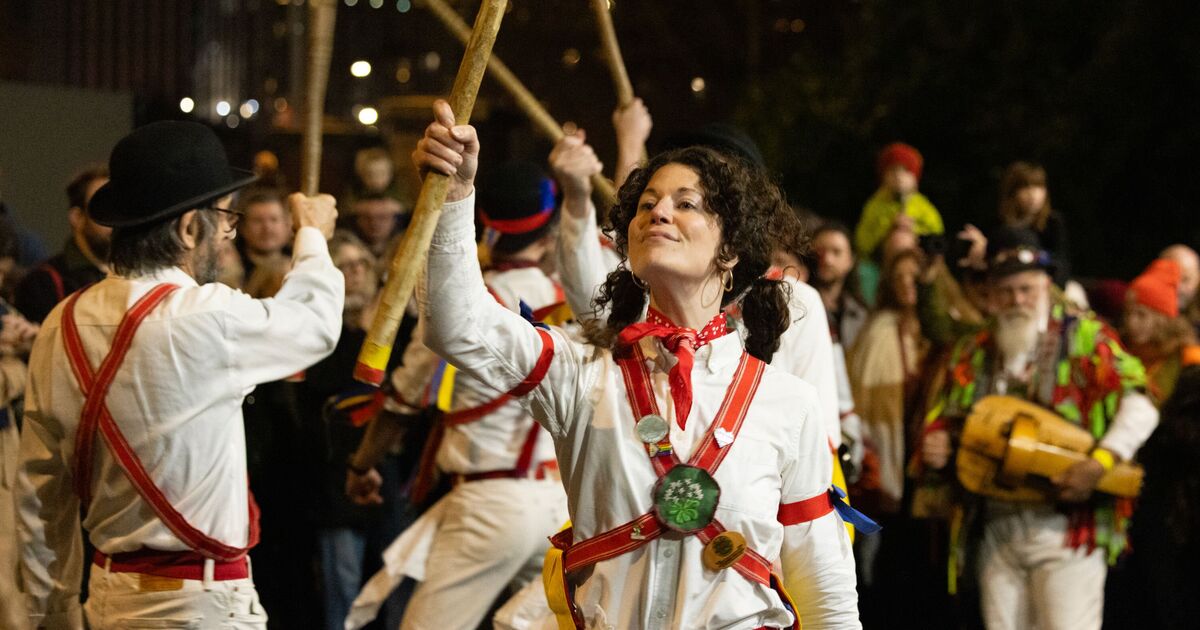
London Pride performs Cotswold Morris – white clothes, bells and bowler hats. This looks like the Morris I remember. There is something comforting about bells and white clothes when you have just witnessed a dancer in a deer skull skipping about the Devil.
I am still not convinced. It feels too strange, too urban, too far removed from the fields and apple orchards I remember.

Black Path performs a witch and pixie dance (Image: Tim Merry )
But then they announce the join-in dance. Quickly, I am handed two sticks complete with ribbons and am partnered with a woman who comes every year. “Last year we stayed until the beer ran out,” she tells me, as if issuing a challenge.
We get one practice. Carol blows a whistle and sternly looks at me to take my allotted place. Raise the sticks. Skip. Dance in a circle. Wave the sticks. Skip again. Surely, I can master that?
Then we do it for real, with music, with the professional dancers cheering us on like we are performing at the Royal Albert Hall.
And something clicks. The costumes do not matter. The fact we are in a car park in London does not matter. This is exactly what Morris was back home. Getting involved, having a laugh, keeping something alive that probably would have died out decades ago but refuses to, because people like the crowd here simply will not let it.
I hand my sticks back and mingle. “If I saw them walking up to me on the Tube, I would think the druids had come to town,” one man mutters. I am inclined to agree, and I decide that would not be a bad thing. A man with a hip flask watches on, tapping his feet to the music. Young men wearing woolly hats topped with papier-mâché apples tell me they have been coming for years. Someone is playing splat the rat with a homemade board. If you win, he buys you a drink.
A passing cyclist stops, FaceTimes his dad to show him the spectacle, then pedals off into the night.
By dance 12, children are Morrising along in the crowd unprompted.
When the dancing finishes, I speak to Johnny, the Squire (or boss) of London Pride. “I was pulled in by early folk music. Then my friend invited me to a class at Cecil Sharp House in Camden.” This, I learn, is the centre of Morris in the country.
Carol is full of praise for the assembly. Her youngest member is in her 30s, the oldest over 70. “It is enormous fun, it keeps us fit and it is sociable,” she says. “I have been doing it since 1982. People see us out and about and they get interested. Everyone is welcome, just have a go and join in.”
Peter Kanssen, 64, the man who spurred me on with the hurdy gurdy, has been doing this for 35 years.
“My girlfriend at the time invited me along. Got me hooked. It is just good fun. It is all about keeping tradition alive. But if the traditions are boring, nobody would do it. Morris is anything but boring.”
Hannah Lisserman, 32, a data engineer, joined because “I wanted a reason to learn how to play the melodeon”. She enjoys the “kind of gothic charm”.
“I met a lady in the loo who asked me if I was going to a concert,” she says. “I told her, I am the concert.”
The crowd moves to the beer garden. Chris Hayes, the landlord, oversees proceedings. He is wearing a hat threaded with branches and leaves. He looks like a tree that decided to become a person.
He sings the apple tree wassail song and pours cider on the roots of trees scattered throughout the garden. Then they hang toast to the branches. Except this is Tottenham, so they hang bagels instead.
The old ways meet the new postcode. We cheer, bang pots and move to the next tree.
Holly Shelton-Newlove, 29, tells me, smiling: “I have no idea what is going on.”
The evening ends with a sing-along in the bar until the beer runs out.
I watch the dancer in the deer skull buying a pint and chatting with the cyclist who stopped 20 minutes ago and never left. A child teaches his father the dance moves whilst his mother films. Regulars who came in expecting a quiet Saturday pint look on with magnificent bemusement.
Walking back to the station, past the police vans and the estate, I find myself thinking about traditions and how they survive.
Morris dancing should not work in Tottenham. It should require fields and farms and people in wax jackets who know what they are doing. It should not involve deer skulls and craft beer and bagels hanging from trees.
But it does work, precisely because nobody told these people it shouldn’t.
They took something old and planted it in a car park. They took the bells and the sticks and the rural charm of it, and they refused to let it die just because the location changed.
Next January, I may be back. Not because I suddenly understand Morris dancing, because I still categorically do not.
But because sometimes the best traditions are the ones that refuse to make sense, that insist on surviving in the most unlikely places, performed by people who simply will not let them go.
And because, if I am being honest, I quite want another go with those ribbon sticks.