Worker suffered ‘most agonising death ever’ and asked doctors chilling question | World | News

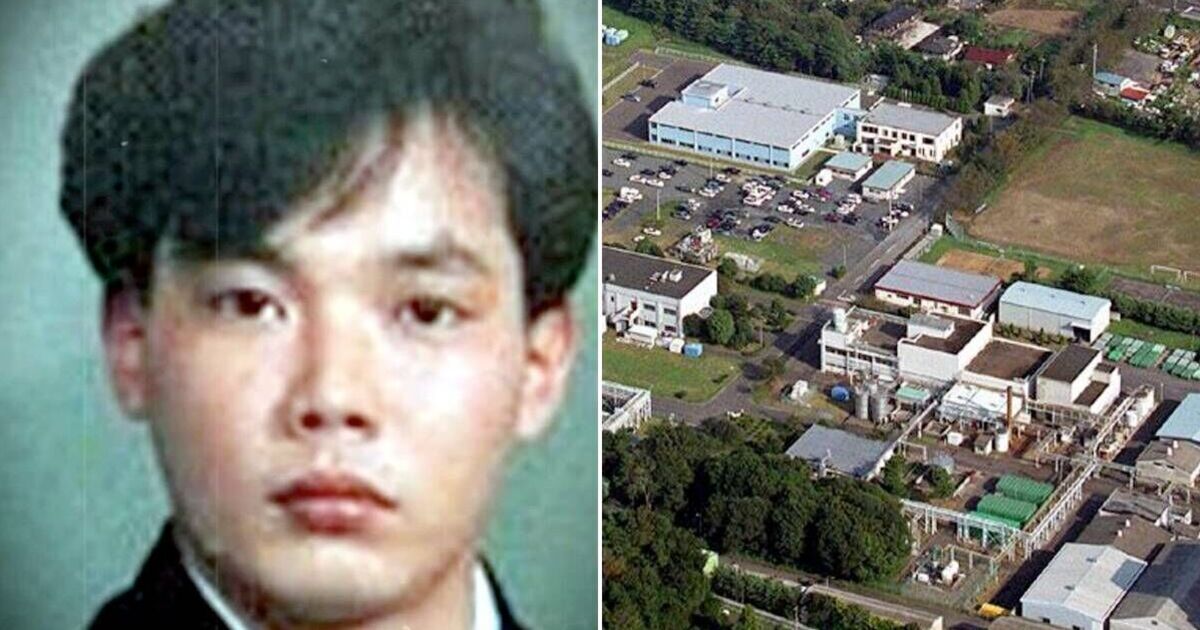
Hisashi Ouchi was a husband and father (Image: undefined)
Hisashi Ouchi was a husband and father. He was remembered as handsome and physically fit, having played rugby during his younger years.
Yet Hisashi was woefully inadequately trained when he was tasked with handling extremely dangerous uranium at his Japanese nuclear facility, resulting in what has been described as “the most agonising death ever documented”.
Ouchi was left “burned from the inside out”, with his skin falling away and his tissue gradually deteriorating, and was maintained alive for 83 horrific days against his wishes.
He continually pleaded with doctors to end his suffering, but was persistently subjected to experimental procedures and treatments even after there remained no possibility of his recovery.
Ouchi, 35, was a senior technician at Tokaimura uranium processing facility in Japan, roughly 110km northeast of Tokyo. The facility already had a track record of negligence – in 1997, a blaze at Tokaimura exposed 37 staff members to elevated levels of radiation – when Ouchi encountered his horrifying ordeal, reports the Mirror.
On September 30, 1999, Ouchi was exposed to 17,000 millisieverts (mSv) of radiation whilst carrying out his duties.
That is 850 times the safe annual dose for nuclear facility workers, 140 times what people living near to Chernobyl were exposed to following the 1986 catastrophe, and the highest dose ever recorded in human history.

Hisashi Ouchi survived for 83 days (Image: undefined)
The exposure was again caused by negligence from facility operators. During standard operations, Ouchi’s colleague Masato Shinohara and supervisor Yutaka Yokokawa poured seven times the correct amount of uranium into a processing tank.
This triggered an uncontrolled nuclear chain reaction known as a criticality accident, instantly releasing lethal radiation across the entire facility.
Ouchi, whose body had been positioned over the processing tank at the moment of the incident whilst assisting his colleague to fill the vessel, received the most severe exposure.
The nuclear reaction was so intense it produced an eerie blue glow that illuminated the room, activating the plant’s safety alarms.
Within moments, Ouchi started vomiting, choking and struggled to remain conscious or move without help.
He was transported urgently to the University of Tokyo hospital, where medical staff documented radiation burns across most of his body and a white cell count approaching zero. This indicated Ouchi had no working immune system.
Six days following his admission to hospital, a specialist examined images of Ouchi’s bone marrow cell chromosomes. They had been obliterated, with only tiny black specks remaining.

Hisashi Ouchi being removed from the facility (Image: The three men who were working at the Tokaimura Nuclear Plant were rushed to hospital by specialist teams)
Yet doctors remained convinced they could sustain Ouchi’s life, even as his internal organs deteriorated and failed.
They attempted experimental treatments, including a stem cell transplant and skin grafts.
Nevertheless, Ouchi’s state only deteriorated further. His skin began peeling away and was incapable of regenerating, exposing his flesh and muscles.
He was unable to breathe independently. The breakdown of his stomach lining resulted in him producing up to three litres of diarrhoea daily and he could only consume food through a tube.
The agony became so unbearable that, two months into his ordeal, Ouchi’s heart stopped, yet medics chose to resuscitate him.
His wife reportedly hoped he would hold on until at least 1 January 2000, so they could mark the dawn of the new millennium together.
However, witnesses say Ouchi pleaded with doctors to let him die. “I can’t take it anymore,” he reportedly told them, “I am not a guinea pig.”
On 21 December 1999, his body finally succumbed. The official cause of death was multiple organ failure.
Four months later, in April 2000, his colleague Shinohara died too, also due to multiple organ failure, at the age of 40.
Supervisor Yokokawa, who had been sitting at his desk when the criticality accident occurred, survived.
An investigation by the Japanese government concluded the accident had been caused by an absence of regulatory oversight, a lacking safety culture and inadequate training for workers.
Six officials from the company operating the plant were later charged with professional negligence and for violating nuclear safety laws. In 2003, they were handed suspended prison terms for their lethal neglect.