Migrant raped by different men many times in ‘journey of hell’ – ‘I wish I died’ | World | News

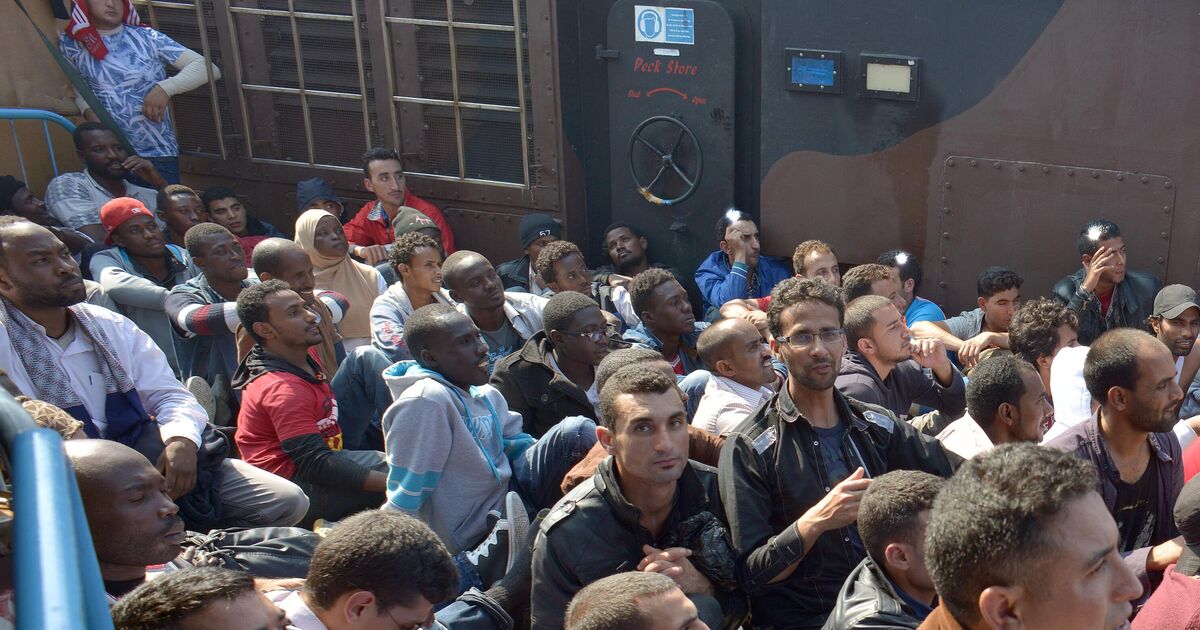
Suspected migrant smugglers are pictured (Marked with white Dot) after they were rescued by Royal Ma (Image: MDM)
An Eritrean woman detained in a human trafficking house in Tobruk, eastern Libya, has recounted a harrowing ordeal of repeated rape and abuse, wishing for death amid what she described as a “journey of hell”. The Eritrean woman told UN investigators: “I wish I died. It was a journey of hell.
“Different men raped me many times. Girls as young as 14 were raped daily.” Her testimony forms part of a damning UN report released yesterday, exposing a “violent business model” of systemic human rights violations against migrants, refugees, and asylum seekers in Libya. The joint report by the UN Support Mission in Libya (UNSMIL) and the Office of the High Commissioner for Human Rights (OHCHR), titled Business as Usual, documents abuses from January 2024 to December 2025.
Read more: Bombshell reason that French pitifully failed to help UK stop Channel crossings
Read more: Outrage as ‘migrant taxi service’ RNLI told to ‘get lost’

Migrants from Syria and Bangladesh are assisted by a rescue team off the Libyan coast (Image: AFP via Getty Images)
Based on interviews with nearly 100 individuals from 16 countries across Africa, the Middle East, and South Asia, it paints a grim picture of migrants treated as commodities in an exploitative supply chain. Victims are rounded up, abducted, and funnelled into official and unofficial detention centres where torture, sexual violence, forced labour, and extortion are rife.
UN High Commissioner for Human Rights Volker Turk declared: “There are no words to describe the never-ending nightmare these people are forced into, only to feed the mounting greed of traffickers and those in power profiting from a system of exploitation.” Special Representative Hanna Tetteh added in the same release: Detention facilities serve as “breeding grounds for gross violations of human rights.”
The Eritrean survivor, held for six weeks, was released only after her family paid a ransom. Another victim, Gloria from Nigeria told Al Jazeera: “People come there to buy people, to buy human beings. They forced me into prostitution. I stayed there for a long time before I ran away.”
The report details further horrors: a nine-year-old boy raped, Sudanese boys aged 12-16 assaulted in Tripoli, and an Eritrean woman cut open to facilitate rape, leading to her friend’s death. Pregnancies from rape often end in untreated miscarriages.
Migrants face arbitrary detention without due process, coerced into paying ransoms from £368) $500 to £7,360 ($10,000) amid beatings, electric shocks, and starvation. Facilities like Ain Zara and al-Kufra are sites of overcrowding and disease outbreaks, with tuberculosis killing over 20 in southern centres since December 2024.
Mass graves uncovered include 65 bodies in al-Shuweirif in March 2024 and 93 near al-Kufra in February 2025. Enforced disappearances affect thousands, with families reporting 27 Tunisians missing since January 2024.
Libya has become a perilous transit hub since the 2011 fall of Muammar Gaddafi, splitting into rival administrations amid factional conflict. The report highlights blurred lines between criminal networks and state actors profiting from the misery.
Dangerous sea interceptions by the Libyan Coast Guard involve ramming boats and gunfire, returning 48,878 people to abuse cycles in 2024-2025. Collective expulsions without assessments violate non-refoulement, abandoning deportees in deserts without food or water.
Suki Nagra, UN Human Rights representative for Libya, described the situation as “extremely dire”. She said: “We’re seeing waves of racist and xenophobic hate speech and attacks against migrants, asylum seekers and refugees, as well as interceptions at sea where people are brought back to Libya—which we do not consider a safe place for disembarkation and return.”