F1’s original disruptors who left Ferrari and McLaren in their dust | F1 | Sport

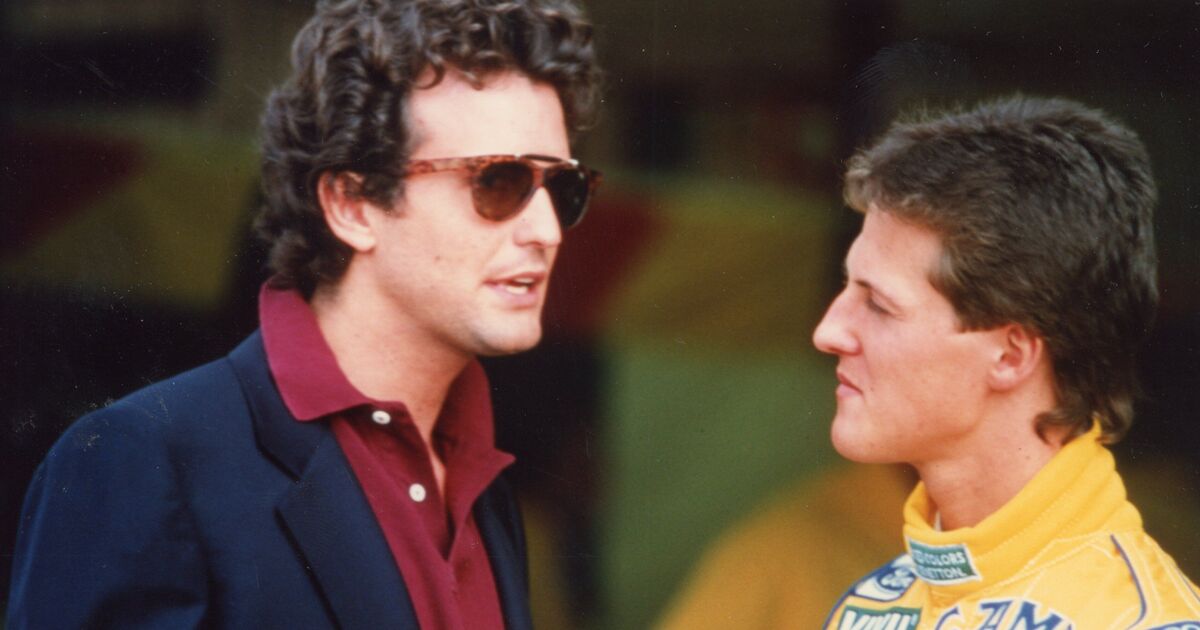
Alessandro Benetton with a young Michael Schumacher, before they were world champions (Image: Supplied)
Formula 1 heavyweights like Ferrari, McLaren and Williams had all won titles in the early 1980s. Little did they know that they would all be beaten to glory by a clothing brand just a few years later.
Having initially got involved in F1 as a sponsor for Tyrrell and Alfa Romeo, in 1985 the Benetton Group bought the financially failing Toleman team, which had, just a year earlier, scored three podiums with a rookie named Ayrton Senna behind the wheel. Though they did not inherit the Brazilian, who had already agreed to join Team Lotus, Benetton would go on to create a superteam which stood at the pinnacle of motorsport in the mid-1990s.
Alessandro Benetton, who was chairman of the team for 10 years, is the first to admit that he was “not a specialist” in motorsport. But still the decision was made to invest heavily in running an F1 team, partly because it provided much more visibility than a straightforward sponsorship, but also because the family had “the courage to do the unexpected”.
He told Express Sport: “I suspect the general feeling [among other teams] was that we were funny guys, creative, mechanics with pink shirts, with spray, with the colours of the cars. We were creating movement – some models in the pit lane and music and well-cooked pasta, so we were bringing some colour into the scene.
“I think, at the beginning, everybody loved us because of those aspects. But it was the type of attitude where people look at you like you are a funny character, more than a real player.”

Benetton brought colour to the F1 pit lane as a team sponsor (Image: Supplied)
Benetton were, in many ways, the original F1 rebels, before other disruptors like affable Irishman Eddie Jordan and, in the mid-2000s, Red Bull. But, like the latter, for all their stunts, it didn’t take long for Benetton to prove to their rivals that they were to be taken seriously.
In what was admittedly an inherited Toleman car, simply rebranded to a Benetton machine but now with powerful BMW engines, driver Gerhard Berger secured a victory and another podium during their first season on the grid in 1986. Two years later, after Alessandro Benetton had become chairman, fellow Italian Alessandro Nannini deliver win number two.
But it was in the early 1990s that things really began to come together. Benetton team manager Flavio Briatore fought for and won the signature of a young Michael Schumacher, snatching him away from Jordan, who had given the German his F1 debut.
Perhaps even more important were the arrivals of Tom Walkinshaw and Ross Brawn to lead the engineering department as Benetton assembled what would become a superteam of technical staff.
It is a perfect example of how everything needs to come together to be successful in F1, and Alessandro takes a life lesson from this as well.
He said: “You need to have a driver, you need to have the engine, you need to have the chassis, you need to have team spirit, you need to have the engineers and the aerodynamics guys – you need to have everybody. You win if you have a team.
“It’s been one of the most important lessons for me in life, even if I was very young and I got into a business that I didn’t know.
“I, as chairman, put most of my energy into trying to work out what people had in common, rather than creating further distance.
“The other element is that we all had good people. We grew together. We built that team by adding pieces – the team was built with a step-by-step approach. We were moving and adding pieces and improving the overall group on a continuous basis.”

Now in charge of his family’s holding firm, Alessandro Benetton has chosen to tell the team’s story (Image: Supplied)
It all came together in 1994, a tragic year for F1, which saw Senna and Roland Ratzenberger killed at Imola, but also a memorable one for Schumacher, who won the first of his seven titles.
The second followed a year later as Benetton also added the constructors’ championship for the first and only time. The gamble had paid off, and their status as F1 world champions brought “incredible value” to the wider company, which at its peak had a presence in 150 countries.
For Alessandro, the feeling of having beaten the traditional teams by doing things their own way was “unbeatable”.
He explained: “To win a world championship, starting from not being taken seriously, it really is maximum satisfaction.”
All good things come to an end, though. It was in the early 2000s, after Schumacher and several top engineers had been poached by Ferrari, that the decision was made to sell the team to Renault.
Our community members are treated to special offers, promotions, and adverts from us and our partners. You can check out at any time. Read our Privacy Policy
“When I first started in ’88, the overall budget for the team was £3million,” Alessandro recalled.
“It was an important number, but a good company could afford it. It was very clear by the end of the ’90s, beginning of the 2000s, that Formula 1 was taking a different direction.
“Perhaps later on, it was not the place anymore for somebody like us – the industry was going in a different direction.”
Three decades on from their championship successes, and 70 years after the company was founded, Benetton have decided the time is now right to retell their story in a new Sky documentary.
“That was the reason why we thought about it at the beginning,” Alessandro said, “but then it came out as something much more profound. It’s a testimony to our core values that we want also to stay in the group, and a point of reference also for future generations of our family.”
Benetton Formula is available on Sky and NOW in both Italy and the UK