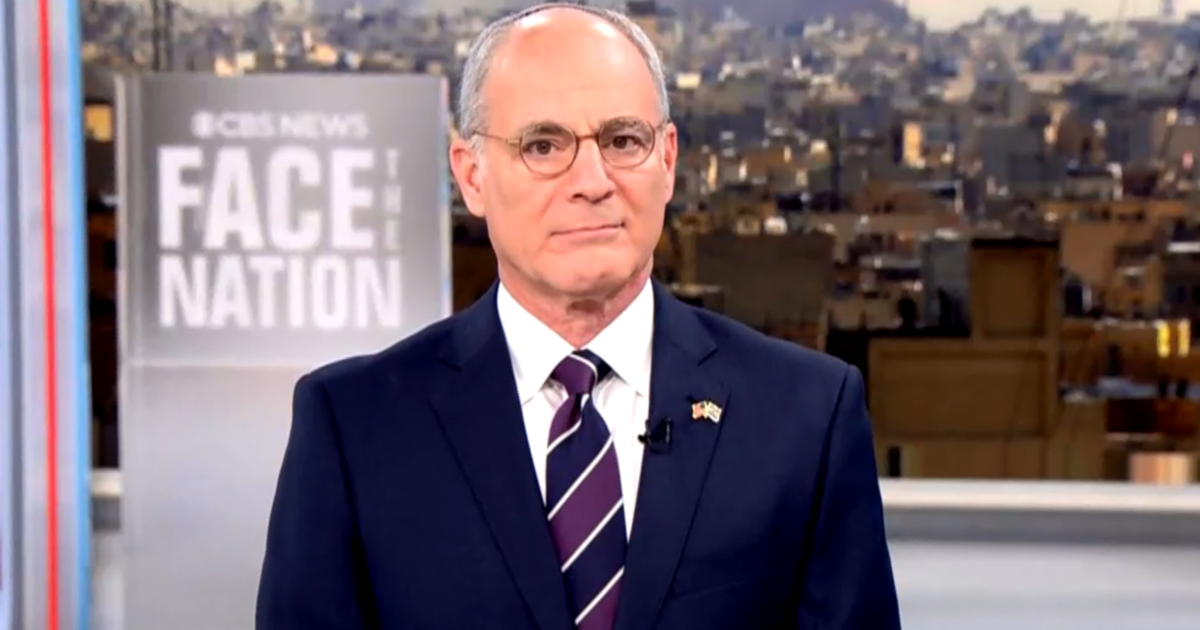
Transcript: Michael Leiter, Israel’s ambassador to the U.S., on “Face the Nation with Margaret Brennan,” March 8, 2026
The following is the transcript of the interview with Michael Leiter, Israel’s ambassador to the U.S., that aired on “Face the Nation with Margaret Brennan” on March 8, 2026.
MARGARET BRENNAN: And we’re joined now by Israel’s ambassador to the United States, Dr. Michael Leiter. Welcome to ‘Face the Nation.’
ISRAELI AMBASSADOR MICHAEL LEITER: Good to be with you. Good morning.
MARGARET BRENNAN: So your prime minister and – the American president speak daily, according to President Trump. Have they agreed to beginning and ending the war on the same timeline?
AMB. LEITER: We’ve been collaborating now for months, I would say, even prior to Rising Lion and Midnight Hammer in June, and that collaboration includes daily conversations in which there is an assessment of how the war is progressing, and I assume that we’re going to reach a complete understanding on the end of this war as well.
MARGARET BRENNAN: So you believe and trust that America will stay with Israel through the duration of this, even if there are strains on the American economy, like gas prices?
AMB. LEITER: We’ve reached a level of collaboration that we’ve never seen between our two countries and between our two militaries. This is a very important operation that doesn’t depend really on a timeline. You know, when you’re doing something that’s so critical you are not going to look at a stopwatch. This has to be finished. This is a terror-sponsoring state that has to be brought down and that’s what we’re focused on.
MARGARET BRENNAN: But you agree with the U.S. assessment from the secretary there he said this is just a matter of weeks?
AMB. LEITER: We believe so. We’re seeing cracks in the edifice of this military security terror regime. They’re starting to have very grave difficulties in conveying orders down through the system. There’s arguments within the system about the appointment of a successor to the supreme leader. They’re having grave difficulties. The fact that they are lashing out irrationally to all of their neighbors and firing these ballistic missiles into all of their neighbors, some 12 countries, into Europe for crying out loud, is indicative of the fact they’re having huge problems. We’re having success in these attacks on their command centers.
MARGARET BRENNAN: So President Trump was specifically asked yesterday about sending troops in to secure Iran’s supply of enriched uranium. He said he’s not ruling it out. Does Iran currently have access to the documented enriched uranium that exists inside the country, and what is Israel’s plan to secure it?
AMB. LEITER: Israel’s plan is to secure it, that’s for sure.
MARGARET BRENNAN: How?
AMB. LEITER: How exactly is an operational issue, I don’t think, Margaret, that you want me to discuss here on a Sunday morning ‘Face the Nation.’ We’ve got to do that. It’s an objective we have to accomplish, but the first thing we have to do is create a situation we’re going to be able to get to that enriched material and remove it, and that has to reach a point where there’s less kinetic activity on the ground. It’s obviously on our radar screen and we’re going to take care of it. The whole objective here of this operation is to prevent a terror state from achieving nuclear weapons. So it’s very much on our radar screen and that’s what we’re going to accomplish.
MARGARET BRENNAN: So just to put a fine point on it the concern is that that material could end up in the wrong hands if the regime collapses and it’s a mess, right? So, how do you secure it without ground forces in some way? Is Israel ruling out ground forces?
AMB. LEITER: We are ruling out the possibility of this regime remaining in the position where they can endanger us and their neighbors. If that includes putting boots on the ground- our preference is for the boots on the ground to be those of the Iranians. These are people who have been living under the boot of this regime now for 47 years. They want freedom. This is a whole generation out there that knows there is such a thing as freedom but has never tasted it yet. They need to put their boots on the ground and ensure their future and the future of the region.
MARGARET BRENNAN: You mean the Iranian army, the IRGC?
AMB. LEITER: The Iranian- the Iranian includes- no, I mean the Iranian people. 80% of the Iranian people are opposed to this regime they just haven’t been able to express themselves.
MARGARET BRENNAN: Well and CENTCOM is telling Iranian civilians to stay home right now. Is there any organized or armed opposition inside Iran that Israel supports?
AMB. LEITER: We’ve been talking to the minorities now for many years.
MARGARET BRENNAN: The minorities meaning the Kurds and the Azeris?
AMB. LEITER: The Kurds, the Balochs, the Azeris, but the Iranian people themselves, the Persians, we saw what they did two months ago. There is a point of combustion where the people will rise up and say we have had enough. We want freedom. So once we set the stage and there is no longer regime with a million armed people that are willing to shoot their fellow citizens in the back, these people are going to rise up and say we want our country back.
MARGARET BRENNAN: Because President Trump said yesterday he does not want the Kurds, who make up about 10% of the population within Iran, he doesn’t want the kurds in neighboring countries to enter the conflict. We don’t want to make the war any more complex than it is already. Turkey’s foreign minister came and said he- he said he had spoken to Rubio about it, but he said this, ‘Israel’s intentions in this matter are not so secret.’ Turkey seems to think that your country is trying to get the Kurds to intervene here. Is that accurate?
AMB. LEITER: I wouldn’t take the words of President Erdogan too seriously. He’s talking about his own caliphate spreading throughout the Middle East.
MARGARET BRENNAN: He was the foreign minister.
AMB. LEITER: He’s talking about taking over- well that’s coming down from the president- he’s talking about taking over Saudi Arabia and Israel at the same time. Look, we want a united Iran, there’s no question about it, but we want to empower the minorities to have their say in the process, in the political process. They’ve been denied of their freedom, so it’s not matter of supporting this particular minority or another, it’s supporting all the minorities. What we’re encouraging them to do is to coalesce, is to come together, to unify. If over the past 47 years the opposition of Iran would have unified, this regime would have come down a long time ago. So we can help them coalesce, we can help them unify, we can help them come together and rise up and say we’re taking our country back. That’s ultimately the end game.
MARGARET BRENNAN: So your prime minister gave an address Saturday and said to the IRGC, to those who lay down their arms no harm shall come. To those who do not, their blood is on their own heads. If there are no Israeli ground forces who do you want the IRGC to surrender to? How does that work?
AMB. LEITER: There are many precedents in history where the people themselves- like Romania, they turned their guns around against Ceaușescu. When people are deprived of freedom, there’s a certain point where they say enough. And all they have to do is put down their weapons and not participate- look they don’t to participate when the people rise up in shooting their own civilians, their own neighbors, their own families in many cases. So look the objective here is to achieve a situation where Iran is no longer an exporter of terrorism, is no longer raining ballistic missiles down on its neighbors and is no longer in the pursuit of nuclear weapons. That’s achievable and together the collaborative effort between Roaring Lion and Epic Rury we’re going to accomplish that.
MARGARET BRENNAN: Ambassador, we have to leave it there for the moment, but we’ll have more questions shortly. We need to take a quick commercial break. Stay with us.
[COMMERCIAL BREAK]
MARGARET BRENNAN: Welcome back to ‘Face the Nation.’ We return to our conversation with Israel’s Ambassador to the United States, Dr. Michael Leiter. Just to pick this back up, when we talk about what’s coming next in Iran, it has tremendous impact potentially for the entire region and American interests there. The president said when it comes to Iran’s next leaders most of the people we had in mind are dead. The New York Times is reporting the Israeli strike that killed the supreme leader also took out Iranian pragmatists, that was how they phrased it, who were also in that same compound, but the White House had hoped that those individuals might help lead a new Iran. Were they intentionally targeted by Israel or was this unintended?
AMB. LEITER: No. Pragmatists are very limited in their ability to influence in Iran. There have been pragmatists all throughout the 47 years of this terror regime, they have had absolutely no influence. The people influencing, deciding for Iran are these ayatollahs who have a very apocalyptic view of the future and don’t really care about how many people they kill of their own or others. So look, what we’re hoping for is that we move into a period of a transitional government where the minorities come together, where the majority of the people come together. All the various opposition parties come together for a transitional government where they can lead the country for a year or so, together with the guidance from the United States, and Israel and other regional allies, who will no longer live under the fear of being hit by ballistic missiles and then move into a mode of a democratic process. Let the people choose. Let’s not forget the people of Iran are the most pro-western people after Israel.
MARGARET BRENNAN: Well, but when I hear this is going to take weeks not months, referring to the combat, what you’re talking about takes a long time- that kind of transition. So we’re not just talking about a limited military operation. U.S. Pressure, Israeli pressure is going to have to be there for a long time.
AMB. LEITER: Well, this isn’t Iraq or Afghanistan because in this case 80% of the people oppose the regime. They just need the ability to express themselves. That’s what we’re emphasizing here. This is not a repeat of forever wars. They have got to put their boots on the ground and they’re beginning to be motivated and to feel that they’re going to be able to accomplish that. They’re beginning to move forward, it’s just going to take a little bit more time. There’s no long-term gain without some minimal pain. Look, I know what war is all about. I hate war. I lost my son in war. I don’t want to see war. None of us in Israel want to see war, but we can’t have a situation where our existence is threatened every day by a regime that says they’re going to eliminate us.
MARGARET BRENNAN: But just to put a fine point on it, did Israel intentionally target those other Iranian leaders that the president had referred to as some of the people he had in mind to lead?
AMB. LEITER: You know Margaret, we’re pretty good at precision, I think we’ve proven that, but the degree of precision where in this very same room there are these people sitting and those people sitting, we’re not that good.
MARGARET BRENNAN: Ambassador, thank you for your time this morning.
AMB. LEITER: Good to be with you.
MARGARET BRENNAN: We’ll be right back