I’m a Dune superfan and here’s what I hope we see in part 3 | Films | Entertainment

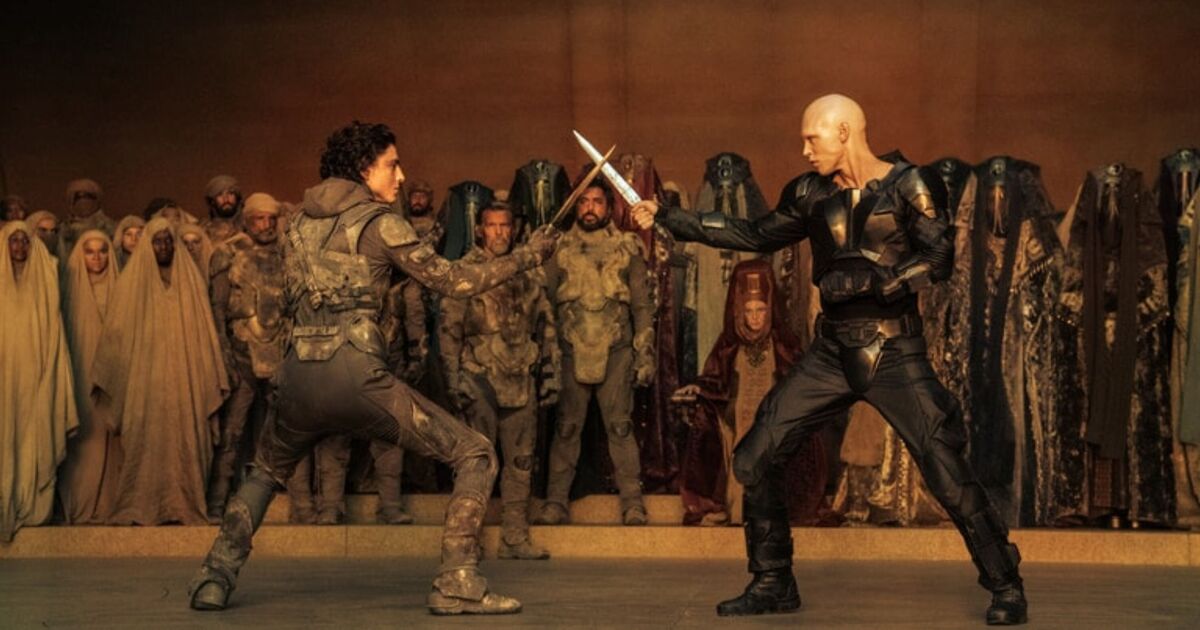
Paul Atreides (Timothée Chalamet) faces off with Feyd-Rautha (Austin Butler) in Dune Part Two (Image: SCU/Warner Bros)
Dune, first released in 1965 by American author Frank Herbert, and its sequels are rightly held up as among the greatest science fiction stories ever written. There have been a couple of attempts to adapt the sprawling tale to screen – David Lynch’s 1984 movie was a critical and commercial bomb, and two US TV miniseries adapting the first three books were released in 2000 and 2003 – but neither matched up to the scale and ambition of Frank Herbert’s vision.
Then in 2021 director Denis Villeneuve brought the world of Arrakis to spectacular life in the first of his two-part adaptation of the initial book, with the second following in 2024. The third film in the series – touted as “the epic conclusion” to the story – is being released in December, and the first teaser trailer for the film was released yesterday. I’m a huge fan of the Dune series, and loved Villeneuve’s films, and here are five things I hope we see in the next instalment – and one we definitely won’t.
READ MORE: Dune Part 3 cast explained as Robert Pattinson unrecognisable in epic trailer
READ MORE: Dune 3 trailer – Timothée Chalamet returns in ‘action-packed’ epic conclusion
The Golden Path
A theme running through the series as a whole is the drive to secure the future of humanity, known as The Golden Path. The struggle of Paul Atreides, played by Timothée Chalamet, with the cost of guiding humanity on the path is a key story element of the second book.
While we don’t learn the true, and genuinely shocking, scale of the personal cost needed until the fourth novel, God Emperor of Dune, if this is the end of the story, then why not go for broke and put it front and centre?
Really, all I want is to see the titular God Emperor on screen. Is that so much to ask?
Children of Dune
While the second book in the series is named Dune Messiah, the film is instead titled Dune Part Three, and is being touted as “the epic conclusion” to the story. The change in title suggests the film won’t be a direct adaptation of the novel, and this might not be a bad decision.
The ending of Dune Messiah leaves a number of story elements unresolved and fates of some key characters uncertain. It’s possible then that Villeneuve is folding in elements of the third book in the series, Children of Dune, which acts as a far more conclusive ending.
If this is the ending of the story, then there are parts of the third novel, including the fates of a number of key characters, it makes sense to include. We know two major characters who don’t fully appear until the third book will appear in December’s film, so maybe this is the direction they’re going.

Anya Taylor-Joy as Alia in the trailer for Dune Part Three (Image: Warner Bros)
Alia of the Knife
One of the biggest changes Denis Villeneuve made to the second film was the role of Paul’s sister, Alia. In the novel she is born at the roughly half-way point, with a full adult consciousness due to her mother Jessica drinking the Water of Life while pregnant.
In the films she was instead kept off-screen apart from a very brief appearance in a vision, in which she was played by the brilliant Anya Taylor-Joy. The star of Furiosa: A Mad Max Saga is returning for the third film, and can be seen briefly in the trailer looking suitably unhinged.
She is by far one of the most interesting and complex characters in the saga, and a then-eight-year-old Alicia Witt’s portrayal in the 1984 movie is a highlight of an uneven film. So I’m excited to see what Taylor-Joy can do with the role, not to mention that her link to the dead Baron Harkonnen – her grandfather – could give an opportunity to bring back the incomparable Stellan Skarsgård, and who doesn’t want that?
Chani’s journey
Another major, and welcome, change made in the films was the role of Paul’s Fremen love interest Chani. In the books she takes a largely passive role, and even accepts Paul’s political marriage to Princess Irulan.
In the films she was instead portrayed as deeply sceptical, and left furious by Paul’s decision at the story’s conclusion. This was a very welcome change from Frank Herbert’s passive love interest, which would have been a sad waste of an actress of Zendaya’s calibre.
It remains to be seen how much more the character will continue to diverge from the page. It would fit her portrayal so far if she ends the story in a very different place than she is at the end of Dune Messiah, and that would not necessarily be a bad thing.
Let’s get weird
It’s fair to say that the Dune series can be pretty inpenetrable to the uninitiated. It can be easy to be thrown off by phrases like “Kwisatz Haderach” and “gom jabbar” and wonder why there aren’t any computers in the far future.
This only continues in later books, to the point where it would be all-but impossible to adapt some of the later novels. While Dune Messiah is straightforward in comparison, there’s still plenty of weirdness to be mined.
Robert Pattinson’s character Scytale, the primary villain of the story, can change not only his appearance, but also his gender, at will, while Edric, another key character, is described by Herbert as a “humanoid fish”. Bring on the weirdness, I say.
And one thing we definitely won’t
There’s a notorious passage in Dune Messiah in which Paul and Stilgar, the Fremen leader played in the films by Javier Bardem, reflect on the scale of the war by discussing other large-scale conflicts from what is, for them, pre-history. Paul references Genghis Khan, and then – jarringly – Adolph Hitler, saying: “He killed more than six million. Pretty good for those days.”
While Frank Herbert’s intention was probably to illustrate the scale of Paul’s war, there’s no chance we’re going to see the lead character of a major Hollywood blockbuster – even one as morally dubious as Paul Atreides – praising Hitler, even in a roundabout way.
Dune Part Three will be released on December 18, 2026.