Giant 6.9-mile underwater tunnel for 350mph trains set to open | World | News
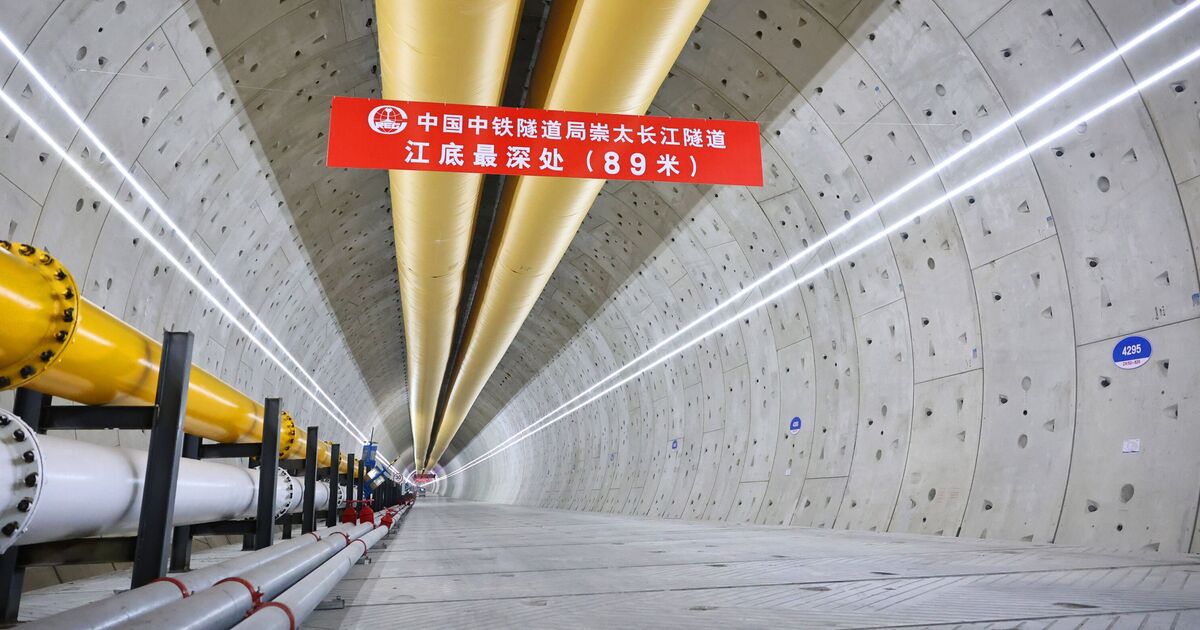
The underwater section of a vast tunnel under contruction in China has been completed, in a major milestone for the project. The Chongming-Taicang Yangtze River tunnel is a high speed train tunnel connecting Shanghai’s Chongming District and Taicang City in east China‘s Jiangsu Province.
By running under the Yangtze River, bullet trains can maintain high speeds, slashing the journey times for commuters and holidaymakers. The entire strech extends along 14.25km (8.8 miles), including the 11.18-kilometer (6.9-mile) underwater section.
Completion of the latter was announced by Xinhua, a state media outlet, on April 4.
The underwater part was done using Linghang, China’s domestically developed high-speed-rail shield tunnelling machine. It’s been hailed as an important feat of engineering.
The machine stretches over 148 meters, weighs approximately 4,000 tonnes, and has advanced intelligent control systems that allow it to navigate safely through “high‑pressure, geologically complex conditions”, as per TunnelBuilder.com.
China’s flagship CR400 trains, which will be used on the line, can travel up to 350kmph, requiring precise tunnel dimensions to ensure the safety of passengers as services zoom across huge distances in the blink of an eye.
While a specific cost for the underwater section doesn’t appear to have been widely reported, it’s part of the larger Shanghai-Nanjing-Hefei high-speed rail line, which is itself part of the overarching Shanghai–Chongqing–Chengdu line – a colossal railway construction project that stretches over 2,000 km (around 1,242.7 miles).
That whole project has total investment of 500 billion yuan (around £54.2billion).
The Chongming-Taicang Yangtze River tunnel is expected to be connected by the end of 2026, though a significant amount of work will be required to get it ready for trains and passengers.
The Shanghai–Chongqing–Chengdu line comprises a number of other connecting railway projects, and is expected to be completed by the end of the decade.