Russian scientist’s drug claim after Putin discussed ‘living to 150’ | World | News

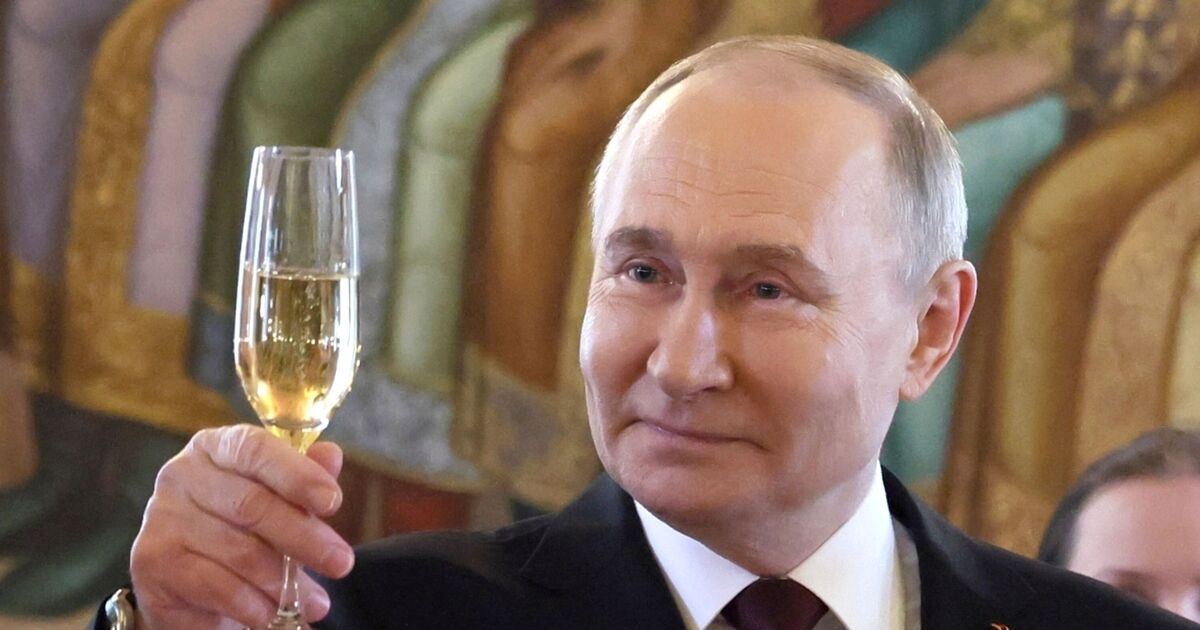
The Russian leader has openly discussed the possibility of humans living to 150 (Image: AP)
A Russian scientist has made a bombshell claim that a world-first anti-ageing drug is in development – just months after Vladimir Putin suggested humans could one day live to 150. The Kremlin-backed push is said to focus on slowing the biological processes behind ageing, with researchers reportedly working on a gene-therapy treatment targeting the so-called RAGE gene, which is linked to cellular deterioration.
Denis Sekirinsky, a Russian science and education minister, claimed the country’s scientists are closing in on a potential breakthrough. Speaking at a longevity medicine forum in Saransk, he said: “[A promising area] is gene therapy of ageing.” He added: “The RAGE gene is a receptor whose activation triggers cellular ageing, whereas blocking this gene, on the contrary, can prolong cellular youth. Based on this principle, an ambitious goal has been set – to develop the world’s first gene-therapy drug that specifically blocks this receptor. The field relies on advanced genetic technologies and represents one of the most promising avenues in the fight against ageing.”
Read more: Russia issues horror ‘eternal war’ threat as WW3 fears explode
Read more: Putin could attack NATO ‘within months’ as fears soar US ‘won’t help Europe’
The project is reportedly being led by the Institute of Biology of Ageing and Medicine as part of a wider Kremlin drive to unlock longer life.
Sources claim Russian scientists have been ordered to submit their latest anti-ageing research, sparking speculation the programme could benefit Putin and his inner circle.
One source has previously claimed: “The biggest boss [Putin] set a task, and officials rushed to implement it in every possible way.”
Another revealed: “We were asked to urgently send all our developments, and the letter came, let’s say, today, and everything had to be sent yesterday.”
Experts were reportedly told to propose ways to reduce cell deterioration, prevent cognitive and sensory decline, repair the immune system and develop new technologies, including bioprinting.
This comes on the back of Putin revealing his extreme longevity ambitions. Speaking last November, he said: “It is probably possible to reach 150, adding: “It will always be too little, just like with money. Always.”

Vladimir Putin and Xi Jinping were allegedly overheard discussing how humans could live to 150 (Image: POOL/AFP via Getty Images)
In a separate hot mic moment, the Russian leader was allegedly overheard discussing near-immortality with Xi Jinping, saying: “Human organs can be continuously transplanted. The longer you live, the younger you become.”
Putin has shown little sign of preparing a successor despite having been in power for two decades, fuelling speculation he could seek to rule Russia for years to come.
Some observers have suggested he may be aiming to rule until his reported eldest son, Ivan Spirodonov, reaches political age.
The Kremlin has launched a national project aimed at “preserving the health” of citizens, with a target of saving 175,000 lives by 2030.
Yet the longevity drive comes amid the human cost of Russia’s war in Ukraine, which is believed to have claimed hundreds of thousands of lives.
Our community members are treated to special offers, promotions, and adverts from us and our partners. You can check out at any time. Read our Privacy Policy
Putin’s alleged ambitions also suffered a setback last year with the death of his long-time anti-ageing adviser, Professor Vladimir Khavinson, aged 77.
Khavinson, who led the St Petersburg Institute of Bioregulation and Gerontology, had claimed he was working on ways to extend human life to 110 or even 120, and once described Putin as “perfect” compared to former leaders Leonid Brezhnev, Yuri Andropov and Boris Yeltsin.
Investigative journalist Ilya Davlyatchin has cast doubt on the more extreme claims, suggesting Putin might be aiming at the more modest age of 97.
“This is the year 2050,” he said. “It’s simple – then his eldest son Ivan will turn 35 – the age when one can be elected to the [Russian] presidential post.”
Despite the bold claims, there is currently no verified evidence that any country has developed a drug capable of significantly delaying human ageing.