Sobbing Lando Norris took ‘huge risk’ with public comments | F1 | Sport

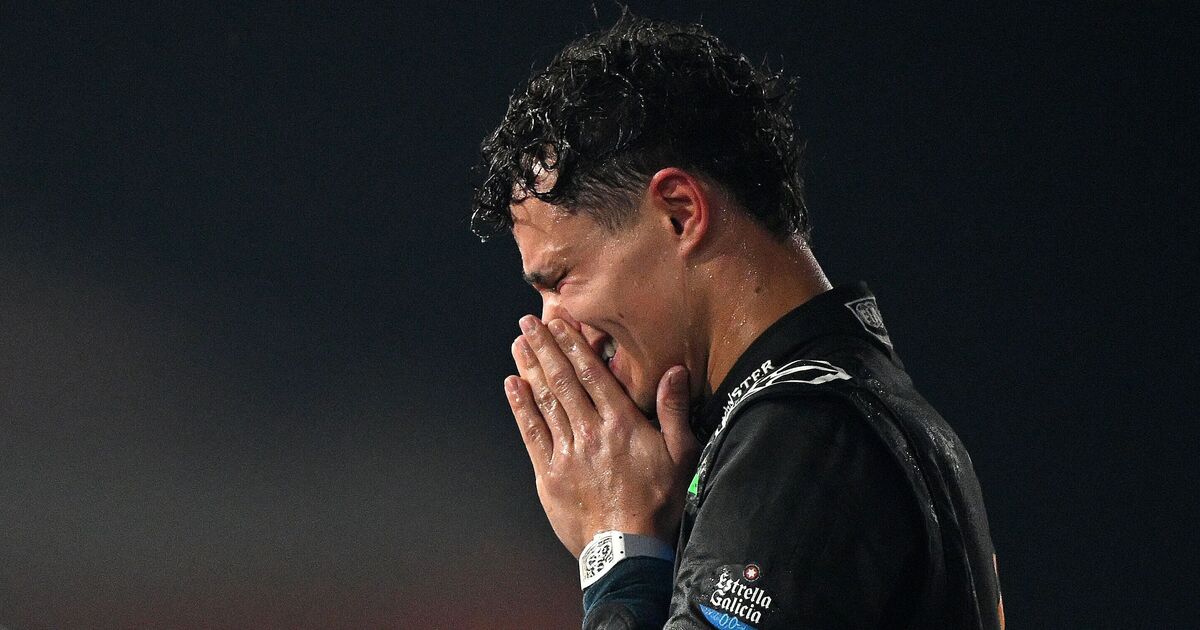
Lando Norris sobbed with joy and relief after winning the F1 world championship for the first time (Image: Getty)
Lando Norris showed a key trait of high performance when he broke down in tears moments after being crowned Formula 1 world champion. That is the view of sports psychologist Dr Marcia Goddard, who has worked closely with several F1 teams. She was delighted to see the Brit resist any urge to try to hide the emotions that his body needed to show to decompress in that moment of glory last December.
Because Norris had achieved his childhood dream, winning the F1 drivers’ title with a podium finish at the Abu Dhabi Grand Prix. It was enough to ensure that Max Verstappen‘s late-season charge would fall short and deliver McLaren‘s first drivers’ championship success since Lewis Hamilton in 2007.
The tears had begun to flow before he had even got out of his car, Norris sobbing as he delivered a message of gratitude to his race engineer, Will Joseph, and the rest of his McLaren colleagues over the radio once he had taken the chequered flag. And while Dr Goddard says not everyone needs to cry to complete what she calls “the stress cycle”, she believes that was what Norris needed in that moment to properly process what he had accomplished.
She told Express Sport: “When we’re in the moment, everything else has to be put aside so we can perform. But the body and the brain are in a constant state of stress, because we’re under so much pressure. So when that is done, when we have reached our goal, we have to finish the stress cycle. Stress response is literally a cycle that we then have to finish. And crying is one way to do that.
“It’s not the only way, I’m not saying everybody has to cry. But if that is the way that you process when you’ve done something that was really, really hard but really worth it, then that is a sign of you saying, ‘Okay, I am decompressing now, and then I can go again’.
“The opposite of that would be to say, ‘Boys don’t cry, I’m not going to do that’. But what happens then, you push it away. Those emotions are still going to be there. So if your natural processing mechanism is crying, but you don’t actually do that, you’re going to be pushing your emotions away. And when you push them away, they’re going to come back with a vengeance because you haven’t processed them correctly. And then the next time you have to perform, they might pop up.
“That’s where you actually diminish your own performance because of it. That’s not to say everybody has to cry. If you’re not a crier, then don’t do that. But if you do need to cry then, in this case, that is a sign of high performance because you’re giving your brain and your body what it means to actually reach peak performance again.”
Norris has been open about his mental health for many years. Dr Goddard thinks it’s highly likely that rivals have tried to take advantage of that on track. She added: “He has struggled with anxiety – that in itself is not necessarily a strength but, in F1, to be open about having anxiety has to be a sign of strength because it’s a risk. He took a huge risk by being open about that.
“In 2022, I interviewed Nico Rosberg about this. He said, ‘I struggled with anxiety and I struggled with all of these things, but I wasn’t going to talk about it because the other drivers, they would eat me for breakfast if I did that. They would use it against me and that is what stopped me from being open’. And I respect that a lot, I understand that.
“I think the fact that Lando does it now is incredible. It’s also a sign that maybe the sport is changing in its understanding of it, because it has never been a weakness. It’s always been part of the human condition. I do a lot of individual coaching with people in the sport, outside the sport, all over the place, in corporations, everywhere. And in every single industry, I speak to strong big men with high roles, they all struggle with stuff like that because we are all human beings.
“So I think the fact that he thought, ‘Screw it, I’m just going to talk about it because this is who I am’, that is very, very, very strong. And I commend him for it because – I can’t prove this – but I’m sure that there would have been drivers who would have been like, ‘Maybe I can just play into his anxiety a little bit and make sure that he feels it when we’re battling’.
“But he made it happen. And it’s not because of his anxiety that he got where he is, but it is part of who he is. And, as a person, he made this happen. So that means that there’s a lot of strength in that kid. And I really respect that.”
‘Driving Performance: 10 Lessons About Building High-Performing Teams from Neuroscience and Formula 1, by Dr. Marcia Goddard, is available to pre-order here‘
Our community members are treated to special offers, promotions, and adverts from us and our partners. You can check out at any time. Read our Privacy Policy