International operation disrupts “cocaine highway” across the Atlantic Ocean
A weekslong operation to thwart drug trafficking routes from Latin America to Europe has successfully disrupted what authorities called “a major cocaine highway” in the Atlantic Ocean.
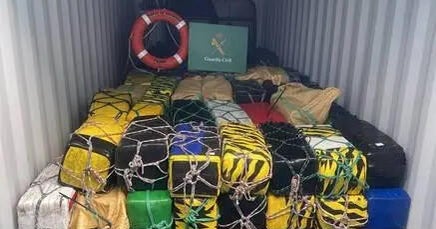
Over 12 tons of cocaine and about 9.5 metric tons of hashish were seized over the course of the operation, which lasted from April 13 to April 26, said Europol, the European Union’s law enforcement agency. Eight vessels were intercepted and 54 people were arrested overall.
The mission involved international law enforcement bureaus and was coordinated by Europol. The agency said it aimed to specifically target drug trafficking networks moving cocaine from parts of Latin America to Europe through “complex at-sea transfers,” conceived to evade detection by avoiding major ports.
In order to locate the boats carrying out these covert transfers at sea, law enforcement agents were deployed to various sites across the Atlantic, focusing on an area between Spain’s Canary Islands and Portugal’s Azores.
They were tasked with detecting, tracking and intercepting vessels suspected of drug trafficking during the two-week operation, according to Europol. After the agency warned earlier this year that trafficking networks were changing how they moved cocaine across the Atlantic, it said the results of its latest mission essentially reinforced what it already beleived to be true.
“The recent operation demonstrates the patterns Europol had identified earlier this year: criminal networks are increasingly moving cocaine offshore to reduce exposure to law enforcement at major ports,” the agency said, adding that shipments across the Atlantic “are now moved in multiple stages.”
Called “fragmented maritime routes,” the piecemeal drug transfers that authorities say traffickers are using more often essentially “fragment” the risks to all those involved, said Europol.
According to the agency, the intelligence gathered during the recent operation helped authorities gain a better understanding of how the evolving networks work — particularly in the section of ocean between the Canary islands and the Azores known to them as the “cocaine highway” because of the frequent trafficking activity there.
“Criminal networks are becoming increasingly flexible, and internationally connected. But our response is evolving fast too,” said Jean-Philippe Lecouffe, Europol’s deputy executive director of operations, in a statement. “Over a two-week operational period, law enforcement dealt a significant blow to what is known as the cocaine highway.”
Lecouffe said Europol will use the new intelligence “to build on the intelligence gathered to help identify and dismantle the criminal networks behind these trans-Atlantic operations.”