Major update on UK charity defending endangered vulture against worrying elephant threat | World | News
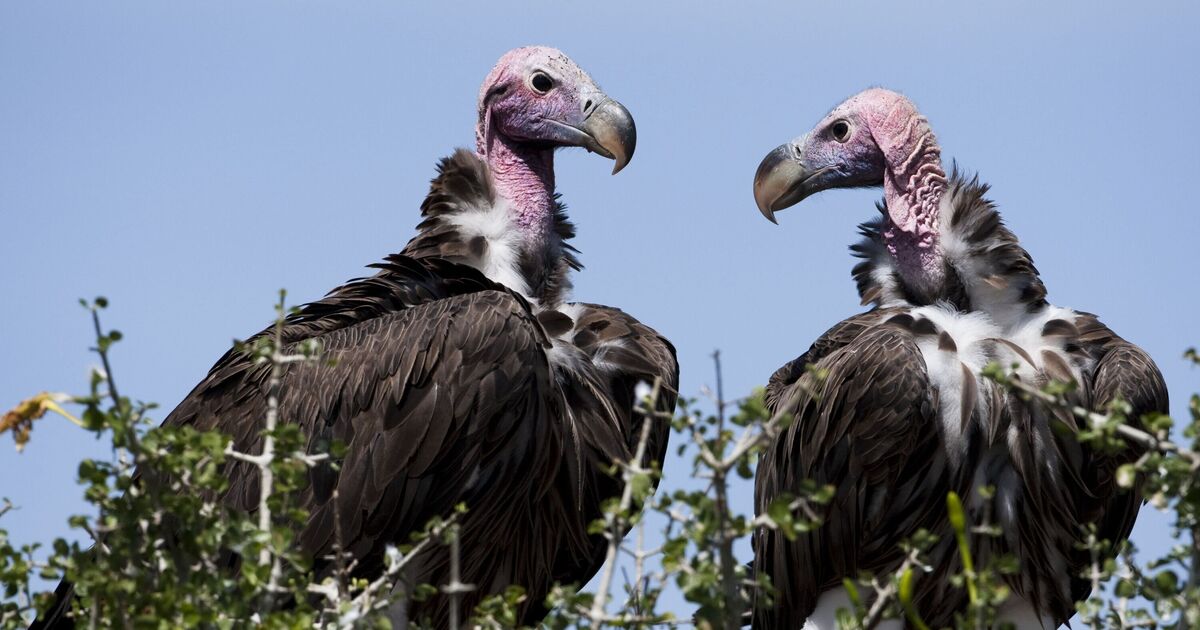
UK bird of prey charity, the Hawk Conservancy Trust, has raised £20,000 with the help of supporters, moved by the plight of Endangered Lappet-faced Vultures, which are facing destruction of their nesting sites by elephants in South Africa. With donations match-funded by the Big Give Organisation during its Earth Raise Week initiative, the Trust can now begin its tree protection project, designed to slow the rapid population decline of Lappet-faced Vultures, fondly referred to as Lappets.
Through a recent detailed study, Hawk Conservancy Trust scientists working in Kruger National Park discovered that, despite the considerable dangers of poisoning, land development and use in traditional local medicine, surprisingly, it is elephants in the area that pose the most significant immediate threat to one of Africa’s largest vultures. Elephants do not harm the vultures directly, but, for reasons not yet understood, they are toppling and destroying certain flat-topped trees such as Acacias – the Lappets’ favourite type of tree for nesting.
With only 30 suitable nesting trees identified within the park, opportunities for breeding are incredibly scarce, and the problem is amplified further because even if Lappets can find a tree, they typically raise only one chick a year.
“The Lappets are simply losing numbers through all the threats they face far faster than they can recover through the breeding cycle, ” says Jamie McKaughan, Conservation and Research Co-ordinator for the Hawk Conservancy Trust. “When we discovered the link with elephant behaviour, our initial instinct was to try to better understand and circumvent that in some way but with Lappets right on the verge of going Critically Endangered there’s no time to do anything but tackle the issue head-on without harming the elephants.”
The Trust has devised a clever answer in the form of pyramid-like concrete blocks arranged in rings around the base of trees. These deter the elephants from standing on them or stepping over them, keeping them away from the trees, which they mysteriously find so worthy of destruction.
This is a neat and scalable solution. It does not affect a food source for elephants, as they do not eat any part of the tree, and it allows smaller animals, birds and insects free access to the trees while being relatively simple to install and maintain.
Each block is comparatively cheap to produce, but for a small specialist charity like the Hawk Conservancy Trust, the requirement for about 2,000 blocks per tree and the added costs of transport and local labour mean a spend of £2,500 to protect each potential nesting site for the Lappets.
With £20,000 raised during Earth Raise Week, the Trust can now protect eight trees and hopes the results will help capture hearts and minds to help raise the additional £60,000 it needs to defend the 22 remaining nesting trees.
“Thanks to our wonderful supporters and the Big Give Organisation’s match-funding, we’re off to an incredible start”, said Jamie. “This is eight more potential sites that Lappets can use for nesting so the odds are definitely better than they were a week ago. We’ll be using that renewed optimism to work as hard and fast as we can to roll-out the solution and to keep up momentum to raise awareness and funding so we can protect more trees and solve this truly elephant-sized issue!”
The Hawk Conservancy Trust has a dedicated page on its website explaining more about the Lappet-faced Vultures, their ecological importance and the project in South Africa to help conserve them for the future. Anyone interested in finding out more can visit: www.hawk-conservancy.org/protecting-and-conserving-lappet-faced-vulture-nests.