World’s longest building cost £1.6bn and can be seen from space | World | News

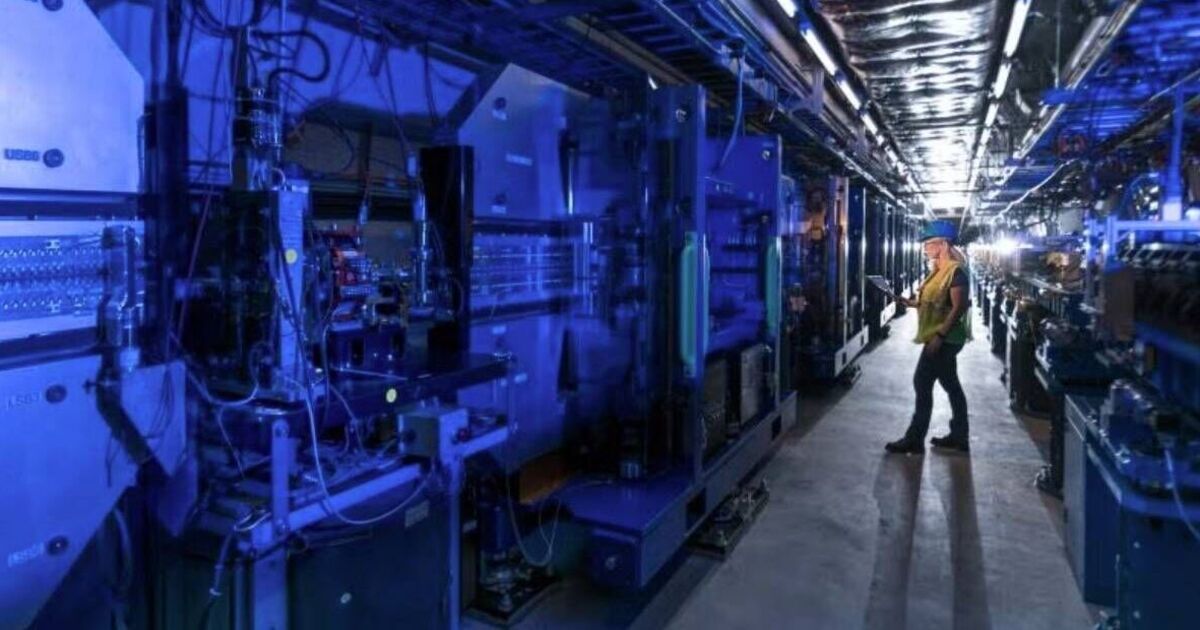
Its extraordinary length was no accident. (Image: SLAC National Accelerator Laboratory)
A little-known building in California has long been considered the world’s longest building — stretching for almost two miles and taking around 40 minutes to walk from one end to the other. The Klystron Gallery at SLAC National Accelerator Laboratory, situated near Menlo Park, California, stretches an incredible 3,073 metres (1.9 miles), taking approximately 35 to 40 minutes to walk from one end to the other at a steady pace. Its sheer magnitude means it can even be spotted from space.
Constructed as part of one of the most ambitious scientific endeavours of the 20th century, the facility formed the cornerstone of the Stanford Linear Accelerator project, a formidable machine engineered to collide particles and uncover secrets about the fundamental structure of matter. The original SLAC project cost approximately $114 million to construct during the 1960s, with a further $18 million allocated to research and development beforehand — bringing the overall total to roughly $132 million (£98 million). Using the Bank of England’s inflation calculator, that figure would equate to £1.6 billion in today’s money. Adjusted for inflation, that would amount to well over $1 billion today.

This is considered by many as the world’s longest building (Image: SLAC National Accelerator Laboratory)
What the Klystron Gallery actually does
At the core of the site lies the Klystron Gallery, a vast industrial service building running above and alongside a two-mile underground particle accelerator. Unlike traditional skyscrapers or shopping centres, the structure exists for a single purpose: powering one of the world’s longest linear accelerators. The structure contains rows of machines known as klystrons, formidable microwave amplifiers that produce radiofrequency energy to propel electrons to near light speed within the tunnel beneath. Scientists frequently draw loose comparisons to microwave technology found in domestic kitchens — except these devices are approximately 60,000 times more potent.
Inside, the gallery resembles a seemingly endless industrial passageway. Lengthy, repeating sections of machinery, electronics cabinets and service zones extend deep into the distance, creating a perspective that looks almost otherworldly in photographs.
Its remarkable length was no coincidence. Particle accelerators demand vast distances to progressively boost particles to exceptionally high energies, and engineers in the early 1960s determined that a two-mile straight line would be essential to accomplish their scientific objectives.

The Great Wall of China (Image: Getty)
Why Earth’s curvature matters
The subterranean accelerator below the gallery became recognised as one of the straightest engineered structures ever built. Due to its length, surveyors needed to factor in the Earth’s curvature when aligning the system, ensuring the beam remained extraordinarily accurate across nearly two miles.
SLAC itself — short for Stanford Linear Accelerator Center, later renamed SLAC National Accelerator Laboratory — opened in 1962 and is managed by Stanford University on behalf of the U.S. Department of Energy. Today, the laboratory continues to be one of the globe’s foremost centres for particle physics, X-ray science, astrophysics, cosmology, chemistry, biology and materials science. Research undertaken there has played a role in numerous Nobel Prize-winning breakthroughs, while sections of the original accelerator now drive the Linac Coherent Light Source, one of the most powerful X-ray lasers ever built.
Is it really the world’s longest building?
For many years, the Klystron Gallery was broadly considered the longest modern building on the planet. Yet categorising the “world’s longest building” proves remarkably complex.
Unlike airports, shopping centres or residential blocks, the gallery is a specialised industrial support framework constructed for scientific infrastructure. Different lists classify longest buildings by continuous enclosed structure, overall length, floor area or intended use.
This distinction proves significant because the accolade may have become contested in 1999 following the completion of the twin facilities of the Laser Interferometer Gravitational-Wave Observatory, more commonly known as LIGO. The two LIGO observatories — situated in Louisiana and Washington state — each feature enormous L-shaped interferometer arms extending approximately 4 km (2.5 miles), considerably longer than the Klystron Gallery. However, many observers argue they should not qualify as conventional buildings, as they function as specialised scientific vacuum systems rather than enclosed architectural structures, while others maintain that their continuous construction meets the criteria.

The enormous structure can be seen on satellite imagery (Image: GOOGLE EARTH)
The battle of the record-breakers
The dispute echoes another widespread misconception surrounding the New Century Global Center in Chengdu, China.
Frequently cited as the world’s largest building, the vast complex encompasses around 1.7 million square metres of floor space and houses offices, hotels, shopping areas, water parks and entertainment venues. However, despite its extraordinary scale, it measures only approximately 500 metres in length — meaning it competes for the title of “largest” rather than “longest”.
To place the sheer scale of the Klystron Gallery into context, the structure stretches roughly the equivalent of 30 football pitches laid end to end, and is sufficiently long to be spotted from the air as a striking straight line cutting across the Californian landscape.
Pilots reportedly used it as a visual landmark, while visitors today often struggle to grasp just how far it extends until they find themselves standing alongside it. Unlike many record-breaking structures, there are no luxury flats, vast shopping centres or observation decks to be found here. Instead, this contender for the world’s longest building is a colossal scientific powerhouse — constructed to help humanity unravel the mysteries of the universe itself.

SLAC itself opened in 1962 (Image: SLAC National Accelerator Laboratory)
Why some giant structures don’t count
Much of the confusion surrounding the world’s longest building stems from differing opinions on what should legitimately claim the title.
At first glance, celebrated mega-structures such as the Great Wall of China would appear to win hands down. Stretching across more than 13,000 miles when all sections are taken into account, it dwarfs every conventional building on the planet. However, it is broadly disqualified as it is categorised as a defensive fortification rather than a single enclosed building.
Other enormous structures face similar issues. Vast airport terminals, tunnels, dams and industrial complexes may extend for miles, yet are frequently divided into separate buildings or regarded as infrastructure rather than one continuous structure.
That leaves the Klystron Gallery occupying a peculiar middle ground: neither a conventional office block, shopping centre nor residential tower, yet still a continuous enclosed structure built above ground for a single purpose — one reason why it has remained a contender for the world’s longest building title for decades.