Massive elephant seal goes on rampage in major city | World | News
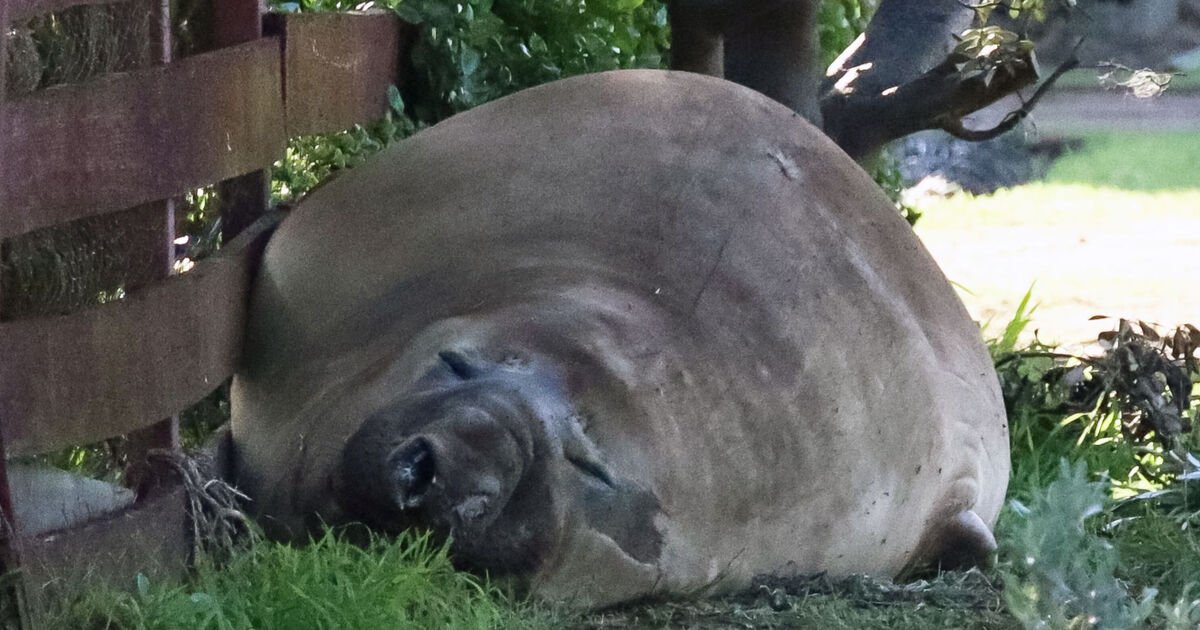
A 2,200-pound (1,000 kg) elephant seal named Neil has caused disruption in Hobart, the state capital of Tasmania, damaging infrastructure and blocking roads during his latest visit to shore. The five-year-old male hauled himself out of the sea in June for his twice-yearly rest period after feeding at sea.
Weighing as much as a small car, the porky pinniped has damaged traffic bollards, a public warning sign about seals, and a fence he attempted to climb over. He has also been seen resting in the middle of roads, bringing local traffic to a standstill, and has damaged parked cars and barriers. Neil is the only male elephant seal known to visit the Australian island in recent years. His behaviour has attracted significant attention on social media, with a TikTok following of 1.4 million.
Tasmanian authorities have expressed concern that the seal’s popularity could encourage dangerous interactions with the public.
Kris Carlyon from the Department of Natural Resources and Environment said at a news conference in Hobart on Thursday that some people had approached Neil with small children in an attempt to take photographs.
“We have had some pretty silly behaviour,” he said, urging the public to keep their distance and respect the animal’s space. Officials have asked people not to publicly identify Neil’s current location to avoid drawing crowds.
Experts note that Neil’s actions, while disruptive, are typical for a juvenile male elephant seal practising for future dominance contests. Sophia Volzke, an elephant seal scientist at the University of Tasmania in Hobart, said young males rehearse by charging at objects when no other seals are available.
Mr Carlyon described Neil’s online fame as “a bit of a double-edged sword” and warned of the risks of human disturbance.
He cited the case of Freya, a walrus in Norway that was euthanised in 2023 after drawing large crowds that posed safety concerns.
He added: “There is a risk here of essentially loving Neil to death.”
Elephant seals normally return to their birthplace twice a year to rest, fast and moult. Sub-Antarctic islands south of Tasmania are home to breeding populations, and Neil’s mother is believed to have come from one of those areas.
While female seals have come ashore in Tasmania before, they are much smaller and cause less disruption.
Ms Volzke said the return of elephant seals to areas where they were previously hunted may require better coexistence measures.
If Neil survives to adulthood, he could grow up to 16 feet (about five metres) long and weigh three times his current size. However, around 90% of male elephant seals do not reach breeding age, which is around 10 years old.