Incredible £1.8bn mega-project set to create world’s longest and deepest underwater tunnel | World | News

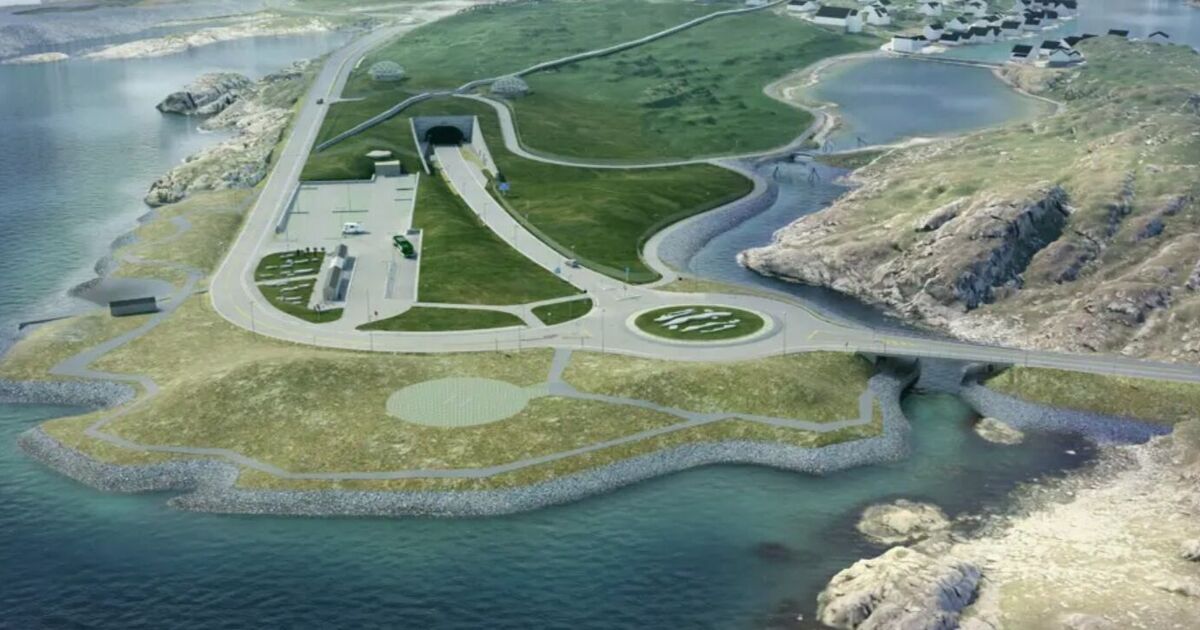
The massive project has been under construction for several years (Image: Norconsult)
There are already some incredible tunnels around the world, but one project is set to take things even further. A huge new road tunnel is currently being built that will break two world records when it opens. As well as becoming the longest underwater road tunnel ever built, it will also be the deepest of its kind anywhere on the planet.
The massive project has been under construction for several years and, once finished, will make travelling across part of Norway much quicker. Known as the Rogfast Tunnel, it is being built beneath the Boknafjord and Kvitsøyfjord in southwestern Norway. The tunnel will connect Randaberg, just north of Stavanger, with the municipality of Bokn.
It forms part of Norway’s long-term plan to make the E39 coastal highway ferry-free. At the moment, drivers travelling along this part of the country’s west coast have to rely on ferry crossings to continue their journey.
One of those crossings currently takes around 25 minutes. When the tunnel opens, the ferry will no longer be needed and journeys between Bergen and Stavanger are expected to be around 40 minutes quicker.
But the scale of the project is difficult to imagine. The tunnel will stretch for 27 kilometres, or around 16.7 miles, making it the longest underwater road tunnel ever built.
At its deepest point it will reach 392 metres below sea level, setting another world record as the deepest subsea road tunnel anywhere in the world.
Rather than having one large tunnel carrying traffic in both directions, Rogfast will have two separate tunnels. One will carry northbound traffic and the other southbound traffic.

At its deepest point it will reach 392 metres below sea level (Image: Norconsult)
Emergency passages linking the two tunnels will be built every 250 metres so drivers can escape safely if there is an incident.
Construction officially began in January 2018, but work was temporarily paused in 2019 after construction costs came in much higher than expected.
The Norwegian Public Roads Administration spent around two years reviewing the project before work restarted in late 2021. The tunnel is now expected to open to traffic in 2033.
The latest approved budget is around 25 billion Norwegian kroner, which is roughly £1.8 billion. Around 40% of the cost is being covered by the Norwegian government, while the remaining funding will eventually be repaid through tolls paid by drivers using the tunnel.
However, constructing the tunnel comes with huge engineering challenges.
Instead of using giant tunnel boring machines, workers are drilling directly into solid rock before blasting it away with explosives.

Rogfast will have two separate tunnels – one for northbound traffic and the other southbound traffic (Image: Norconsult)
Teams are working from both ends of the tunnel at the same time, digging towards each other.
To make sure both sides meet in exactly the right place, engineers use laser scanners that collect millions of measurements every second to create detailed digital models of the tunnel as it is being excavated.
The depth at which the tunnel sits creates another challenge. At almost 400 metres below the sea, water pressure on the rock above is extremely high.
As a result, engineers have to constantly inspect the rock ahead of the excavation, looking for cracks or weak points before digging continues.
As if all of that wasn’t hard enough, engineers are also building a junction that will connect the main tunnel to the island of Kvitsøy. The underground roundabout will sit around 250 metres below the sea, making it the deepest undersea road junction ever built.
Because the tunnel is much longer than most road tunnels, engineers have also had to develop new ventilation and safety systems.
Special ventilation shafts will remove smoke if there is a fire, while the emergency passages between the two tunnels will provide escape routes for drivers if they are ever needed.
If everything stays on schedule, Rogfast will open in 2033.