Trump’s border wall push is back — and it’s destroying national parks and 200-year-old trees
About 22 miles south of the former mining town of Patagonia, Arizona, down a winding, unpaved mountain road that passes cows grazing on open range, stands a cottonwood tree believed to be at least 200 years old. The “grandmother” tree, as some locals call it, is imperiled and already showing signs of stress, almost as if it knows its fate. The leaves are yellowing prematurely, falling to the ground at the height of summer. On July 27th, a construction crew felled three neighboring trees to build an extension of President Donald Trump’s wall along the US-Mexico border.
An activist climbed up the last tree standing two days later and ever since, someone has sat on a platform hoisted onto the tree’s branches. They say they’ll sit there as long as it takes, because as long as someone is in the tree, it can’t be cut down.
The protest is about more than one cottonwood. “This tree represents a literal line in the sand against border militarization in general,” said Russ McSpadden, the Southwest conservation advocate for the Center for Biological Diversity.
In recent weeks, the Department of Homeland Security has revived its effort to wall off the border, dispatching construction crews to remote parts of Texas, Arizona, and the Tohono O’odham Nation’s reservation lands to finish Trump’s wall — and has waived environmental laws to get it built, causing backlash from the tiny desert town of Ajo to the even tinier ghost town of Terlingua.
This latest construction push is happening despite record-low encounters along the southwestern border. In fact, encounters at the southwest border dropped almost immediately after Trump took office — not because of any new infrastructure, but because he effectively shut down asylum. Despite the steep decline in migrant crossings, the One Big Beautiful Bill Act, which passed along party lines in 2025, gave Trump an additional $46.5 billion to finish building the wall.
The border wall is more than just a wall; it’s a vast surveillance network of interconnected drones, towers, and cameras. Even in areas where there’s no visible barrier separating the United States and Mexico, CBP relies on this “virtual wall” to track migrants. This vast surveillance apparatus is far more effective than a wall, and it’s already largely in place.
In the ghost town of Lochiel, Arizona, activists from surrounding communities have set up an encampment on private property near the cottonwood tree to support the protest. They take turns cooking meals and use a pulley system to transport food and water to the person sitting in the tree. They know they’re being watched. Trucks from Vision Quest Solutions, a private security firm that advertises itself as veteran- and Native American-owned, roll up and down the fresh dirt road just south of the tree. The activists track the various contractors that are building the road: Fisher Sand & Gravel, BJ Drilling, Stinger Bridge & Iron, and others.

Henry, a community organizer from Tucson who is participating in the encampment, said that a DHS helicopter flew “dangerously close” to the tree on August 10th.
“This movement was started and held down for a long time by local environmentalists who care really deeply about these ancient cottonwood trees,” said Henry, who asked to be referred to by a pseudonym. He is among a newer group of activists “who see it as an opportunity to physically stop border wall construction.”
The planned construction projects differ by region. In Arizona’s San Rafael Valley, where an older fence already divides Mexico and the United States, DHS is building a wall featuring 30-foot-tall steel bollards. The plan is to have a “double wall” throughout the Arizona-Mexico border — one that runs through the Tohono O’odham reservation, Organ Pipe Cactus National Monument, and the San Rafael Valley. To achieve this, DHS contractors are tearing down the old fence, replacing it with the new bollards, and building an entirely new wall a few dozen feet away. The cottonwood tree sits directly in the path of the second wall.
“They’re approaching the tree from both sides with their work crews,” Henry said. “I don’t really know what their plan is once they don’t have anything else to do.”
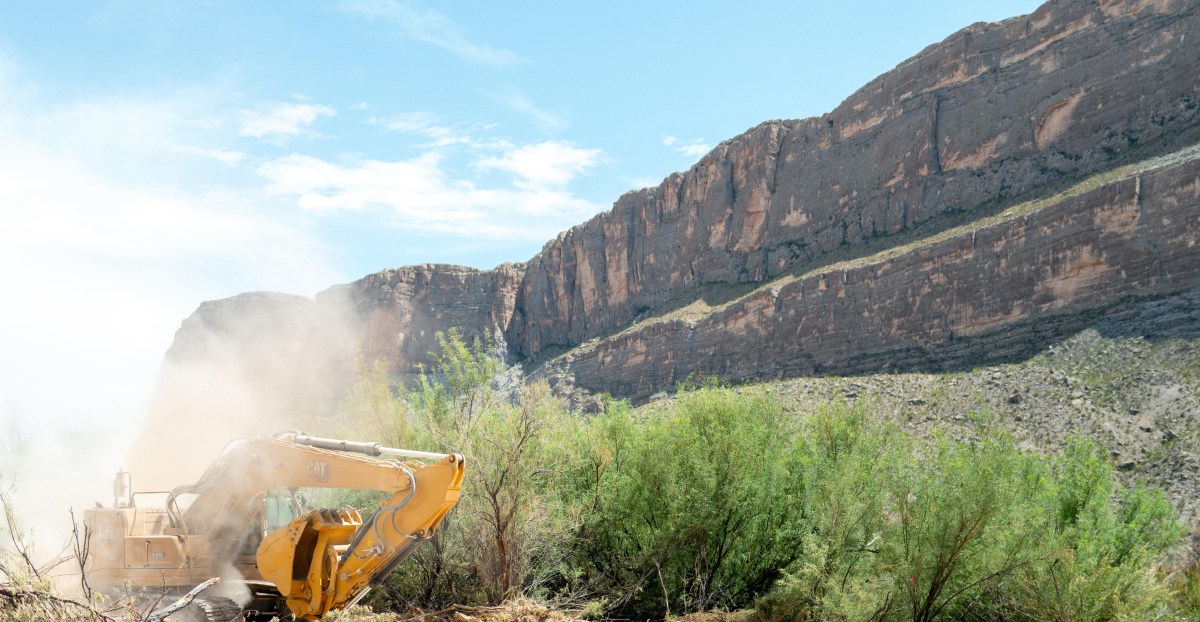
In Big Bend National Park, Customs and Border Protection is building what it calls a “Technology & Patrol Road,” or a “smart wall” system of sensors, cameras, and surveillance towers accessible via a new road — even though there’s an existing road that cuts through the park.
Responding to mass outcry about recent construction in Big Bend, CBP chief Rodney Scott said that DHS isn’t building a wall. “CBP is building one new access road, improving existing roads, installing detection technology, and placing vehicle barriers in limited, strategic locations,” Scott said in an emailed statement. “What people are seeing right now is survey and design work—NOT construction of a wall through the park.” (The statement was also posted near-verbatim on DHS’s X account. )
Unlike in other areas along the border, Scott said, CBP isn’t building a 30-foot wall or installing stadium lighting in Big Bend National Park, Big Bend Ranch State Park, or the Black Gap Wildlife Management Area.
But outraged locals, joined by environmentalists from across the country, charge that CBP doesn’t need to build a 30-foot wall to destroy local ecosystems. Over the weekend, contractors started digging into Mariscal Mountain, a massive limestone ridge, ostensibly as part of the survey and design work needed to build its patrol road.
You can call it what you want. You’re destroying what we’re trying to protect.
— Billy Miller, a river guide and landowner in Terlingua, Texas.
CBP maintains that its goal is to ensure Big Bend remains open to the public. According to agency spokesperson John Mennell, the “smart wall” CBP plans on installing in the area is proactive, not reactive. Though the national park and Border Patrol’s greater Big Bend sector — which encompasses 165,154 square miles — has historically seen fewer crossings than other parts of the border, Mennell said that the buildup of security elsewhere could push migrants into Big Bend.
The Center for Biological Diversity sued the Trump administration last year, arguing that waiving environmental laws to build Trump’s wall “violates the foundational principle of the separation of powers rooted in the US Constitution.” But a federal judge effectively closed the case in March, citing two laws that let DHS disregard nearly three dozen federal laws — including the Endangered Species Act, the Native American Graves Protection and Repatriation Act, and the Clean Air Act — to “ensure expeditious construction of the barriers and roads” along the border. A separate lawsuit, filed by the Center for Biological Diversity, a local church, and Billy Miller, a river guide and landowner in Terlingua, Texas, is ongoing.
“Their lawyers — the contractor’s lawyers, the federal government’s lawyers — told us they would give us 30 days’ advance notice before any ground disturbance,” Miller, who has been a river guide in the area for 22 years, told The Verge. “But they just started destroying the river corridor this past week without telling us anything.”
The government’s attorneys, he said, countered that there hasn’t been any ground disturbance, since what they’re doing is “grubbing and pioneering to create access roads to the river.”
“You can call it what you want,” Miller said. “You’re destroying what we’re trying to protect. Y’all were supposed to tell us about it.”
Miller said that he and other locals have been told that the new CBP roads won’t be open to the public; only Border Patrol will be able to use them. “That’s heartbreaking. You’re going to destroy our national park, or take away private landowners’ property, and create roads nobody can use?” he said. According to Mennell, the CBP spokesperson, the National Park Service will decide whether the roads will be open to the public.
“You’re taking a wilderness area that’s really hard to get through, really hard to walk through on foot, and now you’re creating a brand-new road? They’re creating roads that smugglers could use, if there were smugglers out here in the first place.”

CBP also plans on installing vehicle barriers that locals say will block their access to the Rio Grande, which would threaten Miller and other river guides’ livelihood. In addition to destroying landscapes, jeopardizing livelihoods, and endangering migrants, the border wall threatens migratory species across the Southwest, including Sonoran pronghorns and Mexican gray wolves.
Over the last two weeks, the small, tight-knit community has been invaded by hundreds of construction workers. “Some businesses, like the Starlight Theatre, which is the most popular restaurant in town, have put up a sign that says they refuse to serve border wall workers or border barrier construction workers,” said Miller.
Though Trump received 55.6 percent of the vote in Texas’ Brewster County, the community is almost universally opposed to the wall. Miller has friends and relatives who “voted for Trump without really thinking that he would ever try to build a wall out here,” he said. “And now they are kicking themselves in the ass for voting for him.”
Locals share the opinion that the wall isn’t about border security or immigration. It’s about money. Some of the contractors, they point out, are run by major Trump donors. Fisher Sand & Gravel, one of the contractors working on the wall in Arizona, reportedly lobbied Trump directly, and was awarded a nearly $1.3 billion contract during his first term.
On Wednesday, over 100 people attended a protest in Big Bend National Park’s Santa Elena Canyon. Their chants of “no road, no wall, no wire, no way” echoed off the surrounding cliffs.
Michael Ryan, a retired National Park Service river ranger who attended the rally, said some people he talked to drove more than 100 miles to be there. “We never thought we would see anything like this,” said Ryan, who has lived in the Big Bend region for 35 years. “We used to think more Airbnbs in the area was about the worst thing that could ever happen to us, and now the scope and scale of this construction is mind-boggling.”
In Arizona and Texas alike, locals see the wall as not only wasteful but destructive.
“They could spend this money on more agents if they wanted to, more infrared cameras, more motion sensors, more drones,” said Miller, the Big Bend river guide. “Even though that’s, to everybody out here, a complete waste of money, that would be more effective than what they’re planning.”