Leaders meet at White House amid tensions over Taiwan, trade and AI
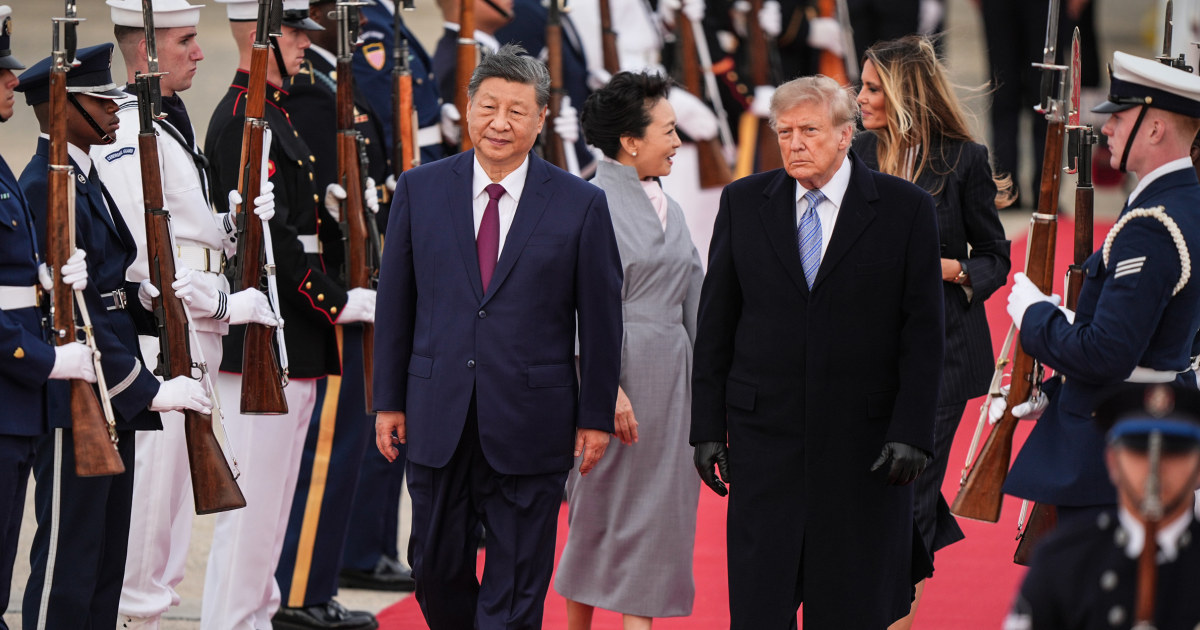
HONG KONG — President Donald Trump’s strong rapport with Xi Jinping is set to be on display in Washington this week as the Chinese leader makes his first U.S. state visit in more than a decade. But below the surface-level pageantry at the White House, little is likely to be resolved as the world’s two biggest economies continue to spar over trade, Taiwan, AI and more.
Since a trade war shook the global economy last year, U.S.-China relations have been at an effective standstill, experts say, buying both sides time to reinforce their strengths and address their vulnerabilities.
Trump, who usually meets with foreign leaders at the White House, will be on the tarmac to greet Xi and his wife, Peng Liyuan, when they arrive at Joint Base Andrews, Maryland, outside Washington on Wednesday, senior administration officials said.
Trump will be greeting Xi in a weaker position than when they last met four months ago, said Allen Carlson, an associate professor of government at Cornell University, as he faces mounting inflation, falling approval ratings, an unpopular war with Iran and a potentially disastrous midterm election result for his Republican Party.
That means even the main question at Thursday’s summit — whether to extend a fragile trade truce that Trump and Xi agreed to last fall — could end up being decided later. U.S. officials have indicated that the two sides may not be ready to extend the truce, which expires Nov. 10, amid disagreements over how long to prolong it.
Another key issue is artificial intelligence, which is increasingly at the center of U.S.-China competition. Warnings from American AI leaders that the technology could pose an existential threat have raised fears about the ability of the world’s two leading AI powers to work together to contain its potential dangers.
Treasury Secretary Scott Bessent said Sunday after preparatory talks with Chinese officials that the U.S. had proposed exchanging safety alerts with China for AI-related incidents that could affect national security. But experts say it’s unlikely that this week’s summit will produce any major security agreement on AI.

That leaves the focus on the White House visit itself, Xi’s first since 2015.
Trump, who has referred to the U.S. and China as the “G2,” often touts his personal relationship with his “good friend” Xi, and the two leaders appeared warm and friendly at their last meeting in Beijing in May.
“It was quite astounding to see the chemistry between those two. And it’ll be even more astounding when Xi comes to the White House,” said Orville Schell, the director of the Center on U.S.-China Relations at the Asia Society, a global nonprofit based in New York.
As he meets with Xi this week, Trump wants “the ability to declare victory, regardless of the substance,” Carlson said.
That has raised concerns about what Trump might offer Xi in exchange for a perceived win, particularly when it comes to the Beijing-claimed island of Taiwan. Trump has described a pending $14 billion U.S. arms package for Taiwan as a potential “negotiating chip” with Xi, who has ramped up military pressure on the self-ruling island democracy.
Ideally, China would like the U.S. to end Taiwan arms sales and express clear opposition to Taiwan independence. But “we’re realistic,” said Zhao Hai, vice president of the Chinese Institute of Hong Kong, a think tank that serves as a branch of the Chinese Academy of Social Sciences, a Chinese government research institution.
“So far, the outcome has been quite good for China, which is the pause on U.S. export of military equipment,” he said. “If we can extend that pause and even cancel some of the more offensive weaponry, that would be better.”
Writing Wednesday in the Chinese Communist Party’s official People’s Daily newspaper, China’s ambassador to the U.S., Xie Feng, said Taiwan was one of China’s “red lines” in any discussions with the U.S., along with human rights.
A senior administration official told NBC News that Trump will make a determination about a new Taiwan arms package “in a fairly short time.”
The official also noted that Trump approved $11.1 billion in arms sales to Taiwan in December, the largest arms package Taiwan has received.
Trump approved more arms sales to Taiwan during his first term than any other president in history, the official said.