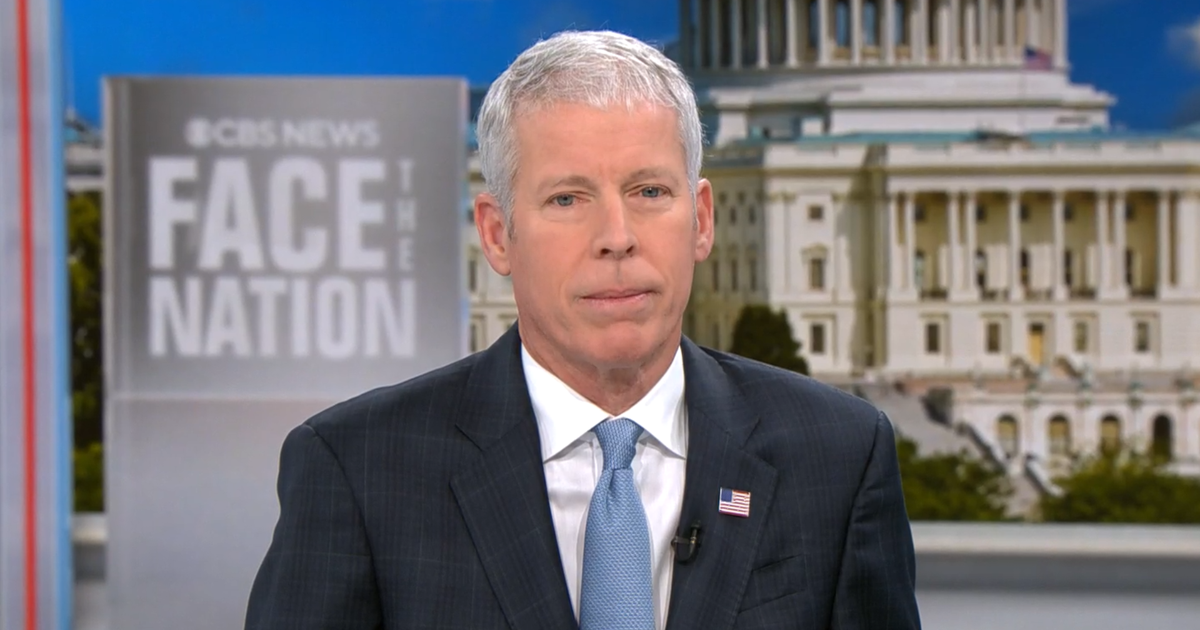
Transcript: Energy Secretary Chris Wright on “Face the Nation with Margaret Brennan,” Oct. 4, 2026
The following is the transcript of the interview with Energy Secretary Chris Wright that aired on “Face the Nation with Margaret Brennan” on Oct. 4, 2026.
MARGARET BRENNAN: Good morning, and welcome to Face the Nation. We begin with one of the Trump administration officials tasked with working to lower those high gas and oil prices, Energy Secretary Chris Wright. Good morning to you.
SECRETARY OF ENERGY CHRIS WRIGHT: Good morning, Margaret.
MARGARET BRENNAN: So, it’s good to have you here. You said this past week that Americans can expect lower gasoline prices and diesel prices by election day. The Wall Street Journal editorial board has a piece outlining that the campaign to squeeze around financially is working, but they can still knock out significant Gulf energy infrastructure. They could be planning an October surprise before the U.S. midterms. We are still seeing Iranian attacks on ships now. I mean, how can you be so confident prices are headed down?
SEC. WRIGHT: Well, because we’ve got increasing supplies coming out of the Strait of Hormuz and they’ve continued to rise over the last months, over the last recent weeks. We’ve got U.S. gasoline production today at record high. We have demand for gasoline, as we come out of the summer driving scene, starting to go down. Similar stories with diesel. Diesel’s mostly been infected by the Russia-Ukraine war and also by China’s decision not to export diesel or gasoline into the marketplace. And of course, we’re living with two refineries that were recently closed, large refineries in California that Gavin Newsom forced the closure of. And frankly, 15 years of Democrat policies that have been energy subtraction, trying to close coal plants, close refineries, and shrink our capacity. Which means when you get in crisis, we’re just less resilient than we should be.
MARGARET BRENNAN: But you still think that in the next four weeks prices are going to go down?
SEC. WRIGHT: Absolutely. Diesel prices have been going down. Gasoline prices have been going down. I expect that to continue.
MARGARET BRENNAN: I want to talk about diesel in a minute, but I- I was reading that the U.S. was sending more defensive equipment to the Gulf countries to protect their oil infrastructure. I see there was a gathering of national security advisers at Camp David on Friday to talk about Iran and the conflict in Yemen. Can you share any outcome from that? I mean, is- is the U.S. about to escalate? We did just see a third carrier strike group get sent to the region.
SEC. WRIGHT: Look, the president has- has taken a strong stand that Iran, the world’s greatest terrorist regime- regime, cannot and will not have nuclear weapons. So, of course, we’re looking at every avenue to achieve that goal economically, to be prepared for what comes militarily. But we cannot pass to the next administration an Iran armed with nuclear weapons. Not only is that a threat to peace and stability–
MARGARET BRENNAN: Right.
SEC. WRIGHT: –that’s a massive long-term threat to energy prices.
MARGARET BRENNAN: Right, but he’s also said that they’re not seeking a nuclear weapon. He said that just the other day that they might have actually already stopped. But in the immediate sense of threats to our neighbors who have refinery and production capacity, how do you guarantee that there is no October surprise that sends those prices going the opposite direction?
SEC. WRIGHT: Hey, well, there’s no guarantees. There’s no guarantees in conflict. There’s no guarantees in life. But everything we’re doing is to grow the supply of diesel, to grow the supply of gasoline, and frankly, again, to reverse years of policies that have been directed exactly the opposite, to shrink our ability to produce, refine, and deliver hydrocarbons.
MARGARET BRENNAN: Can you say whether the president has decided he will escalate post-election day? That’s when that third carrier strike group will be arriving, mid-November.
SEC. WRIGHT: Oh, I’m definitely not going to get in front of presidents’ plans or policies. But remember–
MARGARET BRENNAN: He’d thrown that out there himself.
SEC. WRIGHT: He’s- he’s always planning for contingencies and he’s always negotiating. How you communicate, what you- what you lean in on, it sends a message to the other side. He’s been a master, a master at doing that.
MARGARET BRENNAN: So he’s got both tracks still going, diplomatic and military pressure?
SEC. WRIGHT: Of course, of course. At all times.
MARGARET BRENNAN: Okay, you talked about diesel. The world’s wealthiest countries, the G7, this past week agreed to release 100 million barrels of fuel over four months. They’re going to front load it with a lot of diesel in the next 20 days. I know you asked our friends and allies to consider doing this. How significant a price impact and for how long?
SEC. WRIGHT: It’s a big deal. It’s a big deal. Europe has very large diesel stores. They, you know, they don’t refine enough diesel to supply their own economies, so naturally they store a lot of diesel. They’re very keen to see American diesel continue to flow to Europe. They’ve got a lot of diesel in stores. Why not release some of that? This is what you store diesel for. When all the Russian exports of diesel are shut down, when the Chinese have said we’re not going to deliver any more diesel, and you still have a reduction of diesel flows coming out of the Gulf, but we’re restoring those, but that takes time. This is just common sense. This lowers diesel prices, not just in the United States, but it lowers them in Europe and around the world. But it will drive diesel prices down as those releases come. It’ll drive diesel down through the winter in the United States and around the world. And- and by then we’ll be in another place. We’ll have more refining capacity online. I- I suspect we’ll continue to see diesel decline as we go into next spring as well.
MARGARET BRENNAN: So below six bucks? Which is where it is.
SEC. WRIGHT: Yes.
MARGARET BRENNAN: Yeah. By post-midterms?
[CROSSTALK]
SEC. WRIGHT: It’s- it’s down a little over 20 cents so far.
MARGARET BRENNAN: Yeah.
SEC. WRIGHT: I think you’ll see it continue to go down. Yeah, you should see it below $6 before too long. But exactly when, I certainly don’t know that.
MARGARET BRENNAN: So the allies did this after President Trump said he was considering a diesel export ban. You had so many quotes where you were telling people, “This was not a good idea.” “Let’s not do a diesel export ban.” But the president kept saying it was a consideration. Has he completely ruled out an export ban at this point?
SEC. WRIGHT: Look, every day he’s throwing out ideas. He’s engaging with discussions with me, others in the administration–
MARGARET BRENNAN: Even when you’re saying it’s not a good idea?
SEC. WRIGHT: Absolutely. No, he- he- he’s–
MARGARET BRENNAN: But you’re the expert.
SEC. WRIGHT: –he says well- well, but there’s different ways to slice this cat. There’s different ways to look at it. He’s always looking, “How do I lower energy prices? How do I lower heating prices, electricity prices, gasoline prices, diesel prices?” In fact, I would say his constant communication of that may have been quite helpful in achieving- in achieving the deal we just struck.
MARGARET BRENNAN: Because people thought he might actually not listen to you and go ahead and do it?
SEC. WRIGHT: I–
MARGARET BRENNAN: That was the- the ploy, essentially?
SEC. WRIGHT: It wasn’t a ploy. It’s just a constant dialog about the many levers we have. How can we drive down diesel prices and drive down gasoline and other prices along with it?
MARGARET BRENNAN: So we checked, and it looks like because of this Lindsey Graham bill that gives the president more, sort of, powers to punish the buyers of Russian fuel, he has to make a decision by October the 18th as to whether he’s going to put tariffs on the biggest buyers. That would be China, and that would be India. Is he going to do that?
SEC. WRIGHT: Look, he- he leaves every decision till the end. He’ll evaluate the trade-offs. He has worked ceaselessly to try to end this war. Not only would end- would ending this war end the killing of- of tens and of thousands of people every month, it would dramatically lower energy prices. He’s wanted to end that conflict, yes, since before he was president. So, and- and there is constant, constant dialogs with both sides in that to try to bring that war to an end.
MARGARET BRENNAN: But at this point, like, what’s the direction here? You just had this big state visit. Are we actually in a position where the U.S. might put tariffs on China for buying Russian oil? Are we actually going to see that, and what impact would that have?
SEC. WRIGHT: Again, I won’t get in front of the president on that. We’re trying to have the best relations we can–
MARGARET BRENNAN: I’m sure you’ve looked at the projections on what it would do for pricing.
SEC. WRIGHT: Of course, we’re trying to have great relations with China and move that ball forward. I think things are going reasonably well there. But then the flip side is you’ve got to look at every leverage you’ve got to bring a murderous conflict to an end.
MARGARET BRENNAN: So he may and you would encourage him to?
SEC. WRIGHT: I’m not going to say- I’m not going to say on–
MARGARET BRENNAN: Okay.
SEC. WRIGHT: –either one of those. He’s- he’s looking to how to end that conflict and how to lower prices for Americans every day.
MARGARET BRENNAN: Yeah. Well, the date just stood out, you know, weeks before the midterms, doing something that could arguably push prices back up. And so, if it’s a national security decision versus a political one. Be interested to know your point of view.
[CROSSTALK]
SEC. WRIGHT: If his decisions were political he would have just kicked the can down the road and delivered a nuclear-armed Iran to the next president. You’ve got to respect that. That’s an incredible move to lean in and say I’m not going to let them become nuclear-armed. He knew it was going to elevate energy prices in the short run. He said, “I’m going to take a hit there, but I got to do the right thing.”
MARGARET BRENNAN: You did tell him that? That there would be a huge energy price spike when he made the decision.
SEC. WRIGHT: He- he was well aware of- of the risk to energy flows that were coming out of the Persian Gulf region. He said, “I simply cannot. The world cannot sustain a nuclear-armed Iran, and I’m not going to do it.”
MARGARET BRENNAN: Secretary Wright, thank you for your time today.
SEC. WRIGHT: Thank you, Margaret.
MARGARET BRENNAN: Face Nation will be back in a minute. Stay with us.