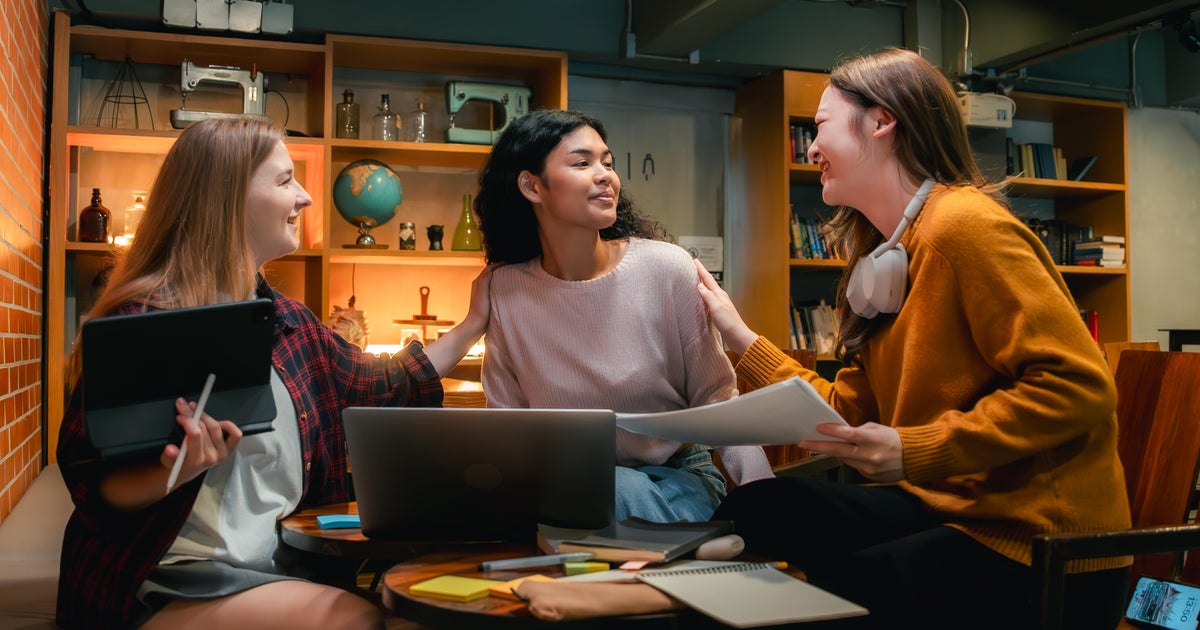
College students competing in “America’s Startup” contest use AI to start businesses from their dorms
One startup uses artificial intelligence to help winemakers better predict crop yields. Another uses insights gleaned from AI to enable earlier detection of skin cancer, while a third develops a seaweed-based hydrogel fire suppressant that’s free of “forever chemicals.”
The entrepreneurs behind these tech-forward startups have one thing in common: They started the companies from their college dorm rooms to participate in “America’s Startup,” a government-backed collegiate innovation competition that’s part of America250, the congressional commission behind the U.S.’s 250th anniversary celebration.
America250 chair and former U.S. Treasury Secretary Rosie Rios, who leads America’s Startup, told CBS News she expects a wave of innovation led by Generation Z entrepreneurs, who will be the first AI-native cohort of workers to enter the job market upon graduation.
“They really hit the ground running and are not intimidated by it,” Rios said. She also thinks AI will help broaden the skills and experience of new entrants to the job market, much as the internet did for millennials.
“It’s no longer what they learned at home or in a classroom — it’s what they see and have access to,” said Rios, adding that AI helps eliminate some of the hurdles to launching companies.
“Idea machines”
Recent research from the Bank of America Institute shows the rate of U.S. business formation is rising, largely driven by Gen Z founders. In June, Gen Z surpassed all other generations in growth in new business registration applications. Researchers concluded that starting a business may be viewed as a desirable pathway to career success as younger workers navigate a challenging labor market.
Additionally, AI can be deployed to perform functions such as bookkeeping or content creation, allowing founders to operate as “solopreneurs” and save on personnel costs, researchers at the Bank of America Institute noted.
“They’ve been exposed to so much because of their comfort with technology that they are basically idea machines,” Rios told CBS News. “AI could be very advantageous for this group, and they have demonstrated their ability to use it for good, so far.”
Kayan Shah, a college sophomore and co-founder of Graft Systems, was one of 10 winners of last year’s America’s Startup competition. He’s partnering with vineyards across San Francisco to test and further develop the company’s technology, which collects images of plants and combines them with machine-learning models that predict how many grapes they’ll yield by analyzing variables such as weather, sunlight and a vineyard’s location.
“AI could take over many, many jobs, but this is the status quo, so the only option you have is to make the best of it, and we’re using it to help wine growers,” Shah said.
While Shah isn’t yet 21 and can’t legally drink, he said he appreciates wine culture and wants to preserve it, citing a decline in alcohol consumption rates. Americans who say they drink alcohol fell to 54% last year, the lowest level in 90 years, according to an August 2025 Gallup poll.
Skin in the game
Another entrant in last year’s startup contest pitched a biotech company that helps people track their exposure to harmful ultraviolet rays and potentially detect skin cancer earlier. Kristina Schiffman, the founder of UV Sense, told CBS News the company uses AI to educate people about their skin, including a tool for analyzing and tracking moles and other conditions.
“We take user inputs, including images and concerns about the skin, and use AI to help people make an informed decision about what they should do,” Schiffman said.
“If you have a freckle you’re concerned about, you can upload photos and use AI to monitor its shape, size and color, and we can recommend a dermatologist visit,” she explained.
Aspiring entrepreneurs can submit their best ideas to America’s Startup before applications close on Oct. 8 at 7:59 p.m. EDT. The competition will award a total of $1 million in cash and prizes to a series of winners. Applicant teams can win up to $50,000 each.
An investor council, which will review proposals and have the opportunity to invest, includes some of the nation’s most prominent entrepreneurs, such as Apple co-founder Steve Wozniak and Sarah Friar, chief financial officer at ChatGPT developer OpenAI.