AI, tech leaders are lobbying Trump health officials in a government-run chat room
A cadre of elite techies, financiers, and high-level Trump administration officials have spent a year quietly charting an extraordinary and rapid campaign to persuade Americans to use apps and other artificial intelligence-powered tools to manage their healthcare and medical records.
As that campaign has unfolded, administration officials have granted tech companies an unusual opportunity to nudge the nation’s health department toward a loosely regulated future for AI health apps in which the government reimburses them for services as it does medical professionals.
In February, federal health officials invited those businesses — including tech giants Microsoft, Anthropic, OpenAI, Apple, and Google — to a listening session on conversational AI products for patients, such as chatbots. Representatives from at least 35 industry organizations attended the meeting held by the Food and Drug Administration, which is responsible for regulating health apps as medical devices. Companies were prompted in advance to explain their AI products and how they access patients’ sensitive medical information.
But the meeting did not appear on the FDA’s public calendar or regulatory notices, nor was the public invited. Rather, the invitation for a select group to help shape federal policy governing AI in healthcare was extended in a chat room on the messaging service Slack.
“This is a great opportunity to support HHS’ goals and share your state-of-the-art understanding of safe Conversational AI development and monitoring to help FDA shape future guidance,” CMS senior policy adviser Morgan Taylor wrote in the Slack workspace.
The Centers for Medicare & Medicaid Services has not formally announced the chat room through federal regulatory channels, though CMS officials have talked about it at industry conferences. Legal experts said the chat room resembles a federal advisory panel, which would be required to operate in public view.
KFF Health News reviewed thousands of Slack messages, meeting transcripts, and video recordings that reveal how the Trump administration has granted the industry a direct line to top government officials — including former head of the Department of Government Efficiency Amy Gleason.
The conversation took place behind the scenes as federal health officials publicly worked to integrate AI and other technology into nearly every aspect of healthcare, a plan they’ve branded the “Health Technology Ecosystem.”
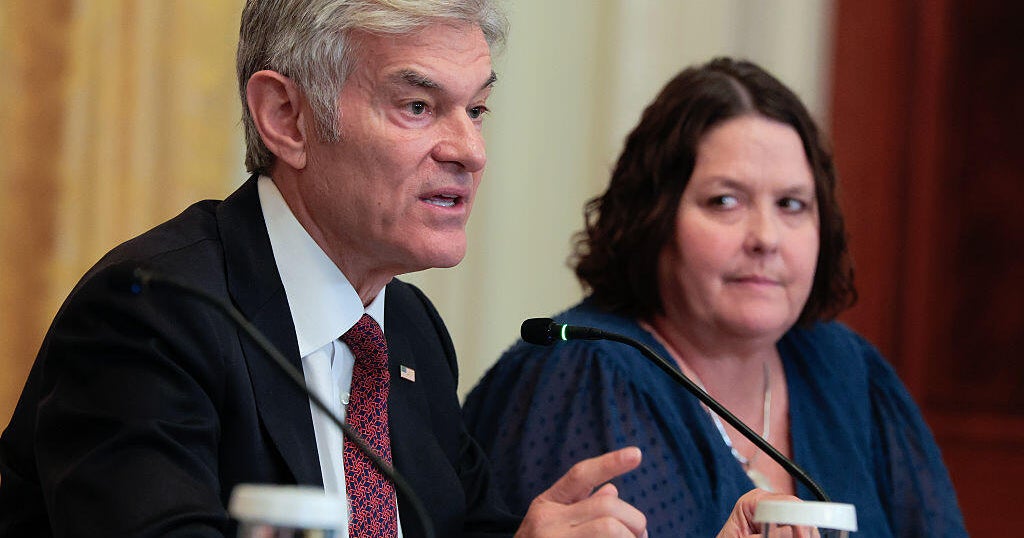
“We wanted to give industry a chance to play in the sandbox of government-supported healthcare,” CMS Administrator Mehmet Oz said in September at the public launch of an initiative that allows health apps to bill Medicare for AI services such as wearable device tracking. Last week, Health and Human Services Secretary Robert F. Kennedy Jr. delivered an enthusiastic endorsement of AI in healthcare, claiming it is “much better informed than any doctor in the country.”
Meanwhile, HHS staff even promised that a recently launched Medicare App Library would serve as a lucrative pipeline for those businesses to get new users. The library’s webpage currently promotes only two dozen commercial apps to millions of American seniors and those with disabilities.
As Trump officials sell it, Americans will get easier access to their medical records so apps can swiftly provide health or wellness advice. In practice, however, so will the tech companies.
Doctors, meanwhile, are increasingly worried about how patients use and share their medical records with the nascent technology.
“Some of these tools just aren’t ready for primetime,” said John Whyte, CEO of the American Medical Association. “We don’t have enough data about them. We don’t understand how they work, how they’re using the information. There’s no liability if these tools get things wrong.”
CMS officials declined to answer several questions about the Slack workspace, including about its legality.
“CMS is focused on giving Medicare beneficiaries greater access to their health information and useful digital tools while promoting an open, interoperable healthcare system,” Gleason, now chief product officer for the newly created Office of Health Technology and Products at CMS, wrote in an emailed statement. “The Health Technology Ecosystem is an open, voluntary technical collaboration. CMS will continue working with patients, providers, payers, technology organizations, and other stakeholders to make health information more accessible and useful to the Americans it serves.”
The FDA did not respond to a request for comment.
The conversation begins
The behind-the-scenes effort to funnel more Americans to AI-powered health apps began in August 2025 in the Slack workspace.
“Welcome all!” Gleason wrote. “Please be sure to read the Code of Conduct and see the Channel list as well to help you find channels that are relevant to you.”
Gleason is best known for serving as the acting administrator of Elon Musk’s Department of Government Efficiency, as it gained access to millions of Americans’ sensitive personal and financial data, including at the Social Security Administration.
As her work with DOGE wound down last year, Gleason welcomed a variety of tech leaders, investors, and entrepreneurs to the chat room.
The Slack workspace’s participants include representatives from major digital wellness companies like Oura Health, AI companies like Palantir, and investment outfits like 8VC, a venture capital firm associated with Kennedy’s son Finn. While the Slack’s member count has ballooned to 1,700 over the past year, only a handful of patient advocates, doctors, and hospital representatives are in it.
The code of conduct Gleason shared on Slack in August 2025 documented that CMS had quietly established a technology working group.
KFF Health News 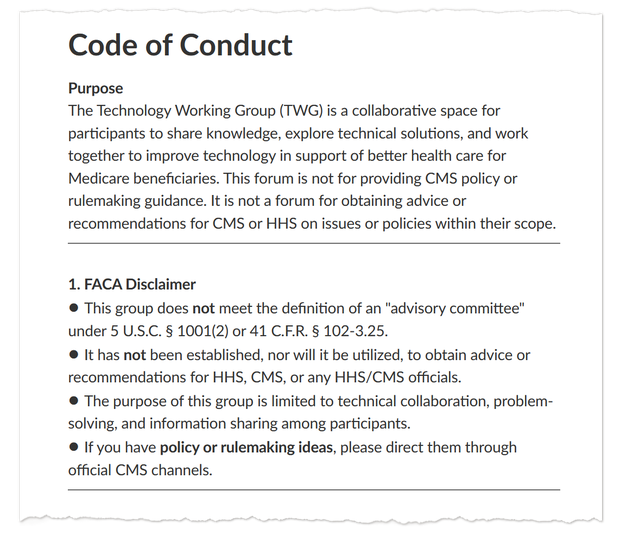
KFF Health News 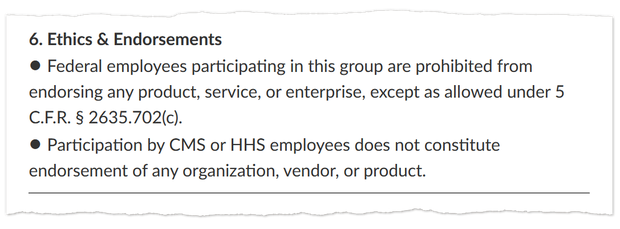
The document also set ground rules for the Slack workspace, noting that the group does not constitute an “advisory committee,” nor would it be used “to obtain advice or recommendations for HHS, CMS, or any HHS/CMS officials.” The code also advises that federal employees “are prohibited from endorsing any product, service, or enterprise.”
Joseph Daval, a former FDA lawyer who is now a research specialist at Harvard Medical School, reviewed messages from the Slack workspace at the request of KFF Health News. He said the chat room in some ways resembles a federal advisory committee — an independent panel that can be formally stood up by an agency head, Congress, or the president to ensure agencies act in the best interest of the public rather than industry.
The law on advisory committees “was passed in part out of a concern about interest group capture, about anticompetitive capture of agency policymaking, about corruption,” he said.
Daval said the chat group looks like a committee, with members interacting with one another and building consensus on preferred courses of action.
If it were a formal advisory committee, though, Daval said, it would be subject to certain “membership requirements having to do with independence and fair balance.”
A “sales engine”
Over a series of video calls, CMS officials promised tech leaders participating in the Slack workspace that the agency would promote their health apps.
Jacob Shiff, the chief AI and technology officer at CMS’ Innovation Center, told industry representatives in a Zoom meeting in February that he hoped the agency’s work would be a “sales engine” for the health apps.
“We’re going to have a directory of all the organizations,” Shiff said in a video recording reviewed by KFF Health News. “The people on this call who hopefully will have amazing solutions that work will be the winners, and you have every incentive to obviously drive down your costs so you can be extremely profitable and scale. So hopefully we’re selling — or enabling you guys to thrive.”
A recording of the call had been publicly available through a Google Drive link but was made private the day after KFF Health News asked about comments made during the meeting.
CMS did not respond to queries about how the agency has decided which AI-powered health apps appear in the Medicare App Library or why federal employees have promised to promote the products.
Days before publicly launching the Medicare App Library, CMS officials promised AI tech leaders during an informal meeting that the new webpage would become an important distribution channel for health apps because Medicare enrollees would place trust in products listed on the CMS website.
“If medicare.gov is promoting it, for lack of a better word, then yeah, it would be an app that I would trust and explore,” CMS’ Taylor said during the April 7 meeting, channeling enrollees, according to a transcript of the call.
The Medicare App Library’s webpage encourages older and disabled Americans to manage health conditions such as obesity, cancer, or diabetes using two dozen AI-driven apps developed by some of the world’s largest corporations, including Microsoft and Google. Many of the apps promise in their product descriptions to give insight, perform analyses, or develop plans that will help patients lose weight or manage diabetes.
CMS officials have suggested to tech representatives during at least two meetings this year that those apps will be prioritized for a new agency program that reimburses companies for AI chatbot advice or wearable device tracking, according to video recordings.
CMS has not publicly divulged all the criteria it uses to decide which apps are listed in its library, but the webpage promotes apps still in their infancy.
Among them is Slothwise, a health app launched this year from a San Francisco apartment by a young, self-described biotech entrepreneur and triple citizen of Russia, Israel, and the U.S. The app says it “knows your whole health” by analyzing medical records and tracking health data for $9.99 a month. It has been reviewed on the Apple and Google app stores only a handful of times.
“I trusted slothwise with my health info because it was endorsed by medicare,” one reviewer wrote in a Google review in August. “Connecting info was smooth and I learned a lot about my health.”
In a statement, Slothwise CEO Sofia Sigal-Passeck did not answer questions about the size and medical expertise of her current team, nor about the availability of a doctor to consult with patients who use the app. The app, she said, is only “informational” at this time.
“I’ve spent years building at the intersection of AI and complex biological data,” Sigal-Passeck wrote in an email. “A small team is not the same thing as an inexperienced team. Slothwise is built by physicians, PhD researchers and engineers.”
“No regulation, no rulemaking”
What’s often less clear — and buried deep in lengthy privacy policies — is that these apps are tapping into the intimate details of patients’ medical records to fuel their AI-driven analyses.
Tech vendors have lobbied the government to treat these apps, once they are vetted and authorized by a third-party company, like a patient requesting records. That position gives apps sweeping access to pull sensitive health data from the national network through which providers electronically exchange medical records, called the Trusted Exchange Framework and Common Agreement, or TEFCA.
A small but influential group of those tech company executives directly made the case to federal health officials during a formal meeting in May, arguing that when health apps request medical records they should be treated as if they are standing “in the shoes” of a patient.
On Slack, tech vendors have lobbied for a “frictionless pathway” for verified users, after they’ve consented once, that allows the app to gain limitless access to patients’ medical records from the TEFCA network.
Ryan Howells, a healthcare management consultant who lobbies for a Washington, D.C.-based digital health tech organization called the CARIN Alliance, has spearheaded an effort for patients — vis-à-vis apps — to more easily access medical records. He has regularly noted in Slack that health apps accessing TEFCA must be vetted by a third-party organization — one of which he sits on the board of — and agree to a code of conduct, developed by the alliance he lobbies for.
“What more can you do to have trust in these apps?” he wrote in a March Slack message, responding to concerns about how much patient consent is needed for apps to access medical records on the network.
Kristen Valdes, the CEO of b.well, a company that also connects apps to the TEFCA network, made a similar argument.
“My opinion is that we need to stop protecting patients from themselves,” she wrote in the same message thread. “Full stop.”
Howells did not respond to an emailed list of questions from KFF Health News. In an interview, Valdes told KFF Health News that her comment reflected her frustration at the “paternalism” of the healthcare system, which she said has historically made it difficult for patients to access their records. Although, she said, “there are going to be good and bad apps.”
Other tech leaders worried in Slack about the approach.
One startup founder cautioned the group to think about the pitfalls of giving health apps broad leeway to pull medical records.
“We might all be good, honest actors here but security & privacy systems have to be designed around the presence of malicious actors – especially if we want this system to scale up to thousands of apps,” wrote Jason Kulatunga, who runs Fasten Health, a medical records management platform.
Gleason, the CMS official, has publicly championed the vision shared by Howells and Valdes. In her speeches, she frequently urges doctors to accept patient medical records directly from apps and calls on them to “Kill the Clipboard,” also the title of a 2025 white paper co-authored by Howells that urges doctors’ offices to abandon paper records.
Last month, Gleason spoke to a crowd gathered at a swanky hotel in Washington for an event hosted by the MAHA Institute, a think tank that supports Secretary Kennedy’s agenda. She laid out her work with tech companies over the past year as she discussed the Trump administration’s efforts to make medical records more digitally accessible.
As she told it, more Americans can now download an app and access their medical records.
“Once you’ve verified your identity you can just click a simple button and say, I’d like my medical records into whatever app I choose,” Gleason said.
She continued: “That was all done just — no regulation, no rulemaking — just by challenging industry to work together.”
KFF Health News is a national newsroom that produces in-depth journalism about health issues and is one of the core operating programs at KFF — the independent source for health policy research, polling, and journalism.