Chaos in Iran as insider reveals regime ‘could topple in weeks’ | World | News

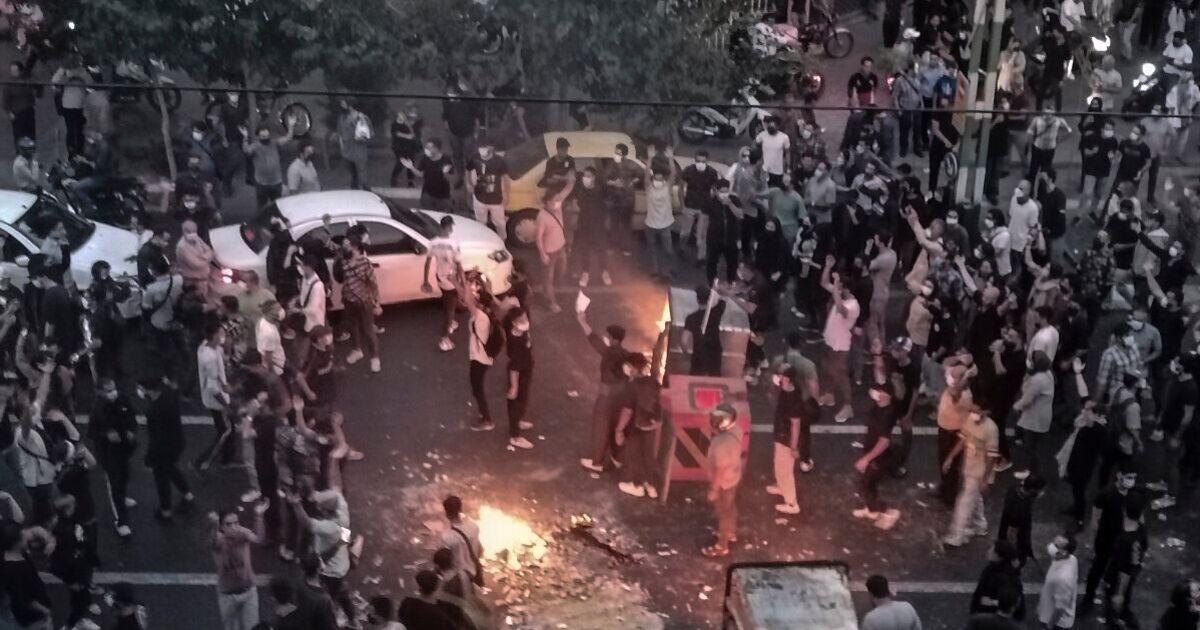
Violent protests across Iran have seen at least 38 killed and 1,000s arrested (Image: AP )
Protests raging across Iran could see the ruling Islamic hardline regime toppled in a “matter of weeks”, a well-placed source has claimed. Cyrus, not his real name, has been closely connected to the workings of the Iranian government for decades in the capital Tehran.
Soaring inflation and fuel prices have put the Islamic Republic’s ailing economy under new pressure and sparked nationwide demonstrations threatening to unseat the ruling Supreme Leader Ali Khamenei and his cronies. Tehran is still reeling from the costs of a 12-day war launched by Israel in June that saw he United States bomb suspected nuclear sites in the country.
And economic pressure has intensified since September when the United Nations reimposed sanctions on the country over its atomic program and Iran’s rial currency has gone into a free fall, now trading at over 1.4million to $1 US dollar. The Iranian government, which has held power since the Islamic Revolution in 1979, has also taken the rare step of raising the country’s usually very cheap fuel prices, sparking anger among ordinary Iranians.
Agencies said at least 38 people had been killed in the protests so far, with more than 2,200 arrests made by the authorities. Angry clashes have erupted in around 340 different incidents across all of Iran’s 31 provinces
Cyrus told the Daily Express the people involved in this latest round of protests were different from previous student and civil rights demonstrations, with shopkeepers and farmers now taking to the streets. He warned if a crack started to show in the government it could be gone “in weeks”.
“In a place like in Iran, everything is possible. Things can change overnight and quite fast. So if there is just one small crack in let’s say, the security forces or army, then definitely this can go nasty for the Iranian establishment very soon,” he said.
READ MORE: Expert warns ‘we are all in danger’ of WW3 in new Trump-era
READ MORE: Iran’s security services ‘shoot at protesters’ as protests descend into chaos

Inflation and fuel prices are soaring in the country (Image: Getty )
“In spite of the regime raising pay for the army and security forces, they are still quite underpaid, and now that they have to come to the streets and suppress the people who could be family members, brothers, sisters and friends and they have to beat them on the streets.
“If there is a defection of any high ranking government officials, especially in security forces and army, then it can end up quite serious for this establishment.
“We don’t have accurate polling here, but a lot of analysts believe and people say, probably about 80% of people in Iran don’t want this government. And of those 20% that do support it, probably most of them only do so because they are getting paid and have benefits.
“It’s really only a tiny per cent who are delusional and believe what the regime is saying about Israel and the US manipulating everything.”
Cyrus added that while the protests may be concerning for the Iranian elites, the regime did have experience of putting down previous revolts. He added: “They will try to suppress it with brutality, by making arrests and beating people, and in this case dozens have been killed so far.
“The government in Iran is still pumping out the usual propaganda on state TV, they’re saying the protesters are Mossad agents plotting against us, but seeing how many they have arrested, they’re can’t be that many Mossad agents in Iran.
“They are claiming the US wants to topple the regime, but this might not work now with so many dissatisfied people over the economy.”
In a post on his TruthSocial platform last week, President Donald Trump said the US was “locked and loaded”, adding: “If Iran shots [sic] and violently kills peaceful protesters, which is their custom, the United States of America will come to their rescue.”

Iran’s Supreme Leader Ali Khamenei speaks speaks in Tehran, Iran on January 03 (Image: Getty )
Cyrus continued: “The background story is that the government had to raise many prices and inflation is skyrocketing, which for the most part has been caused by the war with Israel.
“They (the regime) have been buying military equipment from China, North Korea and Russia a lot, and they have been spending more on military and staff wages because they had to raise the pay to satisfy them.
“They didn’t want any dissatisfaction or uprising from the military personnel. So this has made everything for ordinary people very expensive, and the very last trigger has been the fuel prices rising and that hits everyone.
“This time the protests are different because in 2022 we had the universities, intellectuals and women in the street, but now it has spread to more cities and even in rural areas and it is the farmers and shopkeepers who are protesting. Working class small shopkeepers are a big proportion of the Iranian economy, it’s not like a corporate model in the UK, Iran runs on small shops and businesses.
“Life has become very difficult for ordinary people and they cannot put food on the table.”
Iran decades ago was one of Britain’s top allies in the region under Shah (King) Mohammad Reza Pahlavi, who purchased Western military weapons and allowed agents to run listening posts monitoring the neighbouring Soviet Union.
But in January 1979, the shah fled Iran as mass demonstrations swelled against his rule. Then came the Islamic Revolution led by Ayatollah Ruhollah Khomeini, which created Iran’s theocratic government. During the Iran-Iraq war of the 1980s, the US backed Saddam Hussein and launched a one-day assault that crippled Iran at sea as part of the so-called “Tanker War,” and later shot down an Iranian commercial airliner that the US military said it mistook for a warplane.
Iran and the U.S. have seesawed between enmity and grudging diplomacy in the years since. Relations peaked with the 2015 nuclear deal, which saw Iran greatly limit its program in exchange for the lifting of sanctions. But Donald Trump unilaterally withdrew America from the accord in 2018, sparking tensions that intensified after Hamas’ October. 7, 2023, terrorist attack on Israel.

Protesters in the streets of Iran (Image: AP )
Cyrus said protesters are tired of Iran spending on money supporting wars elsewhere in the world. He said: “The government has been planning to raise the price of fuel because it has been so cheap and it’s heavily subsidised, and people have protested when they have raised the prices before.
“There is now extra pressure on people’s lives because of the money going to militarism and expansionism, and supporting proxy groups in Yemen, in Lebanon and in Iraq. People have been openly chanting in the streets, stop spending money on Houthis in Yemen, on militias in Lebanon, and spend money on us.
“That’s a lot of money from the Iranian economy, which is quite limited already under pressure of the US and other recent sanctions.
“The government has had to cut expenditures, which means less government employees, less spending on different projects, which could employ people. There are definitely more unemployed people on the streets. And then they had to raise the prices, put taxes on all highways, and the cost of food and utilities as gone up and it’s all hurting people.
“These factors are the trigger to the explosion of protests we see now, there have been ashes smouldering for some time and now there is a fire raging.”