Cyprus’ incredible seaside town abandoned since 1974 after devastating war | World | News

This seaside town used to draw crowds of A-list celebrities, but but hastily abandoned (Image: Getty)
Over 50 years ago, a seaside town in Cyprus was a top destination for Hollywood elites and A-list celebrities, from Elizabeth Taylor to Richard Burton. To cater to the masses, many new high-rise buildings and hotels were constructed, and soon Varosha became the city of Famagusta’s modern tourist area.
However, the Turkish invasion of Northern Cyprus on July 20, 1974, changed everything. In the years that followed, the Greek Cypriots who called Cyprus home fled from the northern third of the Mediterranean island, including Varosha’s 15,000-strong population. They had to leave in such a hurry that they fled their homes and left their personal items behind, leaving the town suspended in time and at the hands of nature. Tens of thousands of Turkish nationals relocated to the invaded part to create the de facto state of the Turkish Republic of Northern Cyprus – currently only recognised by the capital of Turkey, Ankara.
READ MORE: Foreign Office updates travel advice for Brits in seven Middle East countries
READ MORE: easyJet issues urgent update as flights to and from Cyprus cancelled

Varosha has been used as ‘a bargaining chip’ that was never played (Image: Getty)
Since then, the neighbourhood has been used as “a bargaining chip” that was “never played”, Hubert Faustmann, professor for History and Political Science at the University of Nicosia and director of the office of the Friedrich-Ebert-Foundation in Cyprus, previously told the Express.
A major roadblock in the return of Varosha to the Greek Cypriots is the Muslim religious foundation Evkaf (Evak), which claims ownership of significant parts of Varosha, citing Ottoman-era documents dating back to the 1571 conquest. Evkaf claims that much of the land in the ghost town was donated to it by the Ottoman Sultan and was never lawfully transferred, meaning any development on it is illegal. However, Prof Faustmann described this as “at best, on very, very dodgy legal grounds”.
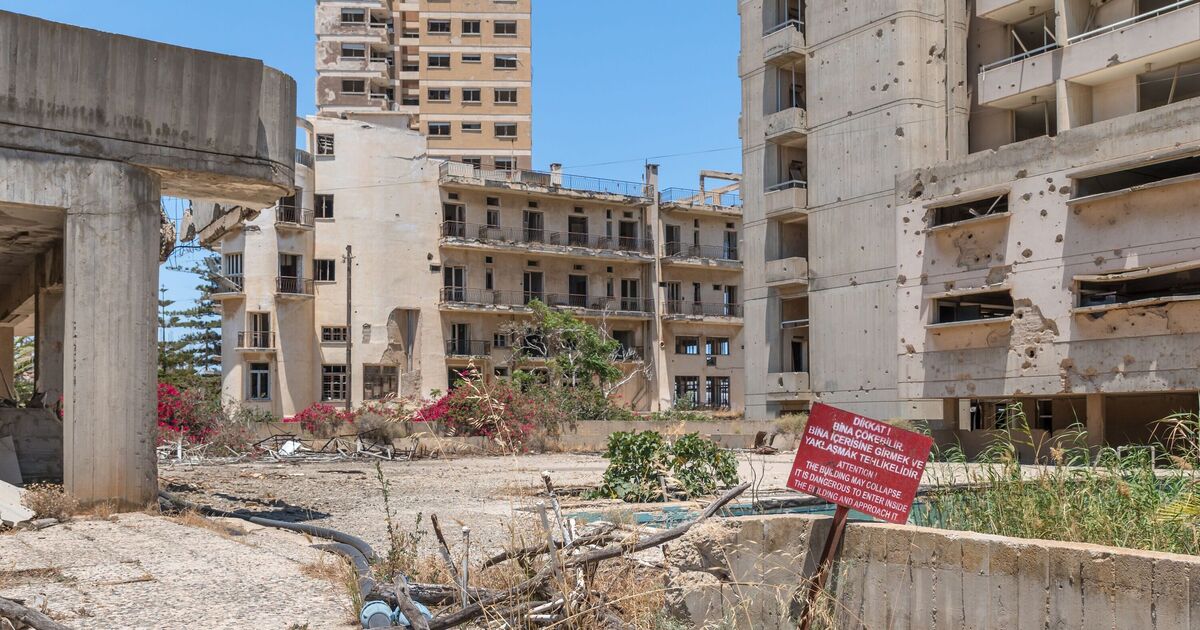
Today, Varosha remains untouched, with the only sign of life being the plants and weeds which have taken over its buildings. Signs have also been erected to warn brave tourists of unstable buildings at risk of collapse.
*** Ensure our latest news headlines always appear at the top of your Google Search by making us a Preferred Source. Click here to activate or add us as Preferred Source in your Google search settings. ***

In October 2020, Turkish President Erdogan and the then prime minister of Northern Cyprus, Ersin Tatar announced the partial opening of Varosha (Image: Getty)
Varosha has been put back on the map in recent years, but this time as a dark tourism hotspot. In October 2020, Turkish President Recep Tayyip Erdoğan, in agreement with the then prime minister of Northern Cyprus, Ersin Tatar, announced the partial opening of the city. The following month, President Erdoğan visited the occupied north and held a symbolic “picnic” in the fenced-off area.
“Varosha is being used as a tourist destination, as a tourist attraction, without a single inhabitant prior to 1974 returning,” Prof Faustmann added. “It’s changed in the sense that it’s open to the public, but it’s not open for return.”
Construction workers have been seen tidying up the area by laying cement, removing debris and roping off edifices sealed from public view, while mobile canteens and tables, umbrellas and chairs now serve visitors. Today, approximately 3.5% of the city is open to tourists, with over two million descending on the area.
However, these efforts would not be enough to allow a full-scale reopening of the quarter, not just to tourists but also to residents, Prof Faustmann noted.