Europe’s controversial £18.5bn answer to Suez Canal that will turn city into an ‘island’ | World | News
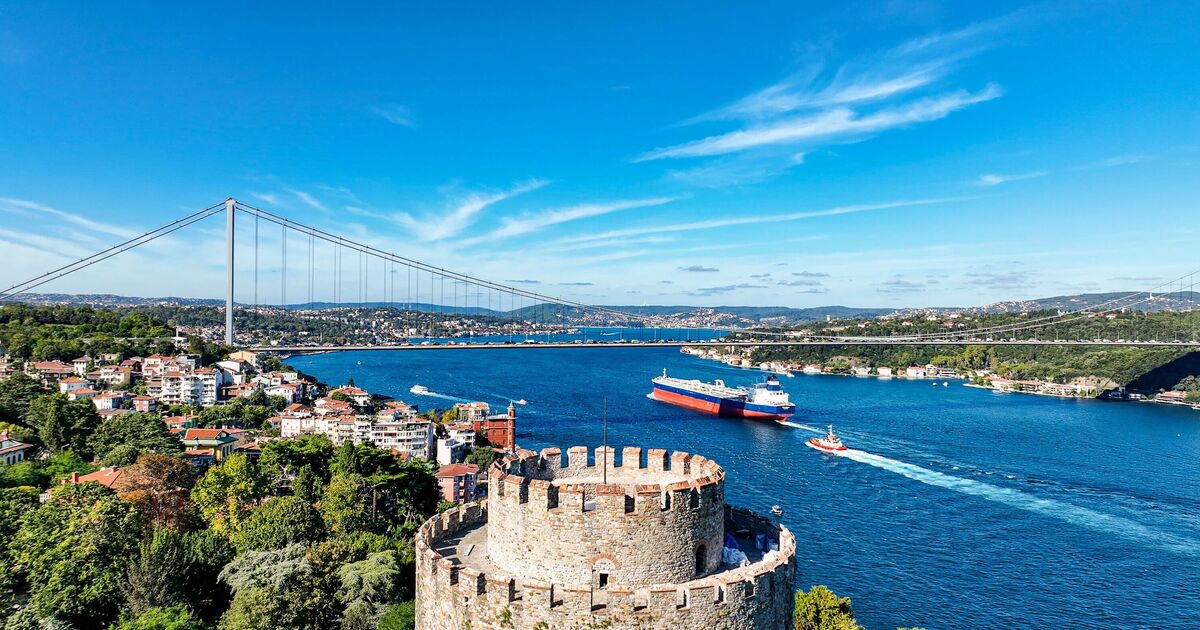
Istanbul’s natural waterway, the Bosphorus Strait, has been a crucial trade route for thousands of years, connecting the Black Sea to the Sea of Marmara and separating Europe from Asia. During the Byzantine and Ottoman eras, it was the economic lifeline for the Black Sea region and Constantinople, with empires controlling the strait, therefore also controlling regional trade.
However, in modern times, the narrow passage, which cuts through Turkey, has become heavily used by ships and crossed by bridges and tunnels, to the extent that it is starting to suffer. Therefore, an artificial waterway parallel to the Bosphorus has been proposed to reduce traffic, risks posed by oil tankers and environmental strain. The New Istanbul Canal project was initiated in 2017, with the intention of creating a new water route that will allow even the largest vessels to pass through Turkey to other countries.
It has been described by the Turks as “the project of the era” and intends to create a 28-mile artificial path which is 82 feet deep and 492 feet wide, to allow the passage of the world’s biggest ships, tankers and submarines. These dimensions will allow approximately 160 ships, as long as 1,148 feet, to pass through each day, meaning that 99% of the maritime traffic currently using the Bosphorus Strait will have a safer and more navigable alternative.
The Turkish Government inaugurated the canal in 2021; however, it will not begin operations until 2027, when the project is fully completed. In total, it is expected to cost an eye-watering $25 billion (£18.5 billion). Turkey hopes to quickly recoup this money, with annual revenues exceeding $8 billion (£5.9 billion), according to official projections.
The canal is being built on the European side of Istanbul, with its route starting from Lake Küçükçekmece near the Marmara Sea, running through the Avcılar and Başakşehir districts, passing the Sazlıdere Dam and reaching the Black Sea north of the city in the Arnavutköy district. This will effectively turn Istanbul into an island, dividing the continents of Asia and Europe.
Construction is under way for six new bridges, including the Sazlidere Bridge as part of the project. Sazlidere was the first to break ground in June 2021 and features diamond-shaped towers along its 643-foot length. It is designed to carry eight lanes of traffic and link suburbs like Başakşehir and Bahçeşehir to the new city zones along the canal.
Three artificial islands will also be created from the canal’s leftovers, with one even set to eventually house an opera house. The project also includes the construction of ports, including a large container terminal in the Black Sea, near Istanbul Airport and logistics centres. Transport projects set to be integrated with the canal project include the Halkali-Kapikule high-speed train, the Turkish State Railways project and Istanbul’s Yenikapi-Sefakoy-Beylikduzu and Mahmutbey-Esenyurt metro lines.
A canal linking the Black Sea with the Sea of Marmara has been proposed at least seven times, but has only now been realised. The first was initiated by Ottoman Sultan Suleiman the Magnificent (1520–1566), but the project was ultimately abandoned. Sultan Mustafa III (1757–1774) attempted twice in 1760, but the project could not proceed due to a lack of funds. Today’s project was announced by President Recep Tayyip Erdoğan in June 2021, who described it as his “crazy project”.