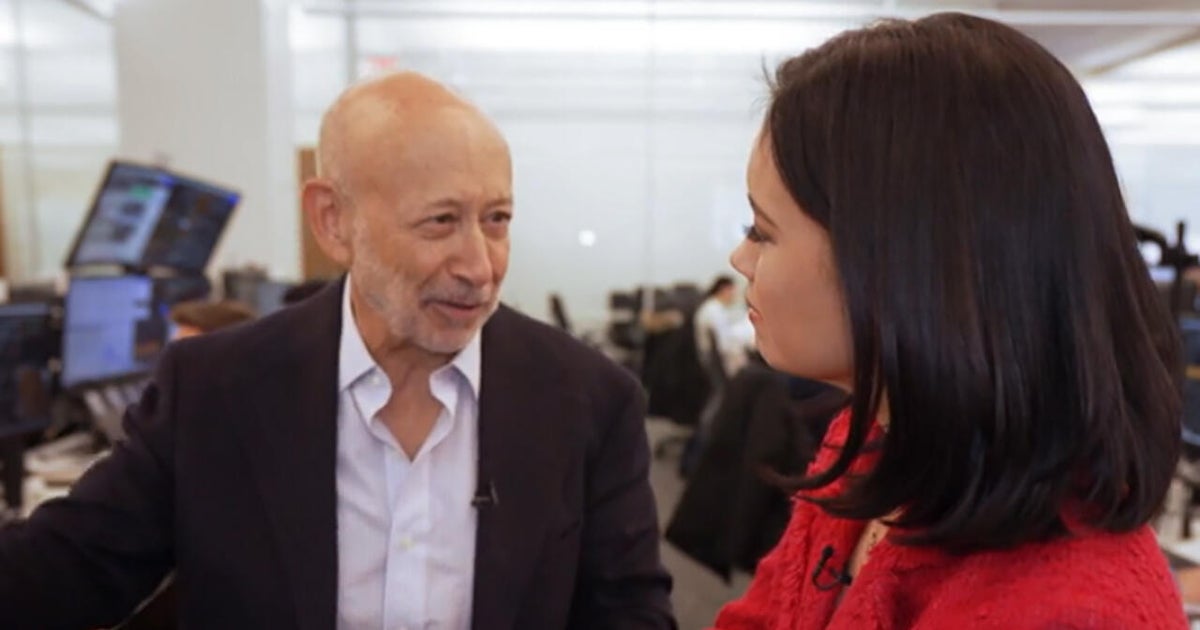
Former Goldman Sachs CEO Lloyd Blankfein talks Wall Street crises, past and future
“It’s been a long time since we’ve had a bad event,” said Lloyd Blankfein. “It’s been 17 years since the financial crisis.” The former CEO of Goldman Sachs, who led the bank through that historic crisis, says it happened before, so it’ll happen again.
“Think of it as kindling on the floor of a forest,” he said. “Eventually, some spark will happen that in different times might not have set the forest on fire, but when this kind of kindling accumulates, some spark will do that. Will that happen eventually? Inevitably, it will happen.”
What was not inevitable was the Bronx-born, Brooklyn-bred billionaire’s path to the top of the C-Suite.
Blankfein grew up in public housing in the Brooklyn neighborhood of East New York, in a small apartment shared with his grandmother. “I shared a bedroom with either my sister or my grandmother until I went off to college,” he said. “The neighborhood became more dangerous. The high school I went to eventually was shut down as a failing high school, but it was pretty much failing when I was there.”
His father held down two jobs, including as a clerk at the post office. To get a 10-percent bonus, he worked the night shift: “I barely saw him. I wish I had known him better.”
Blankfein says he only visited his father at work once, just before he retired: “Dad was sitting with a row of other guys. And behind him was this huge machine wrapped in plastic. I said, ‘What is that?’ It was an electronic mail sorter that could’ve done his job much faster without any risk of making a mistake. And I looked at that, and it was so sad for me. And I thought to myself, I don’t know if I’ll do something, be the most consequential person in the world, but I didn’t want to do something inconsequential.”
So, he buckled down in school, applied to Harvard, and got in when he was just 16.
Asked what he took from his childhood to being CEO of Goldman Sachs, Blankfein replied, “Every challenge I ever had, I wouldn’t necessarily have volunteered for. But every one that was foisted upon me turned out to be a blessing in some way, because it gave me a different outlook. It made me more resilient.”
CBS News 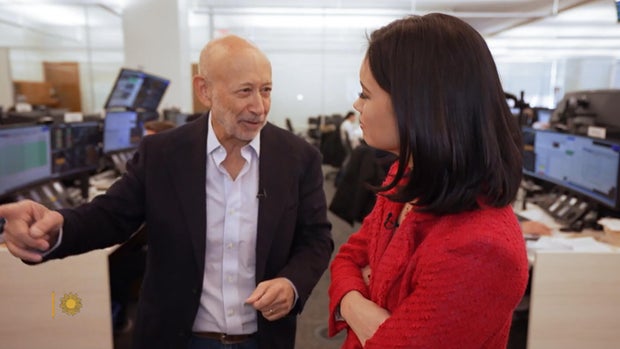
He writes about his experiences in his new memoir, “Streetwise: Getting To and Through Goldman Sachs” (Penguin Press).
His first finance job was in commodities trading. Back then, he says, trading floors were very different. “People communicated by shouting,” he said. “I remember I used to interview people, I used to stand on one side of the trading floor and have the interviewee stand on the other. And I used to make that person do part of the interview shouting across the floor just to see if that person had the voice that could rise to the level that could carry across a trading room. Today, you can hear a pin drop.”
Penguin Press 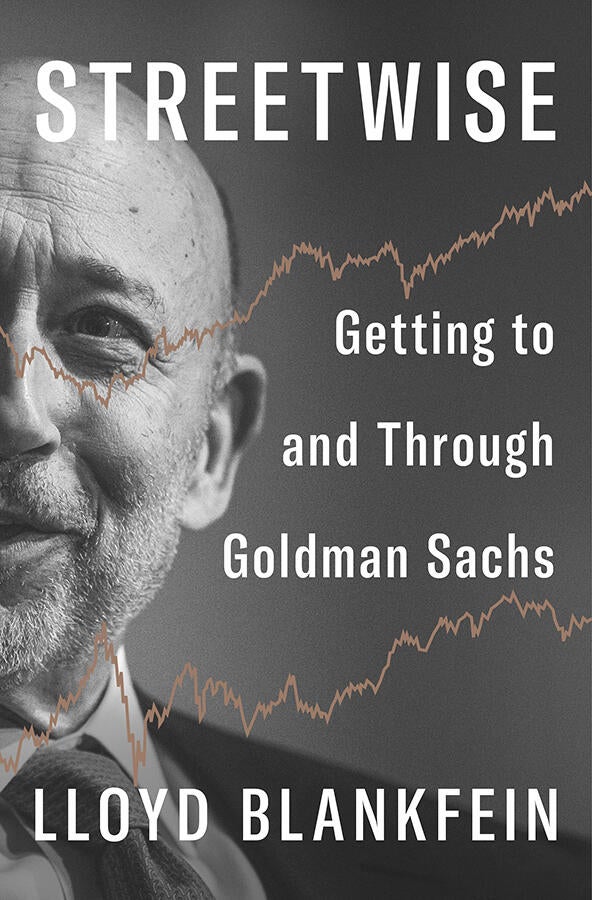
When Goldman Sachs acquired the firm he was working for in 1981, Blankfein began his ascent to the top, becoming the bank’s Chairman and CEO in 2006. It wasn’t long before he was put to the test.
In “Streetwise,” he writes: “No one alive on Wall Street has ever experienced anything as calamitous and dramatic as the global financial crisis of 2007-2008.”
Asked if we are still feeling the effects of that crisis, Blankfein replied, “I think it was regarded as producing unfair outcomes of the system being – I hate to use this overused word – rigged in favor of the higher and mightier, and people with political power. That was the perception.”
The crisis began with financial institutions backing high-risk, sub-prime mortgages, that led to a massive housing bubble which eventually collapsed, bringing with it both banks and consumers.
So, how did the best minds in business and finance not see this coming? “How did Roosevelt leave all those ships tied up together in Pearl Harbor, and not know that the Japanese were on a path to war?” Blankfein said. “Hindsight is 20/20, but the nature of a bubble is that you’re just not seeing it.”
The government intervened in 2008, infusing $250 billion to stabilize the big banks. By contrast, it committed just $46 billion to help families avoid foreclosure.
Blankfein said, “You had to get the banks out of distress so they would perform their intermediation role of getting money out there. But for a lot of people – and I understand this – it wasn’t punishment enough.”
Blankfein was the public face of what was perceived as Wall Street greed in the crisis. In 2010, he and other bank executives got raked over the coals during Congressional hearings investigating what happened.
Sen. Carl Levin: “You are taking a position against the very security that you are selling, and you are not troubled?”
Blankfein: “Senator, again …”
Levin: “And you want people to trust you?”
Blankfein: “Senator, I think people do trust us.”
Levin: “Why would people – I wouldn’t trust you!”
Then in 2016, Goldman Sachs agreed to pay $5 billion as part of a settlement with the Justice Department for misleading investors about the quality of many of the mortgage-backed securities it was selling. “All the institutions settled,” Blankfein said. “Arguing with the government is never a winning proposition. You work to achieve a settlement, that was something that was agreeable to all parties, so that we could all move forward.”
Since leaving Goldman in 2018, Blankfein still buys and sells stocks, just for himself. He was an early investor in The Free Press (which, like CBS News, is owned by Paramount-Skydance). He supports his alma mater, Harvard, where he has given millions: “I think education is the real accelerator for most people into the middle and upper classes,” he said.
In the workforce, though, Blankfein believes programs aimed at increasing diversity do not provide more opportunity. In his book he writes: “Special programs we ran for minorities at the firm were often counterproductive.”
“That may be a provocation to other people. But I think if you brand something a remedial program, you’re kind of also branding the people who go into that program,” he said. “And I think that happens. And I think that becomes counterproductive. But I think there’s another alternative. Just do the stuff. The programs that you do to advance the careers, the education for everybody, do those very well, and guess what? That’ll disproportionately help the people who need it the most, which might include the people that would’ve otherwise been in those DEI programs.”
As for the crisis that will define much of his legacy, does he feel a sense of guilt, or remorse, about what happened?”
“Well, not guilt. I mean, sorrow,” he said. In “Streetwise” he writes, “Losing investors’ money felt worse to me than losing our own.”
“I still feel that way today,” he said. “After I retired from Goldman, a lot of people said, ‘Will you manage my money?’ And I didn’t want that – you know, I shed that responsibility. I didn’t want to have it back again. I didn’t want to disappoint people. Maybe that’s from my childhood or from wherever.”
Asked if he feels a sense of great personal responsibility, Blankfein replied, “I do. I always did. And if you want to call it guilt, you can call it by other names. But I’ve always felt accountable.”
READ AN EXCERPT: “Streetwise” by Lloyd Blankfein
For more info:
Story produced by Wonbo Woo. Editor: George Pozderec.
See more: