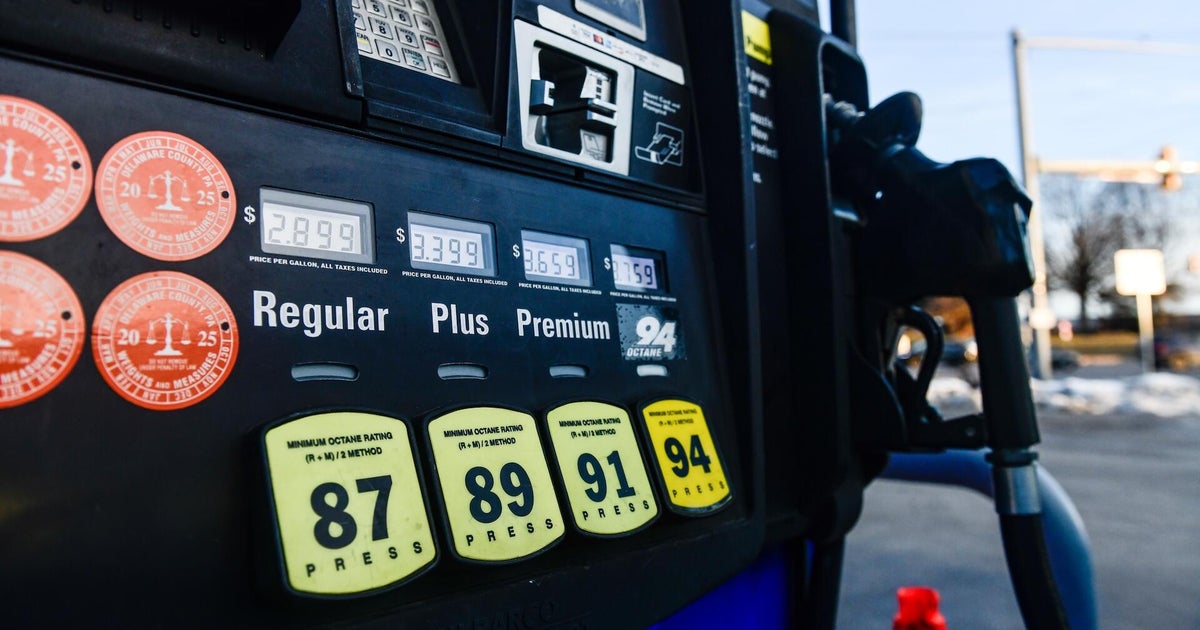
Gas prices edge higher with Brent crude remaining above $100 per barrel
Gasoline prices inched higher on Monday with Brent crude remaining above $100 per barrel, as the Strait of Hormuz, a vital shipping lane for the global energy supply, remains paralyzed amid the Iran war.
The average price for a gallon of gas rose to $3.72 on Monday, up from $3.70 on Sunday and representing an increase of almost 79 cents per gallon from a month earlier, according to data from AAA.
Brent crude, the international benchmark, slipped about 2.4% on Monday to $101.93 per barrel, FactSet data shows. Meanwhile, a barrel of benchmark U.S. crude, West Texas Intermediate, fell 4.1% to $94.62, easing some pressure off the economy after topping $102 earlier in the morning.
Oil prices have been mostly rising sharply from roughly $70 per barrel since the United States and Israel began their attacks on Iran. In response, Iran has hit energy infrastructure in the Persian Gulf area with drones and missiles.
Economic ripples
With traffic through the Strait of Hormuz effectively closed, oil producers are cutting production because their crude has nowhere to go.
The worry in financial markets is that if the Strait remains closed for a long time, it could keep enough oil off the market to drive inflation up to a debilitating level for the global economy.
“Every escalation in the Middle East pushes energy prices higher,” noted Nigel Green, CEO of deVere Group, in a March 13 email. “Energy costs ripple through every layer of the economy. They squeeze businesses, erode consumer spending power and push inflation higher at the same time.”
Stock market bounce
The slight retreat in oil prices on Monday helped bolster Wall Street, with the S&P 500 rising 89 points, or 1.3%, to 6,720.75 in morning trading. The Dow Jones Industrial Average rose 1.2% and the tech-heavy Nasdaq composite jumped 1.5%.
The U.S. stock market has a track record of bouncing back relatively quickly from military conflicts in the Middle East and elsewhere, as long as oil prices don’t stay too high for too long. Many professional investors are expecting that to be the case again this time around.
Escalations have been mounting quickly, but that could suggest “both sides are facing growing constraints that may prevent a long conflict,” according to Paul Christopher, head of global investment strategy at Wells Fargo Investment Institute.
For all its dramatic swings, the S&P 500 is still only about 4% below its all-time high.
Strait of Hormuz
President Trump over the weekend demanded that other countries hurt by the closure of the Strait of Hormuz “take care of that passage” and said his country “will help – A LOT!”
European countries, meanwhile, demanded to know more about Trump’s plans for the war on Iran and when the conflict might end as they weighed his demand.
On Monday, CBS News’ Nancy Cordes asked White House Press Secretary Karoline Leavitt why other countries should answer Mr. Trump’s call to help safeguard ships in the Strait of Hormuz, given that they weren’t consulted on or involved in the U.S. and Israeli strikes on Iran that sparked the ongoing war.
“Because these other countries are benefiting greatly from the United States military taking out the threat of Iran,” Leavitt responded. “The rogue Iranian regime has long not just posed a threat to the United States of America, but of course, to our Gulf and Arab partners in the region. So, these countries are absolutely benefiting from ensuring that Iran can never obtain a nuclear weapon. This is something not just the United States, but the entire Western world has agreed with for many, many years.”
Leavitt did not reveal what plans the White House might be formulating to address Iran’s threat to shipping in the Strait of Hormuz if other countries decide not to help reopen the waterway.