I’ve seen enough – Verstappen is better than Schumacher and Hamilton | F1 | Sport

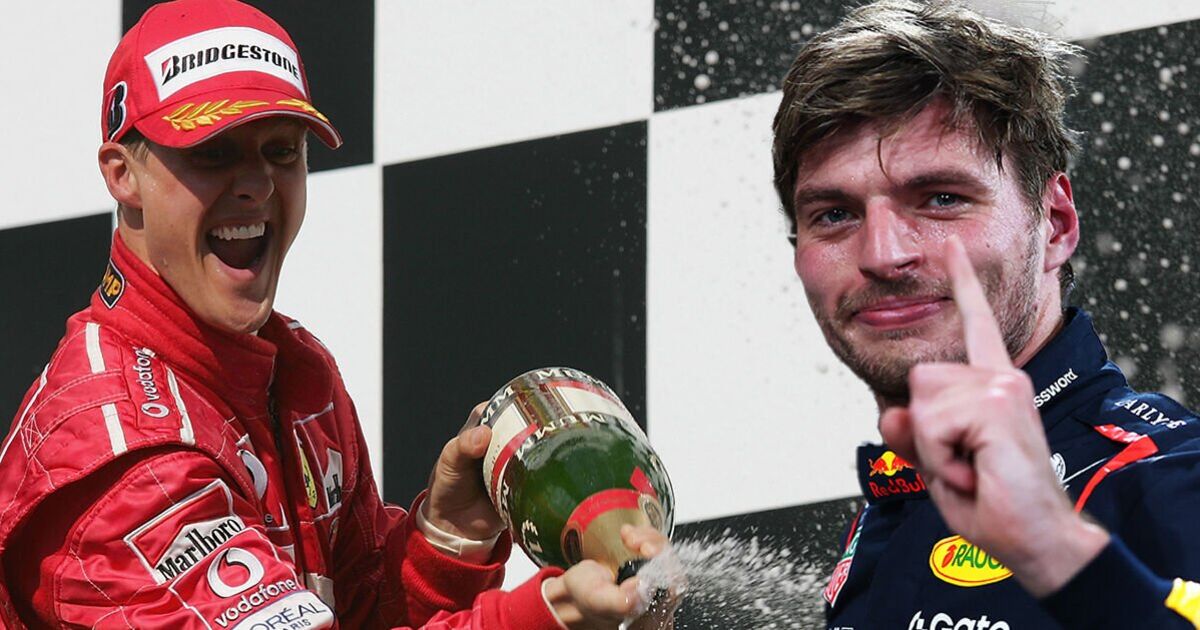
Could Max Verstappen be the best driver in F1 history – even better than Michael Schumacher? (Image: Getty)
Max Verstappen is the greatest F1 driver of the modern era and would beat prime Michael Schumacher and Lewis Hamilton in identical machinery. Comparing drivers between different generations is difficult – Schumacher and Hamilton were both stunning talents who richly deserve their places in F1’s hall of fame.
But Verstappen is on a different level and is probably the most naturally gifted driver since Ayrton Senna. Schumacher and Hamilton, with 91 and 105 wins respectively, each have more victories than Verstappen at 71, but the Dutchman has a far superior ratio over his much shorter career.
The four-time champion has won 30.47% of all the races he has entered, higher than Schumacher’s 29.64% and Hamilton’s 27.63%. If Red Bull delivers a good enough car over the next couple of seasons, Verstappen could surpass Hamilton’s record by the end of 2028.
Likewise, Verstappen picked up four world titles with a higher race-win percentage (59%) than any driver in F1 history, surpassing Juan Manuel Fangio’s 57% and ahead of both Hamilton (54%) and Schumacher (46%).
But stats alone aren’t enough to explain Verstappen’s genius and his biggest edge behind the wheel – namely, his ability to do the business when a car isn’t performing.
Due to the massive development and lottery around new rule changes, not every top driver will always have the best car. But the best find a way to take a poor-performing car and elevate it to a podium finisher or race winner.
Ayrton Senna did it for Toleman back at Monaco in 1984, knocking on the door of his debut win before a late race red flag. Sebastian Vettel took a shock pole and win in Italy in 2008 behind the wheel of a Toro Rosso, with Gilles Villeneuve picking up victory at the 1981 Spanish Grand Prix after holding off four faster cars.
Schumacher was one of those, impressing on his F1 debut by qualifying P7 in a Jordan at the 1991 Belgian Grand Prix. The German went on to build Ferrari around his own image after joining the Scuderia in 1996 following his two title-winning seasons at Benetton. Schumacher came close on several occasions but found the winning formula in 2000, picking up five straight drivers’ crowns until 2004.

Lewis Hamilton struggled at Mercedes after his dominant run came to an end (Image: Getty)

Max Verstappen almost snatched the 2025 F1 crown right at the death (Image: Getty)
But in 2005, Schumacher struggled to compete with a much better Renault package in the hands of Fernando Alonso. The Spaniard secured the championship with two races to spare.
A year later, the Ferrari was more competitive, and Schumacher did fight for the title, but a series of uncharacteristic errors in Australia, Monaco, Hungary and Turkey cost him a chance at an eighth crown.
The same devastating problem affected Hamilton in the ground effect era, as he was beaten by team-mate George Russell in 2022 and 2024. Max Verstappen had his own dominant run, securing four titles back-to-back, including an absolutely dominant 2023 campaign.
But did Verstappen stumble after his own fall from the top as McLaren stamped its authority as leaders? No, he did the opposite and got even better.
Last year, we saw Max Verstappen at his absolute best, delivering performances that were well beyond the Red Bull tools at his disposal.
Unlike Schumacher in 2006, for most of last year, Verstappen never had a right to fight for the title and wasn’t actively in the fight until the last handful of races.

Michael Schumacher was unable to muster his best in 2006 (Image: Getty)
McLaren may have self-destructed at times, while Red Bull picked up form after the Italian Grand Prix thanks to a new floor upgrade that corrected the car’s balance issues.
But take nothing away from Verstappen’s unrelenting pressure, which surely played a role in unsettling Norris and Oscar Piastri at season’s close.
Norris’s title win means that Verstappen’s incredible 2025 run, from a 104-point deficit to a last-race decider, will probably be forgotten. The history books are only there for the winners after all.
He might not have the drivers’ trophy, but 2025 was Max Verstappen’s year, and the season he finally proved he is F1’s modern great.