Key gold update as price ‘pulls back’ in Iran war | Personal Finance | Finance

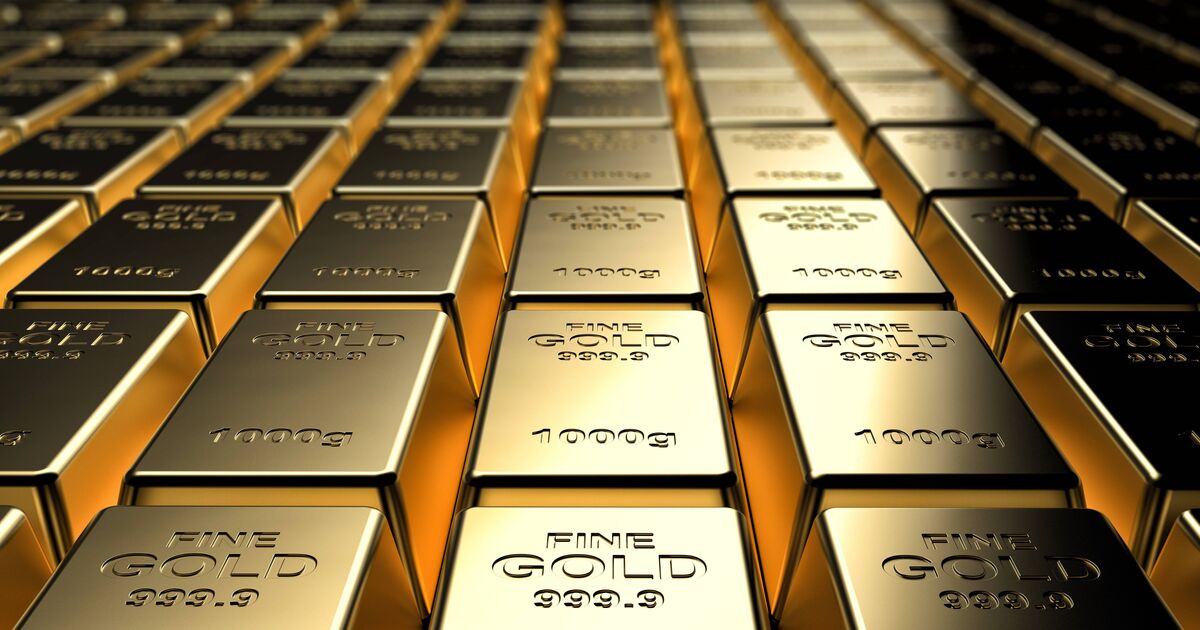
Gold is often seen as the safe bet in tricky times (Image: efks via Getty Images)
The price of gold remains steady amid the Iran war despite predictions it would spike during conflict, with experts saying it “remains the ultimate tail-risk insurance for any portfolio”. Gold’s behaviour during the Iran conflict has left many investors scratching their heads, with the traditional “safe haven” asset failing to surge in a straight line despite rising geopolitical tension.
After briefly spiking to over $5,360 per ounce as the conflict escalated, the price of gold has since pulled back and stayed steady around $4,700 – many experts had expected it to push towards $6,000. While gold is often seen as a go-to asset in times of crisis, experts say the current environment is being shaped by a mix of competing forces – from a stronger US dollar and rising inflation, to shifting expectations around interest rates.
That has created a more volatile and less predictable pattern than many expected, with gold looking steady rather than reacting to headlines. Despite the recent fluctuations, the longer-term outlook for gold remains positive, with central bank demand, global debt levels and ongoing geopolitical instability continuing to underpin its appeal, experts say.
Analysts are warning that investors should avoid simplistic assumptions about how gold behaves during periods of uncertainty, with short-term pullbacks seen as part of a broader cycle rather than a sign the market is weakening.
Cameron Parry, CEO at gold savings account TallyMoney, said he expected the price of gold to “ebb and flow as it always does, albeit in an upward trajectory”.
He added: “Gold has remained steady during this conflict as the gold price had already increased during the pre-conflict build up. The war created an initial extra push into safe-haven assets, in turn pushing gold briefly to around $5,400 an ounce, but that pulled back a little as panic faded and other market forces rebalanced themselves.

Gold hasn’t reached the heights predicted (Image: ValentynVolkov via Getty Images)
“A stronger US dollar, delayed expectations for interest rate cuts and some profit-taking after gold’s strong years-long run have all helped keep gold steady as geopolitical risk and uncertainty reigns. In my view, the current gold price just reinforces the critical role gold plays. Gold is functional and reliable during war and during peace.
“It is a continual counter to inflation and currency debasement. Over the coming weeks and months, I would expect the gold price to ebb and flow as it always does, albeit in an upward trajectory. Fast or slow, the rise is not a trend, it’s the norm since the turn of the century.”
Paul Denley, CEO at London-based Oakham Wealth Management, said gold “often helps in a storm”.
He added: “Gold has surged in recent years reflecting growing geopolitical uncertainty. However, although the gold price is often associated with fear and risk-aversion, it also competes with income. Rising oil prices have rekindled inflation concerns, pushing real yields higher and strengthening the US dollar. In that environment, a non-yielding asset inevitably loses some of its shine.
“There is also a mechanical element. Periods of stress tighten liquidity, and when investors need cash to meet margin calls or rebalance portfolios, they often sell what they can, not necessarily what they want. Gold becomes the market’s cash machine. Yet the broader case remains intact.
“Central banks continue to accumulate reserves, global debt levels are elevated, and geopolitical fault lines show no sign of narrowing. Gold is best understood as portfolio ballast. It rarely drives returns in calm waters, but it often helps in a storm, and with JPMorgan targeting $6,300 per ounce by year end, the storm may not yet have passed.”
Tony Redondo, founder at Newquay-based Cosmos Currency Exchange, said “gold remains the ultimate tail-risk insurance for any portfolio”.
He added: “Gold is acting as a ‘release valve’ for market stress rather than a direct beneficiary of it. Historic bull runs like the 1970s regularly saw sharp pullbacks of up to 20% before the most significant gains, so the current correction from January’s all-time high above $5,300 to below $4,700 per ounce represents price indigestion, not a broken thesis.
“The paradox of gold falling amid geopolitical conflict stems from the dollar’s dominance as the primary safe haven, alongside forced institutional liquidations to cover losses elsewhere. Rising oil prices have spiked bond yields, increasing the opportunity cost of holding non-yielding bullion.
“Despite this, the structural bull case remains intact with central bank diversification and long-term debt concerns keeping analysts eyeing a return to $5,000 and beyond. Short-term volatility will persist, but gold remains the ultimate tail-risk insurance for any portfolio navigating an increasingly fractured global economy.”
Anita Wright, Chartered Financial Planner at Ribble Wealth Management, said short-term pullbacks were normal for gold.
She added: “The idea that gold ‘should rise’ during geopolitical conflict is too simplistic. Gold is not merely a crisis hedge, it is a barometer of monetary confidence. In the early phase of a geopolitical shock, you often see a dash for liquidity, strength in the dollar and temporary pressure on gold as leveraged positions are unwound.
“Short-term pullbacks are entirely consistent with a market that has already moved strongly and is consolidating before its next leg higher. Gold still has a clear role, but it needs to be understood properly. It is not there to generate income or track equities, it is there as a form of monetary insurance. In a world where debt levels are elevated and confidence in fiat currencies is increasingly questioned, that role arguably becomes more important, not less.
“Gold should be used as a diversifier and a hedge against monetary instability. Allocations need to be measured and purposeful rather than reactive to short-term headlines.”
Samuel Mather-Holgate, MD and IFA at Swindon-based Mather and Murray Financial, said Donald Trump‘s presidency had contributed to the price of gold rising.
He added: “The recent movements in the price of gold are complex. As a source of caution in an uncertain world, it is understandable that its value went up during Donald Trump’s presidency. However, it entered bubble territory through momentum trades and when it came off its peak many investors took profits causing it to slide back more than in a normal cycle.
“Trump is still unpredictable so investors may see the upside in the gold metal, but as it is still priced much higher than just one year ago this might be baked in to its current position.”
Nick Cawley, analyst at Solomon Global, said he expected gold to recover to $5,000 per ounce.
He added: “Gold continues to be in recovery mode after the January to March 2026 sharp sell-off. Looking at the weekly gold chart, the strong bounce from the recent $4,100 per ounce low gives reason to believe that this year’s low has already been reached. Inflation will remain a short to medium-term worry and cannot be ignored.
“Central banks will start to tighten monetary policy over the coming weeks, but, as long as markets can see that this is a short-term situation, with rates falling at the end of this year onwards, then traditional gold headwinds will be mild.
“The next level of importance for gold is $5,000 per ounce, more as a psychological barrier than a true technical level of resistance. A confirmed break above here over the coming weeks will see gold reset its sights on the end-of-January all-time high. This time last year, gold was trading just under $3,000 per ounce.”
Ray Palmer, director at Suros Capital, advised people not to chase gold or expect it to shoot up in times of war.
He added: “Gold hasn’t stopped being a safe haven, but it’s just not a panic button you press and watch go up straight away. Right now, the market’s more worried about fundamentals such as interest rates, cash flow and the dollar than the war itself.
“When money’s tight, people sell what they can and gold is easy to sell. It doesn’t mean it’s lost its role but more that it’s being used as liquidity. The price of gold doesn’t move neatly with the news. Put simply, gold often looks disappointing when things are uncertain but functioning.
“When it really earns its keep is when things are breaking or being fixed with cheap money. My strategy advice is not to chase it, and don’t expect fireworks every time there’s trouble. Hold a sensible amount, sit on it and let it do its job as both a store of wealth and to leverage if necessary.”