Nightmare for Putin as Orbán concedes Hungarian election after 16 years in power | World | News
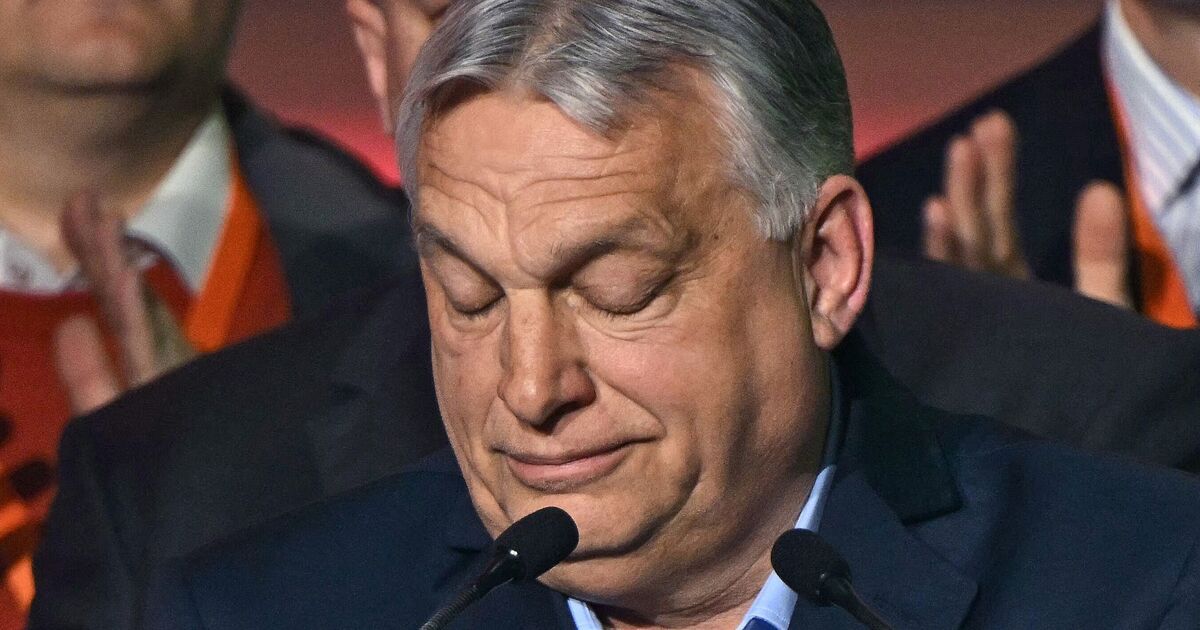
Putin and Trump ally Prime Minister Viktor Orbán has conceded election defeat in Hungary after 16 years in power. The Hungarian PM has congratulated his rival Péter Magyar, who is on course to win Hungary’s parliamentary elections. Held on Sunday, April 12, a record 77% of Hungarians turned out to vote in what is seen as one of the most significant elections for the European Union.
Preliminary results project Magyar’s Tisza party winning 137 seats in Hungary’s 199-member parliament. This signals a clear victory for Magyar and an end to Orbán’s 16-year rule famous internationally for illiberal policies that have curtailed democratic rights, strengthened ties with Russia, and led to frequent vetoes of EU decisions, including financial aid to Ukraine.
Although the results are not yet final, Orbán has already conceded defeat following what he described as a “painful” outcome.
“I congratulated the victorious party,” Orbán told supporters in Budapest. “We are going to serve the Hungarian nation and our homeland from the opposition as well.” Just minutes before Orbán’s speech, Magyar also posted on Facebook, confirming he had received congratulations from his rival.
The Hungarian election system is very complicated with most voters casting two votes in separate voting systems. It will likely take days or even weeks even to get the final results.
But some leaders have already congratulated to the newly-elected prime minister, with Emmanuel Macron posting on X that “France salutes a victory of democratic participation, of the Hungarian people’s attachment to the values of the European Union, and for Hungary in Europe.”
Silence still remains from Donald Trump, who endorsed Orbán and hailed him as a model for the rest of Europe.
The strongest congratulations, however, came from the streets. Reporters on the ground have described the euphory in Tisza’s headquarters and on the banks of the Danube in Hungary’s capital Budapest.
András Petöcz, a writer and poet, told CNN the feeling reminded him of being in Budapest in 1989 “when the Communist regime collapsed.”
As of early 2026, Péter Magyar has been considered the main opposition challenger to Prime Minister Viktor Orbán. He is currently the president of the Tisza Party (Respect and Freedom) and a member of the European Parliament, having surged in popularity after breaking from the inner circles of the ruling elite.
“He has built an opposition movement at amazing speed,” said Gábor Győri of Policy Solutions, a Budapest-based political research institute. “Never, since the history of this post-transition Hungary, have we seen a party rise this quickly.”
Magyar is often described as conservative liberal, with some aspects of his political views actually similar to his predecessor. But bringing fresh air into Hungarian politics, his Tisza party is promising a comprehensive transformation of Hungarian society, focused on anti-corruption, economic reform, and Western alignment. It also wants to root out Russian influence across the government, raise defence spending, invest in Hungary’s army, and review defence industry contracts for corruption.
According to the broadly pro-government media platform Magyar Hírlap, Tisza could win as much as two thirds of the seats in the parliament, giving the party a powerful constitutional majority. A minimum of two thirds, or 133 of the parliament’s 199 seats, is what Tisza is hoping for. In case of supermajority, Magyar’s party could amend the constitution and begin to dramatically change Hungary’s political landscape.
It’s the same power used extensively by Viktor Orbán’s Fidesz party for four consecutive election cycles. If Orbán decides to use this power for one last time to pass last-minute laws that would make it fiddicult for any government to cut past policies, Magyar might face practical obstacles in achieving those goals.
Still, this is a huge victory for a centre-right party only founded two years ago and a serious blow to national populists across Europe.