Russia: Eight days of rape, beatings & mock executions in Putin’s brutal Ukraine prison | World | News

Oleh Buratyn is a fearless investigative journalist from Kakhovka (Image: Oleh Buratyn)
Oleh Baturyn could hear the shouts of a large group of angry protesters from the open window of the room where he was being held captive. It was March 13, 2022, just weeks after Vladimir Putin had ordered his full-scale invasion of Ukraine.
Demonstrators had gathered outside the regional administration building in Kherson – a port city in southern Ukraine that had quickly fallen to the Kremlin’s army – and were chanting “Putin is a d***head”, as well as demanding the withdrawal of Russian troops from their country. All of a sudden, he was overcome with an uncontrollable urge to run towards the window and jump.
At the time, he was being interrogated by a young Russian FSB officer on the second floor of the building, blindfolded, handcuffed and tired after a sleepless night in a freezing police cell.

Russian soldiers patrol streets in occupied Ukraine (Image: Getty)
“The new rulers clearly told me that they were sentencing me to death,” he told the Express, explaining his impulse to end it all. “I was scared. I didn’t understand – When will this happen? How are they going to kill me? I had a feeling of such chaos in my head.
“And then these sounds [from the protest] evoked some new and very, very strong emotion in me. I had the feeling the entire rage and hatred that the protesters directed at the Russians would compress the air and turn it into stone. It was just an ocean of aggression.”
The crowd’s fury rattled his interrogator, who couldn’t understand why people were protesting against those who had “come to free them”.
Arrest and an audience with Vladimir Leontiev
His nightmare started a little under 24 hours before, on Saturday, March 12, when he was seized by soldiers from Russia‘s National Guard after being lured into a trap.
Oleh – a fearless investigative journalist with over 25 years of experience – had received a call from the army veteran and blogger Serhiy Tsygipa, who said he urgently needed to see him. The two agreed to meet at 5pm at the bus station in Oleh’s home town of Kakhovka.
As a precaution, Oleh made sure to leave his mobile phone and documents at home before setting off for his rendezvous – a decision that probably saved both his life and the lives of the contacts the Russians could have reached with the help of his phone.
When he arrived at the bus station, there was no sign of Tsygipa. Preparing to go back home, Oleh suddenly heard a van door slam and the sound of people running towards him.

Vladimir Leontiev liked to take part in WW2 recontructions (Image: Oleh Buratyn)
Within seconds, he was surrounded by Russian soldiers, who handcuffed him and threw him into the van, before taking him to the City Hall in Nova Kakhovka
There he was interrogated by Vladimir Leontiev – the recently appointed Russian mayor of the city – and Valentin Matuzhenko – a fighter from the pro-Kremlin DNR militia.
The previous day, Oleh had published an unflattering article about Leontiev, whom he described as a “crook” and who was a relative unknown at that point.
The city’s new administrator was a fan of historical reenactments – particularly of battles fought in World War 2. Oleh had discovered a compromising photo of Leontiev dressed as a Nazi and drinking beer, which was published with the article – a move that clearly infuriated the Russian collaborator.
During the first interrogation, Leontiev threatened to kill Oleh and cut him up into pieces. He was then transferred to the police station along with several anti-Russian protesters at around 7pm, where things began to turn nasty.
Beatings and mock executions
The prisoners were ordered to stand with their arms and legs widely spread in a starfish position against a wall on a slippery floor, and were beaten if they moved “a millimetre”.
“If you moved, they hit you on the legs or on the arms, on the limb of your body which moved,” he explained. The Russians picked on a young man – aged between 18 and 19 years – showing him no mercy as they beat him to a pulp with their rifles.
“He begged for mercy, and they said ‘well, we are now, bitch, sentencing you to execution, and we are going to f*** you up, damn it.’

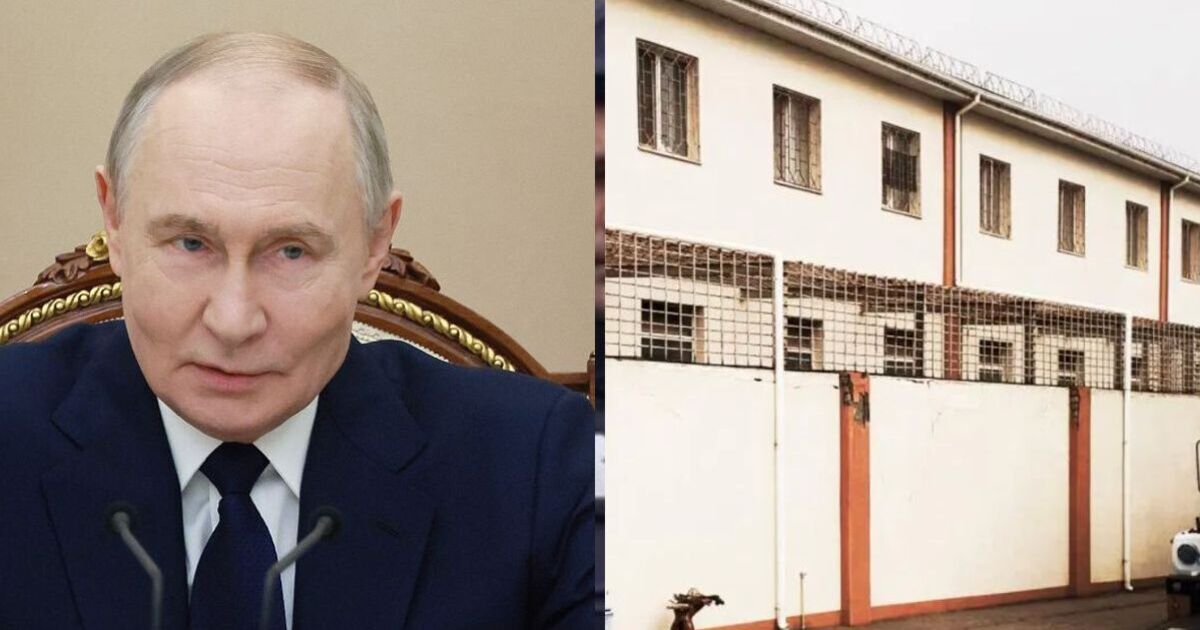
The detention centre on 3 Teploenerhetykiv Street (Image: © 2022 Roman Baklazhov)
“There was a click, but it was a blank shot. It was a heartbreaking scene. Just heartbreaking, because the guy was howling. He didn’t scream, but howled, begging for mercy.
“He started crying hysterically and they just laughed. ‘Well, did you think we would shoot you the first time? Now we will definitely shoot you. The second one will be for sure. So get ready, say goodbye to life.’
“And everything starts all over again. All of this repeats, and the second time is also a blank shot – a click. And they laugh even louder. I thought the young lad was going to go crazy at one point.”
Oleh was also beaten and suffered four broken ribs – his captors furious that he had no mobile phone with him.
Kherson’s brutal ‘isolator’
The next day, he was transferred to Kherson, where he was interrogated by the FSB officer, who wanted details about army veterans, opposition journalists and various local officials – but each time, Oleh kept pleading ignorance.
After being forced at gunpoint to sign a document promising to co-operate with “the federal authorities”, he was taken to a complex of buildings at 3 Teploenerhetykiv Street.
One of more than 20 such places in and around Kherson, it soon became notorious as a key detention and torture facility used by Russian forces during their occupation of the city, which was eventually liberated in November 2022.
Eugen Tereshenko – a prosecutor with the war crimes unit for the Kherson region – estimates that there were 4,000 to 5,000 registered cases of civilians detained during this period, but the actual number may have been much higher.

A cell inside a detention centre in Kherson (Image: Getty)
Oleh was one of the first to be held there and shared a cell with a 60-year-old man. Both were repeatedly interrogated and beaten.
“They constantly kept us hungry. Every day, several times, they came to the cell,” he said. “They beat me with automatic weapons. They beat me with their hands and feet. They mostly beat me, but they didn’t torture me with electricity.”
Oleh could hear the screams of other inmates being abused by their guards, among whom were the feared and brutal Chechen “Kadyrovites”.
In a cell next to his own, the Russians sexually assaulted a woman. “I heard a female voice, and she was being raped,” he recalled. “She cried for a very long time.”
Other inmates included two foreigners – a Spanish charity worker called Mario and a Dutch man who was very ill.
“I heard them beating him [Mario], interrogating him. And I remembered that he was very expressive, like a Spaniard. He constantly shouted to the Russians: ‘Putin is a piece of sh*t’.”
One of the hardest psychological battles to deal with at the beginning was the fear that he would be forgotten by people, and he was completely alone – a sense of insecurity that his gaolers did their utmost to cultivate.
“The Russians constantly said that everyone had forgotten and given up on me. And in those circumstances, it actually has quite a strong effect. Somewhere on the fourth or fifth day, I suddenly remembered that I am a journalist, that I am quite a public person. And that my disappearance would not go unnoticed.
“This realisation somehow calmed me down. I understood that I needed to hold on to this thought. To the fact that I am not alone. Yes, it is hard for me right now. And other people who are in captivity are also having a hard time . When I understood, when I remembered and realised that I am not alone, I felt better and hope returned.”
Freedom and escape
Oleh’s release came out of the blue on March 20 – eight days after his initial capture. He was taken to the outskirts of Kakhovka and walked back home to his family. The Russians said they would be in touch again in the coming days.
Realising he had little time, he organised for his family and himself to escape to Ukraine-held territory – a perilous journey that took four days.
Despite his ordeal, Oleh believes he was one of the lucky ones, given that the Russians had not organised themselves properly and were still refining their brutal system of repression and torture.
“I was very lucky because I was one of the first to be caught,” he said. “If I had been caught after April 1, then it would have been much more difficult for me.
“In March 2022, there was chaos among the Russians. Over time, they organised. They were honing the flywheel of repression on us. Of course, for those people they encounter now, it is much worse.”