Spy novelist David McCloskey admits one major ‘hazard of the trade’ | Books | Entertainment

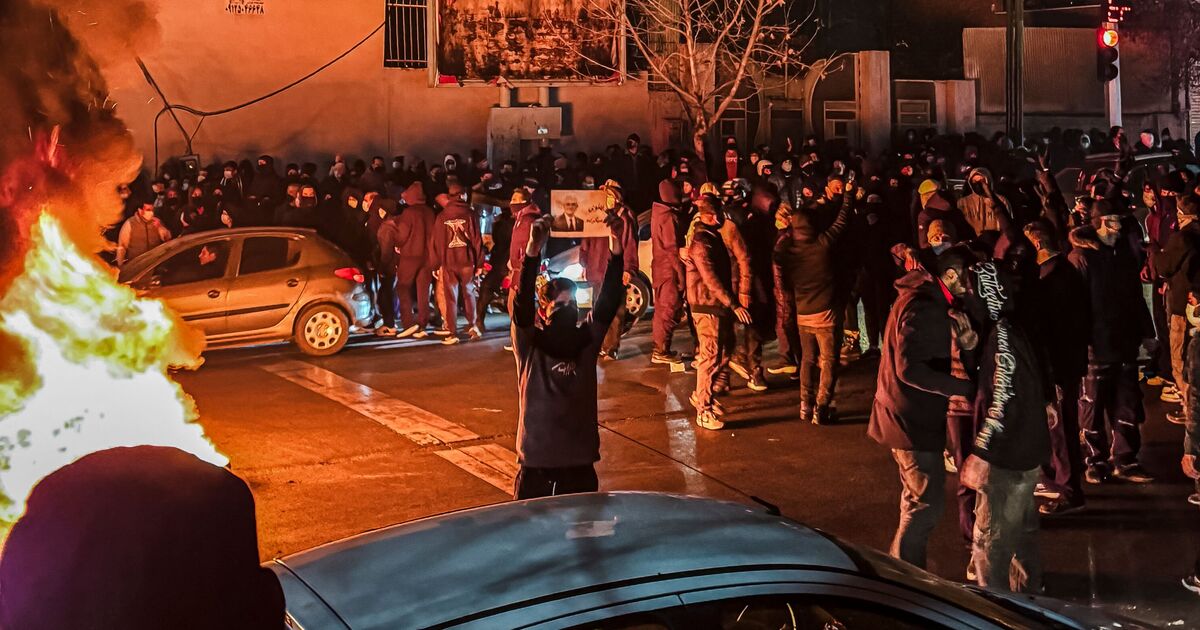
The violent protests in Tehran, Iran, last month almost overtook David’s McCloskey’s new book, The Persian (Image: Middle East Images /AFP via Getty)
Former CIA analyst turned bestselling spy writer David McCloskey is either cursed or blessed to live in interesting times. Arriving in London this month to promote his gripping new novel, The Persian, featuring the “shadow war” between Israel and Iran, there was a moment when it looked like the latter’s brutal theocratic government might be on the verge of collapse following severe anti-regime demonstrations.
Such real-world intrusions into fiction are nothing new for the 40-year-old writer and podcast host whose second novel, 2023’s Moscow X, featuring a deep-cover plot to destabilise the Kremlin, was almost upended firstly by the Ukraine invasion and, again, when Vladimir Putin’s catering boss turned mercenary chief turned on him.
Then, the blowing up of a jet carrying Yevgeny Prigozhin and his co-conspirators ended a short-lived mutiny against the Russian dictator. This time round, a blood-soakedcrackdown which has so far cost the lives of 30,000 protesters, many of them young women, appears to have shored up the autocratic Iranian regime for now.

Spy author McCloskey has to predict changes in world politics when plotting his books (Image: Phil Sharp courtesy of Goalhanger)
“It’s kind of a hazard of the trade these days as a spy novelist,” McCloskey admits. “From the moment you sit down to write a story to the point where it comes out is going to be around two years. So you’re asking, ‘What does the Israel-Iran conflict I’m thinking of now look like in two years?’ In today’sgeopolitical climate, that’s pretty hard. In the span of writing and editing this novel, we had the drone and cruise missilevolley between Israel and Iran. We had the Hezbollah pager bombings. We had Trump striking Iran’s nuclear programme…”
All of which meant numerous adaptations for the Minnesotan-born, Dallas-based father of three, who quit the CIA in 2014 after eight years as an analyst on its Syria desk, coinciding with the country’s horrific civil war.
“I had to adjust to make sure that, when this thing lands on bookshelves, it feels like Iran today,” he continues. “As opposed to a world where, if the Islamic Republic is gone and you crack open this book, it’s harder to imagine.”
Not that he wouldn’t have welcomed success for the Iranian protesters – even if it meantThe Persian, already a UK top-three bestseller, being out of date on arrival!
“I’d take the fall of the Islamic Republic,” he tells me. “Moscow X was already at the printers when Prigozhin did his little mutiny march on Moscow, and I remember waking up that morning, looking at the news and thinking, because I had a scene with Putin, ‘I kind of hope this guy holds on, just for a little!’”
He pauses and adds: “I don’t feel comfortable rooting for Putin – that’s not something I do – so I say that tongue in cheek. But I have had a kind ofironic laugh over the last couple of weeks about what has been going on in Iran.”

McCloskey, pictured as a young CIA analyst, spent eight years working for the Agency (Image: Courtesy David McCloskey)
The clean-cut McCloskey’s brilliant grasp of tradecraft, compelling characters and deliciously addictive plots have launched him into the top-tier of espionage writers since debut novel Damascus Station in 2021, selling 500,000 books in the process. He equates the troubled state of the world with a golden age for spy writers. “Readers are out there saying, ‘OK, if I want to learn something about Iran, maybe a way to dip into this is through a book like The Persian’.” In which case, they’re in for a treat.
As well as shining a light on the shadow war between Iran and Israel, it makes for athrilling read. Its protagonist, Kamran Esfahani, a Jew whose family fled Tehran after the revolution, is working as a dentist in Sweden when he is recruited by Mossad spy chief Arik Glitzman, with the promise of a new life in California.
Readers are aware from the start that Kam has been caught by the Iranians and is being forced to tell the story – written in crayon in between torture sessions – in a series of confessions to Mossad’s nemesis, the General. The latter oversee a unit hunting Israeli agents behind the assassinations. Glitzman, in turn, is trying to find the Quds Force operators before they kill more of his colleagues.
“The elevator pitch for me was a simple what-if?” explains McCloskey. “You look back at the whole string of targeted killings and assassinations in Iran that goes back to 2007, flip that on its head and ask, ‘What if the Iranians had a similar capability inside Israel? What would that cat-and-mouse look like, where the Israelis are trying to figure out who’s doing the killing and go and kill them?’”
Some readers may be disappointed McCloskey’s baseball bat-carrying, beer-guzzling, shotgun-toting and highly unconventional CIA chief Artemis Procter, the standout star of his three previous books, doesn’t appear in what is his first standalone.
“That got too clunky from a storytelling standpoint,” he explains. “As I discussed the idea with Agency friends, they told me, ‘We’re not involved in those kinds of operations. Mossad does that, they don’t tell us about it. We don’t ask questions!’ I had a third of a book written and I threw it away and I think it was a better outcome.”

Iran’s Supreme Leader Ayatollah Ali Khamenei (Image: AP)
It was markedly harder, he admits, than writing about what he knew.
“I found Mossad officers who were willing to talk, but it was harder to get them toopen up if I was trying to test a particular scene or a piece of tradecraft. If I feel like I don’t know the answer and we’re dealing with a CIA character, there’s a huge Rolodex of people I can talk to and it helps shape the authenticity of the novel.
“As a writer, it’s kind of your happy place to go back to a character you know. In the same way that if you’re going to have lunch, it’s easier with a friend, right? In this novel, I had to go out and make those friends as I was writing.” The good news for fans, and McCloskey has many, is that Procter will be returning in his fifth book and – touch wood – a forthcoming TV series. There’s also an Artemis-free film of Moscow X on the way.
If they all fail to materialise, unlikely as it might seem, The Persian would makea great TV drama, opening with the dramatic killing of an Iranian scientist. The scenes are based on the real-life assassination in 2020 of Mohsen Fakhrizadeh, the head of Iran’s nuclear program. “It sounds like science fiction, but it actually happened,” says McCloskey, who co-hosts the hit Goalhanger spy podcast The Rest is Classified with ex-BBC security correspondent Gordon Corera.
“It was a remotely-operated machine gun fired via satellite uplink with some special software that accounted for the communications delay between Israel and Iran and things like the kick-back of the gun – which was hidden in the back of a pick-up truck – and the speed of the target.” The robot killing device was so accurate it shot Fakhrizadeh dead, hitting him at least 13 times, but left his wife sitting next to him in the passenger seat without a scratch.
“I knew I needed an assassination close to the start of the book,” continues McCloskey. “This was another example where the real world was almost unimprovable from the standpoint of a spy novel plot.”

McCloskey’s second critically-acclaimed novel, Moscow X, featured a plot to destabilise The Kremlin (Image: Getty)
Despite this, real life can sometimes be too extraordinary even for fiction. For instance, Operation Grim-Beeper, as it was nicknamed in September 2024, when thousands of pagers used by the Iranian-funded terror group Hezbollah exploded after being intercepted and sabotaged by Israel.
“I told my editor, ‘If I’d put this in a book, you’d have said it was completely unbelievable’. Oftentimes the truth is actually too insane to build into a book.”
With his CIA analyst’s hat on, how does he see events playing out in Iran? While the theocracy remains in power, McCloskey suggests the “pillars of stability” – the things that keep an autocratic regime in power – show severe strain.
“These include the nature of the opposition, divided or unified; the socioeconomic contract with the population; the legitimacy narrative; the foreign environment, and whether that works for or against the stability of the other pillars,” he explains. “The foreign environment has gotten significantly more challenging, they’ve got rampaging inflation and the economy is in tatters, right? So that’s not good.
“The legitimacy narrative is very much eroded and not just by the recent crackdown. A lot of things point toward weakness. But the two most important ones are how cohesive your elites are and how effective and loyal are the military and security services?”
These, he believes, are the hardest to predict. “It comes down to a totally unpredictable network effect of individuals inside the Islamic Revolutionary Guard Corps either changing their minds or not – how 150,000 different humans are behaving to a set of stimuli.

The Persian by David McCloskey is pitch-perfect, utterly gripping and deliciously timely (Image: Swift)
“It could be as simple as, ‘We’re not going to disobey orders but we’re not going to fully enforce orders’ and it’s impossible to predict.”
Despite Donald Trump’s tough rhetoric over Iran, McCloskey believes the US will be reluctant to involve itself given poor outcomes resulting from other interventions, mostnotably in Afghanistan.
“We have a very long track record in the Middle East of our words getting way out in front of our actions,” he sighs. “I also think we’re very good at breaking things in the region, and not very good at encouraging the construction of more positive political outcomes. I think if Trump did anything, it would be purely destructive in intent. That couldlead to a better outcome – but it could also hasten a spiral into a worse one as well.”
Contrary perhaps to reputation, and despite the uncertainties at the top of US politics, McCloskey insists the CIA remains largely apolitical, even post Trump Mk II. “Some agency people tell me it’s business as usual and nothing has changed. Other friends, including some in more senior positions, are like, ‘This is exhausting, it’s just too much’.”
McCloskey’s next book, London Station, features the return of Artemis Procter as CIA chief in the capital. “A role she’s not well suited for,” he adds with a smile. The book imagines arupture in the US-UK intelligence partnership – something a few years ago would have been unthinkable. Given McCloskey’s track record, we might want to brace ourselves for fireworks!
- The Persian by David McCloskey (Swift, £20) is out now. David is co-host with Gordon Corera of The Rest is Classified podcast