The great e-bike crackdown has begun
This is The Stepback, a weekly newsletter breaking down one essential story from the tech world. For more on the e-bike movement, follow Andrew J. Hawkins. The Stepback arrives in our subscribers’ inboxes at 8AM ET. Opt in for The Stepback here.
Last week, I did something I don’t typically do, which is call up one of my elected officials and yell at them about a new bill.
New Jersey’s car-brained lawmakers had just passed legislation that would impose heavy restrictions on e-bike ownership in the state, and I was livid. Obviously there’s been a lot of concern about the growing number of teenagers being injured and killed while riding e-bikes, many of them powerful, high-speed ones that are more akin to motorcycles than bikes. Lawmakers claim they’re just trying to bring some order to what is increasingly becoming a wild, unregulated market.
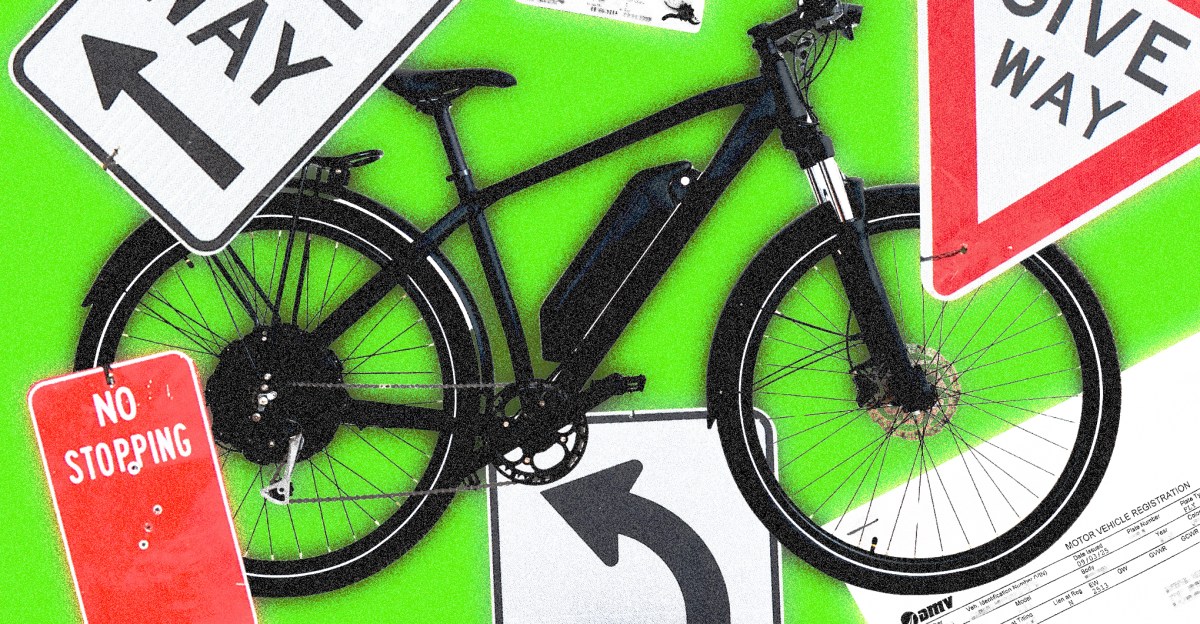
But the bill needlessly lumps together high-powered e-motos with low-speed pedal-assist bikes, often used by food delivery workers or parents who want to take their kids to school without using a car. Forcing someone who owns an e-bike without a throttle that can’t go faster than 20mph to register their bike with the DMV, acquire a license, and buy insurance seems ridiculous on its face, and will absolutely harm efforts to encourage more sustainable transportation modes in the state. And for that reason, I called up my governor and asked him to veto the bill.
Well, he didn’t listen.
Now, New Jerseyeans will be forced to reckon with one of the nation’s most restrictive e-bike laws. Bike advocates are aghast at how this bill sailed through the legislature and was signed into law at the eleventh hour by an outgoing governor. And they worry that other states will follow New Jersey’s lead, given the rising panic around teenagers riding e-bikes.
New York City recently capped e-bike speeds at 15mph, which is painfully slow and robs an e-bike’s ability to outmaneuver multi-ton SUVs and trucks on busy city roads. And now some Manhattan residents are calling for an outright ban on e-bikes in Central Park, citing a handful of collisions between pedestrians and e-bikes. Meanwhile, lawmakers in California have proposed a bill that would ban the sale of e-bikes with motors that exceed 750W of power.
To be sure, lawmakers are certainly getting an earful from their constituents about the proliferation of high-powered, high-speed e-bikes in their communities. Dip into any town’s Facebook group, and you’re likely to find a lot of pearl-clutching about teenagers riding e-bikes. And often their concerns are warranted, given the increasing rate of injuries and fatalities related to e-bikes. This is a problem that’s solvable with better infrastructure and more safety education, both for parents and their kids.
But when these complaints result in disastrous legislation, like in New Jersey, it adversely affects the broader community of people who want to use a low-cost, environmentally friendly mode of transportation to replace car trips — teens included. Multiple studies have shown that e-bikes are ridden more often than traditional bikes, and are typically used to replace car trips, which results in lower carbon emissions and cleaner, healthier communities. But rather than support and promote this mode of transportation by building bike lanes to protect riders, lawmakers are becoming more reactionary, which fails to address the real safety issues that contribute to the rising number of fatalities and injuries on our roadways: cars.
Bike advocates are scrambling to fix the glaring problems with New Jersey’s e-bike law, hoping to redirect the energy toward stricter rules around kids and e-motos. Their success is no guarantee.
But in the meantime, misinformation about e-bikes is proliferating online. My colleagues at the Montclair Bike Bus are being inundated with negative comments from people illogically equating all e-bikes with death and danger, failing to grasp the enormous difference between a 40mph electric dirt bike and a throttleless pedal assist bike that maxes out at 20mph.
None of this is surprising. In a country as car dependent as the US, we sometimes fail to grasp the need to promote better, more sustainable modes of transportation, instead of just working within the same, broken, car-centric system. There are many names for this phenomenon — windshield bias, car brain, motonormativity — the view that all decisions should be in service of the automobile. Lawmakers are especially prone to these biases.
It’s true that some e-bikes are a menace, just like some cars. But treating all e-bikes as the same, regardless of power capabilities and speed, fails to account for the enormous potential of e-bikes. I can’t help but think that e-bikes are victims of their own success. I’ve seen nasty comments from drivers annoyed about having to slow down for an immigrant delivery worker or a mom with her kids on a cargo bike, or about a new bike lane in their town. E-bikes are just as polarizing as they are popular, so maybe it was inevitable that car drivers, who can’t countenance any delay, no matter how slight, would strike back.
- One of the strangest aspects of New Jersey’s new law is that it completely abandons the three-class system that exists for e-bikes. Class 1 is pedal-assist with no throttle. Class 2 is throttle-assisted with a maximum speed of 20mph. And Class 3 is pedal-assist only, no throttle, with a maximum speed of 28mph. New Jersey really said “Screw it, we’re calling them all e-motos” and left it at that.
- Safety advocates point to Connecticut as a state that got it right. Last year, the state passed a law that requires riders of e-bikes without pedals and equipped with batteries over 750W to obtain a driver’s license to operate them. More powerful e-bikes with batteries over 3,500W capable of speeds from 35mph to over 50mph will require registration and insurance, similar to motorcycles. And low-speed pedal-assist e-bikes were left alone.
- Electrek’s Micah Toll has an interesting take on the uselessness of trying to regulate e-bikes based on motor wattage. Companies will just fudge the numbers.
- This piece in the Daily Kos offers a good summary of where e-bike and e-moto regulations are across the US.
- Last year, I wrote this piece celebrating electric cargo bikes and how these incredibly useful bikes helped us start a bike bus in our town.