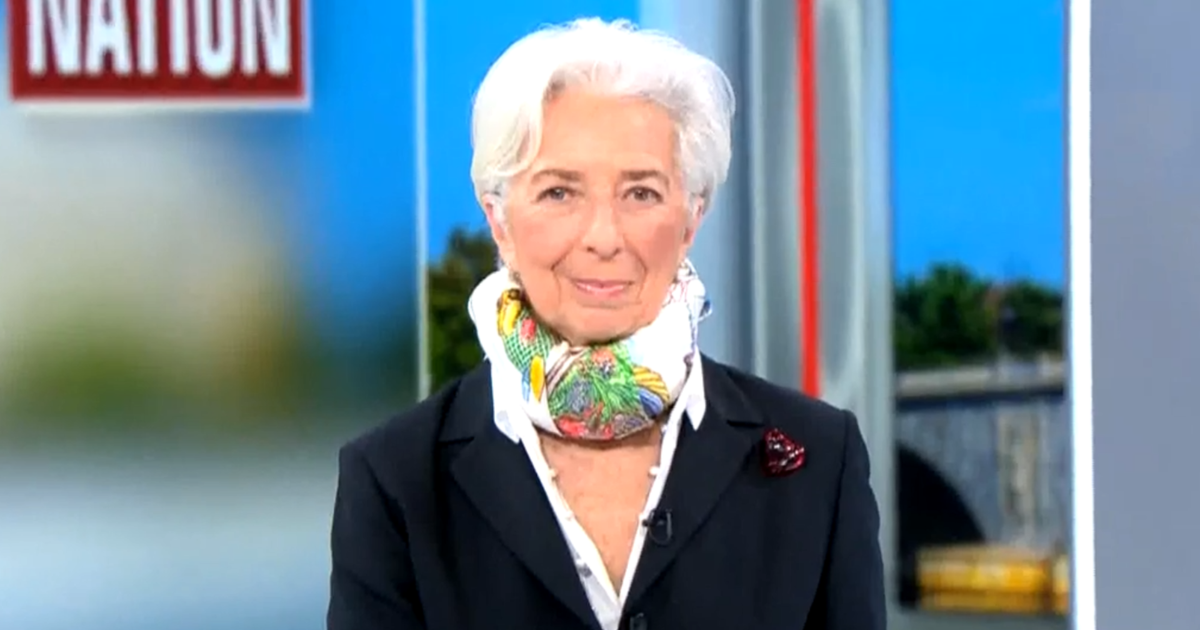
Transcript: Christine Lagarde, European Central Bank president, on “Face the Nation with Margaret Brennan,” Feb. 22, 2026
The following is the transcript of the interview with Christine Lagarde, European Central Bank president, that aired on “Face the Nation with Margaret Brennan” on Feb. 22, 2026.
MARGARET BRENNAN: Welcome back to ‘Face The Nation.’ We’re joined now by the head of the European Central Bank, Christine Lagarde. The ECB sets interest rates for many countries in the European Union, which is America’s largest trading partner. It’s great to have you here.
CHRISTINE LAGARDE: Great to be here, Margaret.
MARGARET BRENNAN: Well, particularly in this moment in time where there is confusion over what happens next with global trade. I saw that the Chancellor of Germany, Germany is the biggest economy in Europe, he came out and said, tariffs harm everyone, the biggest poison for the economies of Europe and the U.S. is this uncertainty about tariffs. Did you hear and get any clarity from Ambassador Greer about what’s going to happen next?
CHRISTINE LAGARDE: I’m not so sure. And I tell you, I think it’s, it’s critically important that all people in the trade, both outside of the United States, but also in the United States, have clarity about the future of the relationships. Because, you know, it’s a bit like driving. You want to know the rules of the road before you- you get in the car. It’s the same with trade. It’s the same with investment. You want to know what the rules are, and you want to avoid having to, you know, come back and claim tariffs back. Because this is just not the purpose of people doing business. They want to do business. They don’t want to go into legal suit- legal lawsuits. So I hope it’s going to be clarified, and it’s going to be sufficiently thought through, so that we don’t have, again, more challenges, and the proposals will be in compliance with the constitution, in compliance with the law.
MARGARET BRENNAN: Well, what you just said sounded very similar to what one of the justices raised, I think, it was Justice Gorsuch saying, like, that’s why there is the call to put things in law so that there is clarity for planning ahead. I didn’t hear Ambassador Greer say with any certainty that they’re going to try to put any of these things in law, just use existing regulations, is what I under- heard him what I heard him say. But he did seem certain that the existing trade deals will hold. The EU and the US do have an agreement, 15% tariff ceiling in a recent trade deal. But there’s an emergency meeting about all this tomorrow. Do you see that as disruptive that this could be in jeopardy in fact?
CHRISTINE LAGARDE: I’m no longer trade minister. I used to be. So I don’t know what the outcome of those meetings will be, but it’s not as if it was sort of straightforward 15% across the board. There are also exemptions, there are carve outs, there are areas for which there is no tariffs. So I think if it shakes the whole equilibrium which people in the trade had got used to because they continued trading after the April decisions and the July trade arrangement between the U.S. and Europe, but to sort of shake it up again is going to bring about disruptions in the business for sure.
MARGARET BRENNAN: Well, when you were last year in October, and I asked you about the impact of the tariffs, you said the global economy had not yet felt the pain. Did we avoid that pain? Did the consumer avoid the pain?
CHRISTINE LAGARDE: I don’t think the consumers avoided the pain. And I think that there are many studies that are being completed now to determine what is the impact and where is the burden of tariffs. And I think that while some some exporters have borne some of the brunt, most of it was borne by the U.S. importers and eventually, the U.S. consumers, because the U.S. importers have squeeze their margins a bit to absorb some of these additional cost due to tariffs. But there is a point where you don’t squeeze your margins so much, and you have to pass it on to the consumers. I think this is what we are. We are beginning to see, and, you know, multiple studies and very serious people are looking into this. We are trying to look at the data ourselves to make sure what impact it has on trade and on our economies. And this is a continuous process which is clearly going to be a bit disrupted by the current development.
MARGARET BRENNAN: I want to ask you about, as a central banker, your thoughts on some of the populism we’re seeing right now. You took a lead role in defending Chair Powell, Jerome Powell, here in the United States after President Trump’s Justice Department launched an investigation into him. You said it was critical to preserve the independence of central banks with full respect for the rule of law and democratic accountability. We know Powell is set to be replaced in May by Kevin Warsh, someone you also know from your time as trade minister. Do you believe that he personally can resist political pressure from the President?
CHRISTINE LAGARDE: First of all, I have enormous respect, as you know, for Powell, for Kevin Warsh and for fed chairs in the past, and I’m very proud to receive an award tomorrow in the name of Paul Volcker. You know, for monetary policy, the rule of law is critically important, and the independence of a central bank is critically important. We have seen in history, we have seen in literature, we have seen in, just, anything that analyzes the activity of a central bank, be it the Fed, be it the ECB, that the independence matters a lot. Why is that? Because you don’t want someone who sets interest rates, who has in charge price stability and financial stability, you don’t want that person to be under political influence. And the decisions that we make generally do not impact right away. They produce an effect 6, 12, 18 months, sometimes two years down the road. In the meantime, the political life continues, and we have to be, in a way, immune to that. That’s why many central bankers around the world signed this support to central bank independence as applied to Chair Powell.
MARGARET BRENNAN It was an incredible statement, because usually bankers want to stay out of that spotlight, but you see a real risk here. And- and there is concern about this populist wave, even in France, the far right could win the French election next year. I have to ask you about these reports that you might be leaving the ECB early because of, basically, an insurance policy to allow for the French president to select a successor, rather than potentially a far right leader helping to select a head.
CHRISTINE LAGARDE: I’m riveted to a mission, and my mission is price stability, financial stability. I want the euro, which we are custodian of, to be strong and fit for the future. I think we’ve achieved a lot. Inflation is at target, growth is okay, not brilliant, but resilient, 1.5%, and unemployment is at the lowest level ever. But we need to consolidate all that. And my baseline is that it will take until the end of my term. And electors in any country in the world make their choices, and those choices have to be respected.
MARGARET BRENNAN: So, no- we are not answering on the leaving early, but you think- it sounds like it will take more work till the end of your eight year term–
CHRISTINE LAGARDE: I’m not done.
MARGARET BRENNAN: Very quickly before I let you go. How challenging is it to keep leverage when Russia and China are trying to avoid European sanctions and American sanctions by using their own currency? Is the West losing its leverage as we look towards this war in Ukraine?
CHRISTINE LAGARDE: I think our responsibility is to make sure that our currencies are strong, that our payment systems are strong and independent, and this is certainly something that we are going to continue doing for the reasons that you’ve mentioned.
MARGARET BRENNAN: Christine Lagarde, thank you very much for your time this morning. We’ll be right back.