Trump makes his case for Iran war, saying it will end ‘shortly’ but more strikes are ahead
President Donald Trump hailed the U.S. military’s “unstoppable” prowess in the war with Iran, telling Americans in a prime-time address Wednesday night that the conflict, now entering its second month, will end “shortly” without offering a definite timeline.
Subscribe to read this story ad-free
Get unlimited access to ad-free articles and exclusive content.

Delivered on Day 32 and framed as an operational update, Trump’s speech offered the clearest public case yet for the conflict, arguing it is necessary for the security of the free world and laying out a framework that he said would measure American success.
“Thanks to the progress we’ve made, I can say tonight that we are on track and the country has been eviscerated and essentially is really no longer a threat,” Trump said. “This is a true investment in your children and your grandchildren’s future. The whole world is watching.”
Still, he said the conflict would continue until the military objectives were “fully achieved.”
“Shortly, we’re going to hit them extremely hard,” he said. “Over the next two to three weeks, we’re going to bring them back to the Stone Ages. In the meantime, discussions are ongoing.”

FORSUBSCRIBERS
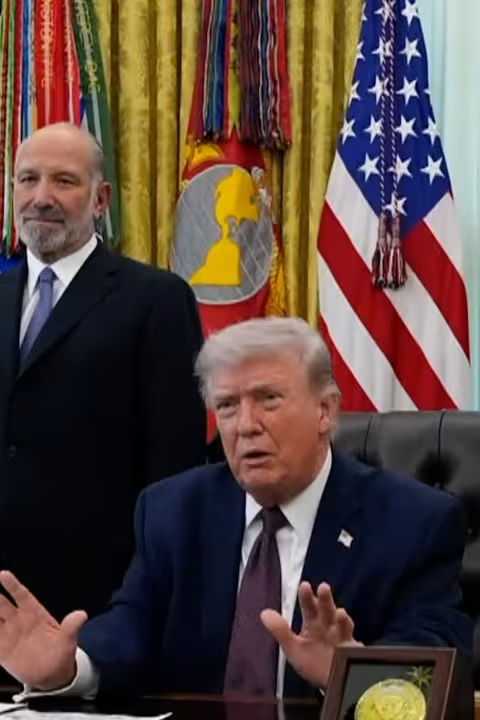
He also said that if Iran does not make a deal with the U.S., “we are going to hit each and every one of their electric generating plants very hard and probably simultaneously.”
Trump, who launched the war with a recorded video from his Mar-a-Lago compound in Florida, has frequently spoken to the media throughout the conflict. While light on new details, this address may reach a broader audience: an American public who may have been watching the finale of “The Masked Singer,” which was interrupted for his first speech to the nation about the war.
Trump sought to explain why the U.S. entered the war in the first place, accusing Iran’s theocratic regime of having destabilized the global order for decades and claiming Iran was building its nuclear program at a new location, “making clear they had no intention of abandoning their effort to obtain nuclear weapons.”
“Everyone has said that Iran cannot have nuclear weapons, but in the end, those are just words if you’re not willing to take action when the time comes,” he said, later adding: “We are on the cusp of ending Iran’s sinister threat to America and the world.”
And other major conflicts have lasted much longer, he said, including American involvement World War I, which “lasted one year, seven months and five days”; the Korean War, which lasted “three years, one month and two days”; and “Iraq [which] went on for eight years, eight months and 28 days,” he said.
“It’s very important that we keep this conflict in perspective,” he said.
During the address, Trump made several false and misleading claims, among them that Iran was “close” to having a missile that could strike the U.S., though an intelligence report said Iran would not have that capability until 2035.

Oil and gas prices have surged and stocks have tumbled since the start of the war, ratcheting up economic pressure at home that the White House says will ease once the operation is complete.
He also said the U.S. has “so much gas,” thanks to his administration’s promise to increase U.S. oil production and its cooperation with Venezuela.
Trump acknowledged that “many Americans have been concerned to see” rising gas prices due to the war, but pinned the blame on the Iranian regime. Earlier Wednesday, behind closed doors, the president offered a more frank assessment of public opinion that underscored the tension between the White House’s optimism and the reality of the conflict.
While speaking at an Easter lunch at the White House in a since-removed video, Trump discussed the possibility of seizing Iran’s oil “easily” — a high-stakes operation that would likely require deploying a small contingent of U.S. troops on the ground — before saying that he was “not sure that the people in our country have the patience to do that” and calling that “unfortunate.”
Much of what Trump said Wednesday night echoed his remarks in recent weeks on the road and in exchanges with reporters at the White House and aboard Air Force One, deeming the war “a little journey,” akin to “an excursion,” as he has also called it.
The address was a reminder of what remains at stake, with thousands of additional U.S. troops heading to the Middle East and regional allies and partners continuing to take daily fire from Iranian strikes.
Throughout the war, Trump has declined to rule out putting U.S. troops on the ground, with the White House explaining that he wishes to retain all available military options. He did not address that possibility Wednesday, but he had privately expressed a serious interest in deploying ground troops as part of a limited operation to secure Iran’s highly enriched uranium and oil, NBC News reported soon after the strikes started.
Large majorities have voiced opposition to sending U.S. ground troops, including significant shares of Republicans, according to surveys by Reuters/Ipsos and CNN.
U.S. military strikes have damaged or destroyed more than 159 Iranian ships, along with more than 12,300 targets, including command and control centers, missile sites and weapons production and storage bunkers, according to Defense Department figures.
At home, however, Trump continues to face a public that has remained skeptical of the military operation since it began more than a month ago.
NBC News polling conducted Feb. 27 to March 3 found that while a majority of voters oppose the military action, opinion is divided sharply along partisan lines.
Republicans were broadly supportive, with 77% backing the operation. And within Trump’s Make America Great Again movement, support is even clearer: Voters who self-identified as MAGA gave him a 100% approval rating, with 90% supporting military action in Iran.
Trump has repeatedly said the war would end “pretty quickly,” “very soon” and “pretty much, the very near future,” and on Tuesday night he said it could end within “two weeks, maybe three.” But at other times, his timeline has been more opaque. At one point, he said his measure for when the war would end would be “when I feel it in my bones.”
As for the Strait of Hormuz, through which roughly one-fifth of the world’s oil travels, Trump said Wednesday that those who use the strait must “cherish” it. While the U.S. “will be helpful” in protecting the oil that passes through it, he urged those countries most affected to “build up some courage” and “take it.”
Trump has gone back and forth on how he hopes to reopen the strait. U.S. allies have ignored his demand to send their warships in, and lately, Trump has mused about the strait’s opening “automatically,” telling the New York Post this week that that would happen once the military operation comes to a close.
Military and foreign policy experts told NBC News that the U.S. military has carried out tactical objectives in degrading Iran’s offensive and defensive capabilities, but that there is a more open question about Trump’s strategy if the remnants of the Iranian regime remain in power, control the Strait of Hormuz, still possess highly enriched uranium and retain the capacity to threaten America’s allies in the region.
“You’d have to ask yourself, exactly what was this all about?” said Aaron David Miller, a senior fellow at the Carnegie Endowment for International Peace and former State Department official.
Retired Army Colonel Steve Warren, an NBC News military analyst and former Pentagon spokesperson, said, “This is clearly a tactical success.”
“Strategic success is often in the eye of the beholder, isn’t it?” Warren continued. “I think by sort of conventional standards, we would have to say it’s not a strategic success” if Iran keeps those cards, “but this president doesn’t appear to be adhering to the conventional standards.”