Trump says Iranian Kurdish attack on Iran would be “wonderful,” but will he help?
Northern Iraq — Seven days into the U.S.-Israeli war on Iran, President Trump’s end goal remains vaguely defined. He’s said, however, that he wants to “go in and clean out” the Islamic Republic’s theocratic regime, and on Friday he demanded “unconditional surrender.”
The means by which he hopes to meet his objectives may involve help from some regional partners, who would more than welcome U.S. assistance. Mr. Trump said Thursday that it would be “wonderful” if Iranian Kurds based over the border in Iraq joined the fight with a ground attack on the besieged Iranian regime.
One potential U.S. ally among the Iranian Kurdish factions in the region is hoping for more than just words of support.
A leader of the lightly-armed Democratic Party of Iranian Kurdistan (KDPI) — which represents Iran’s Kurdish ethnic minority who compose around 10% of the country’s overall population — told CBS News the group is in contact with the U.S. government, and it hopes to use the opportunity created by the U.S.-Israeli war on Iran to help topple the regime.
The crucial question is whether they have been promised any material support from Washington. When asked directly by CBS News on Thursday at the party’s base in Northern Iraq, Amanj Zabtaee — part of the KDPI leadership committee — said he couldn’t answer, because it was “too sensitive.”
“But the reality at the moment is both sides have the same goal, and it is the toppling of the Islamic regime, that is all what I can say now,” Zabtaee said.
“We have the same goal,” he reiterated. “This is why we could be help to each other.”
It’s unclear whether Zabtaee’s refusal to respond to the question was due to some secret U.S. alliance already in the works, or if he was just hoping that speculation might help secure support from the White House.
Crucially, the group has not yet received any direct U.S. support, and its fighters could be sitting ducks if they do attempt to cross the border into Iran without the kind of air support the U.S. could provide.
He does have reason to be hopeful, however.
Mr. Trump encouraged Iranian Kurds to attack Iran in an interview with Reuters on Thursday, saying: “I think it’s wonderful that they would want to do that. I’d be all for it.”
A precedent of U.S. abandoning Kurdish allies
The Iranian Kurds’ current hopes come despite the fact that the U.S. has, multiple times over the years, abandoned Kurdish factions across the region after they provided significant battlefield assistance.
In the 1970s, Iraqi Kurdish rebels allied with American and Iranian forces against the government in Baghdad, but they were cut off by Iran’s former royal ruler the Shah after he got Iraq to cede territory. Henry Kissinger, then-President Nixon’s foreign policy adviser, said of the abandonment: “Covert action should not be confused with missionary work.”
In the 1990s, then-President George HW Bush encouraged Kurdish and Shiitte Muslim groups to rise up against Saddam Hussein in Iraq, but the U.S. did not help defend those communities when Hussein loyalists slaughtered tens of thousands of their members.
Most recently, the Syrian-Kurdish SDF forces became the main U.S. proxy on the ground in helping defeat ISIS after years of grueling war in Syria. Mr. Trump’s special envoy to Syria Thomas Barrack said in January that the anti-ISIS alliance had now “largely expired,” as the administration backed the new Syrian government. In a matter of weeks, the Kurds lost 80% of the territory they had held at the start of the year in clashes with the new government.
Despite the precedent, however, some Iranian Kurdish groups see a new potential U.S. alliance as too good to pass up, after their decades-long quest to overthrow Iran’s repressive Islamic Republic.
The Iranian regime — with its thousands of drones and ballistic missiles, sophisticated intelligence and large armed forces — is a much more potent enemy than ISIS, however.
CBS News visited the KDPI’s base in northern Iraq, around 30 miles from the Iranian border, in January. The group is lightly armed and many of their fighters are young women. Some told us they fled Iran because women’s rights aren’t respected there.
CBS News 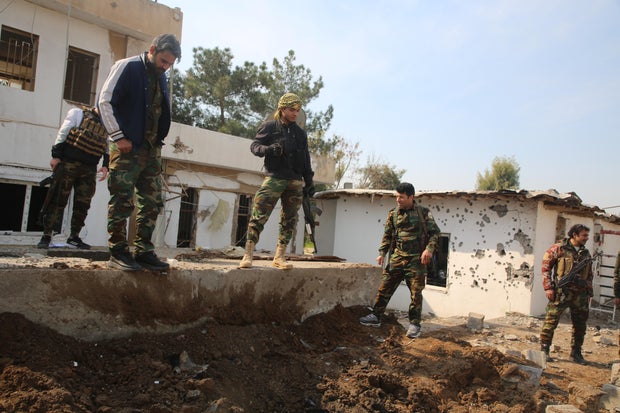
On Friday, CBS News visited the camp of another Iranian Kurdish opposition group in northern Iraq, the Khabat Organization of Iranian Kurdistan, hours after its members said they were hit by a drone strike. They believe they were targeted either by Iran directly, or one of the militia groups Iran supports in Iraq.
Later Friday, the KDPI base came under attack, but the two missiles and three drones that landed didn’t kill or wound anyone.
“For 80 years we have been in the fight with the current and previous dictators. Until now, no country’s air force has defended us, and we are still standing,” Zabtaee told CBS News on Thursday. “If something like this [air support] can happen, it will be great. But if it doesn’t happen, it doesn’t mean that we will be less committed to our cause.”
“We see the current situation as a great opportunity,” he said. “Everything is now possible. The party might use this opportunity to enter Iran.”