Which countries are involved, cost and more
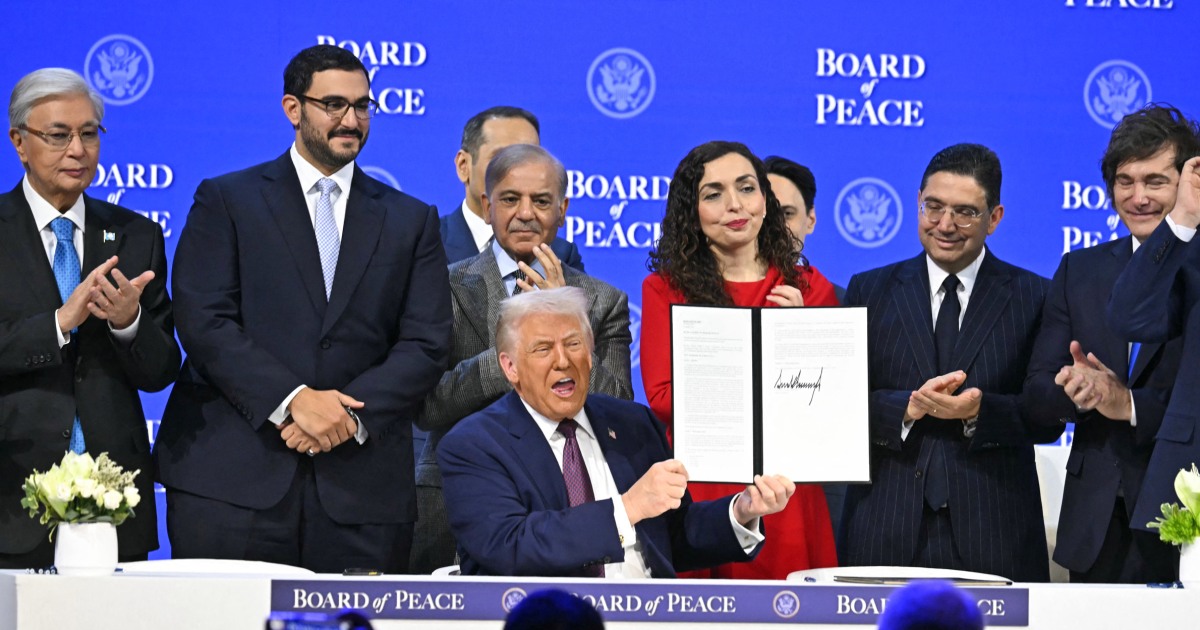
President Donald Trump was joined by a small number of world leaders on Thursday as he signed the charter of his “Board of Peace,” a new body he has billed as part of the solution to a series of global conflicts.
Major Western allies chose to skip the ceremony on the sidelines of the World Economic Forum in Davos, Switzerland, with some voicing concerns about the possibility of the body, which Trump plans to personally chair, replacing the United Nations.
Trump, who has previously derided the U.N. for “empty words” that “don’t solve war,” said Thursday the two bodies will work alongside each other, after suggesting earlier in the week that it “might” replace it.
With many allies absent, Trump was flanked by leaders and representatives from Argentina, Turkey, Hungary, Bulgaria, Bahrain, Kazakhstan, Kosovo, Qatar, Armenia, Azerbaijan, Morocco, Paraguay and Pakistan at the event.
Russia and China said they have received invites to the body but have not yet confirmed whether they will join. Israel has backed the body but Prime Minister Benjamin Netanyahu, who is subject to an International Criminal Court arrest warrant, did not attend the Davos summit.

What is the Board of Peace?
The Board of Peace was first proposed by Trump as an entity that would oversee the next phase of his peace plan for the Gaza Strip, but has since morphed into something with a much broader remit.
Last November, the U.N. Security Council approved a Board of Peace as part of a broader plan which included the establishment of a security force in Gaza.
The current charter for the board, as confirmed by NBC News, makes no direct mention of Gaza and proposes a broad mandate for a new international organization that “seeks to promote stability, restore dependable and lawful governance, and secure enduring peace in areas affected or threatened by conflict.”
The charter states that Trump will chair the board and can only be replaced as chairman through “voluntary resignation or as a result of incapacity, as determined by a unanimous vote of the Executive Board.”
It also states that each member state “shall serve a term of no more than three years,” with an exception for those “that contribute more than” $1 billion.
The White House Rapid Response account on X said this was not a “minimum membership fee to join the Board of Peace.” They said the $1 billion contribution “simply offers permanent membership to partner countries who demonstrate deep commitment to peace, security, and prosperity.”
The White House has said a “founding Executive Board” will include U.S. Secretary of State Marco Rubio, Trump’s special envoy Steve Witkoff, Trump’s son-in-law Jared Kushner, former British Prime Minister Tony Blair and World Bank President Ajay Banga.
Who is part of the Board of Peace?
More than 20 countries have said they will join the board.
They include Albania, Argentina, Armenia, Azerbaijan, Bahrain, Belarus, Bulgaria, Egypt, Hungary, Indonesia, Israel, Jordan, Kazakhstan, Kosovo, Mongolia, Morocco, Pakistan, Paraguay, Qatar, Saudi Arabia, Turkey, UAE, Uzbekistan and Vietnam.
It is not known whether any have agreed to donate $1 billion for permanent membership.
What has Trump said about the Board of Peace?
Signaling broad ambitions on Thursday, Trump said his Board of Peace “has the chance to be one of the most consequential bodies ever created,” adding that it was an “enormous honor” to serve as its chairman.
Trump said his board would work alongside the U.N., which he said has “got tremendous potential.” The two bodies together “can be something very, very unique for the world,” he said.
Rubio thanked the world leaders present, but expressed hope that those who might have reservations will ultimately join.
“Others will join,” Rubio said. “Many want to be a part of this effort, because it is going to be a successful effort,” he added.
Rubio said the body would be about “action” and not just “strongly worded statements” the world is used to from global leaders.
“We often find ourselves at events where people are reading these scripted statements, these strongly worded letters that they put out, but no action. Nothing happens,” Rubio said.
Who isn’t joining the Board of Peace?
The U.K., France, Norway, Sweden and Slovenia are among the countries to indicate they would not be immediately joining the body.
French President Emmanuel Macron’s office said earlier this week that the board’s charter “goes beyond the sole framework of Gaza and raises serious questions, in particular with respect to the principles and structure of the United Nations, which cannot be called into question.”

Britain’s Foreign Secretary Yvette Cooper cited concerns over Russian leader Vladimir Putin’s possible participation.
In an interview with the BBC on Thursday morning, she said: “We won’t be one of the signatories today because this is about a legal treaty that raises much broader issues, and we do also have concerns about President Putin being part of something which is talking about peace, when we are still not seeing any signs from Putin that there will be a commitment to peace in Ukraine.”