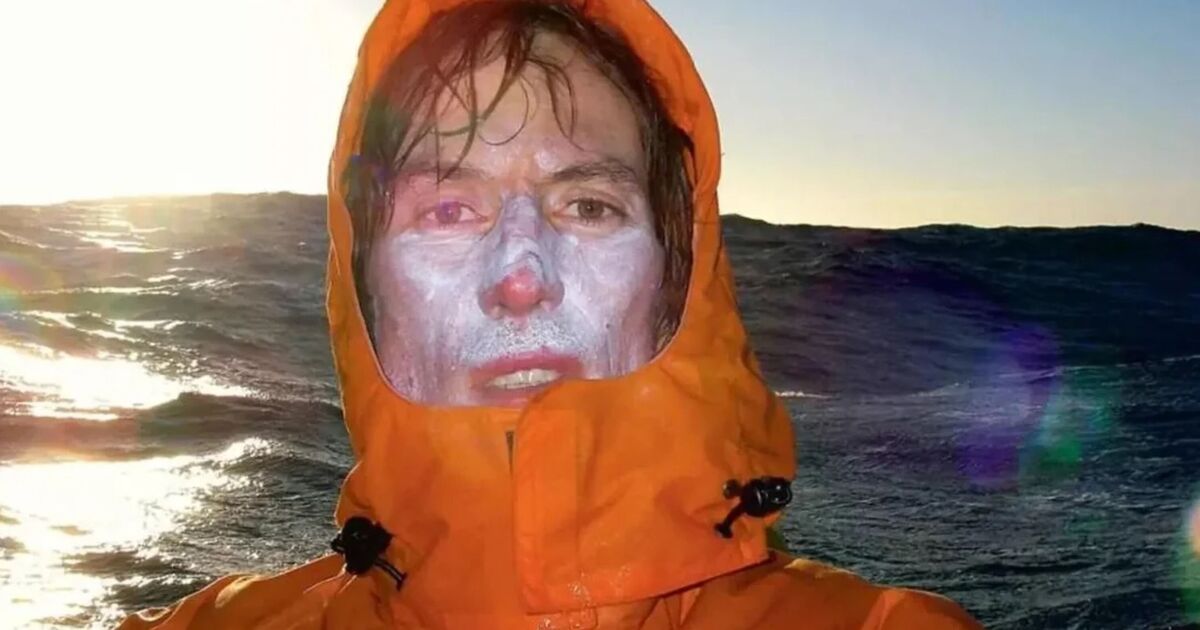
Haunting last selfie of kayaker who vanished at sea | World | News
This is the chilling final selfie of a kayaker who vanished at sea and was never found before two heartbreaking clues shed light on his last moments.
Andrew McAuley disappeared in the treacherous waters of the Pacific Ocean during a solo kayaking expedition that was supposed to last a month. Tragically, it proved to be his final adventure.
Andrew had set his sights on becoming the first person to paddle a kayak from his native Australia to New Zealand across the perilous Tasman Sea.
His eerie last video message was recovered from the wreckage of his kayak, in which he said: “I may have bitten off more than I can chew”.
Devastatingly, Andrew was merely days away from completing the feat. His remains have never been recovered, though his kayak was discovered capsized and abandoned approximately 50 miles off the New Zealand coastline, reports the Daily Star.
READ MORE: ‘Hidden gem’ drama with ‘gripping plot twists’ perfect for fans of The Capture
READ MORE: Paedophile trio jailed after brutal rape of missing teen girl – ‘Awful crimes’

Waves in the Tasman sea can be incredibly powerful (Image: AFP via Getty Images)
The memory card from Andrew’s camera was retrieved, revealing the Australian, with thick sunscreen smeared across parts of his face, staring directly into the camera while a towering wave bears down behind him.
When the kayak and his belongings were found without any trace of Andrew on 10 February 2007, having originally set off on 11 January 2007, the search for the devoted husband was formally called off on February 12.
The documentary Solo revealed a distress call he made on the evening of 9 February.
He said: “Do you copy? This is kayak one. Do you copy, over? I’ve got an emergency situation. I’m in a kayak about 30 km from Milford Sound. I need a rescue. My kayak’s sinking. Fell off into the sea and I’m going down.”
Andrew would sleep in the kayak by deploying a drift anchor and wedging himself into the well of the kayak — sealing the hatch with fibreglass.
This enabled him to withstand the most severe conditions at sea. However, if the capsule was in its stowed position — it would fill with water making a kayak roll impossible — meaning Andrew had to swim out and haul himself back up every time he was knocked over.

Andrew McAuley was an established adventurer (Image: undefined)
When his kayak was discovered, one of the pivot arms was damaged — suggesting he had been struck by a rogue wave.
Veteran sailor Jonathan Borgais, who was directing the expedition by providing weather predictions said: “From the beginning, my biggest concern was the approach to New Zealand.
And this part of New Zealand is notoriously dangerous. On a good day, you can get rogue waves: a two- or three-metre set that can come out of nowhere. Not big, but powerful. That’s very dangerous. I have no doubt that a wave got him.”
Don’t miss: Village dubbed ‘prettiest in UK’ with cobbled streets, great views and no cars
Don’t miss: Woman rescues drowning man then discovers he was wanted for double murder

A chilling photo of the upturned canoe (Image: undefined)
The Sydney Morning Herald reported Andrew may have drowned while asleep in his kayak, though without recovering his body, it is impossible to confirm this was the case.
His boat was discovered 56km from his goal destination — Milford Sound. His wife Vicki was left heartbroken and, at a memorial service in February 2007, she said: “You’ll go down in history” as she delivered a deeply emotional tribute to her beloved partner.
Speaking at the service, Vicki added: “I chose this lighthouse for you today not only because it looks over the Tasman but because it symbolizes what you’ve always been, and what you continue to be for me, my beacon of light.
“I also chose it for its historical significance, it is Australia’s first lighthouse and you, my very brave man, have just achieved an historical first, paddling a kayak across the Tasman.”
This was, in fact, Andrew’s second attempt at the feat. In December 2006, his bid to cross the Tasman Sea in a modified one-man kayak was abandoned after he struggled to stay warm inside the kayak during the night.
Yet Andrew was far from inexperienced — in 2003, he completed the first nonstop kayak crossing of the Bass Strait. In 2004, he kayaked across the Gulf of Carpentaria. Then, in 2006, he led a team across the Australian Antarctic Territory, where kayakers paddled through the Antarctic circle.