‘Weak’ EU savaged for silence over new atrocities in Iran | World | News

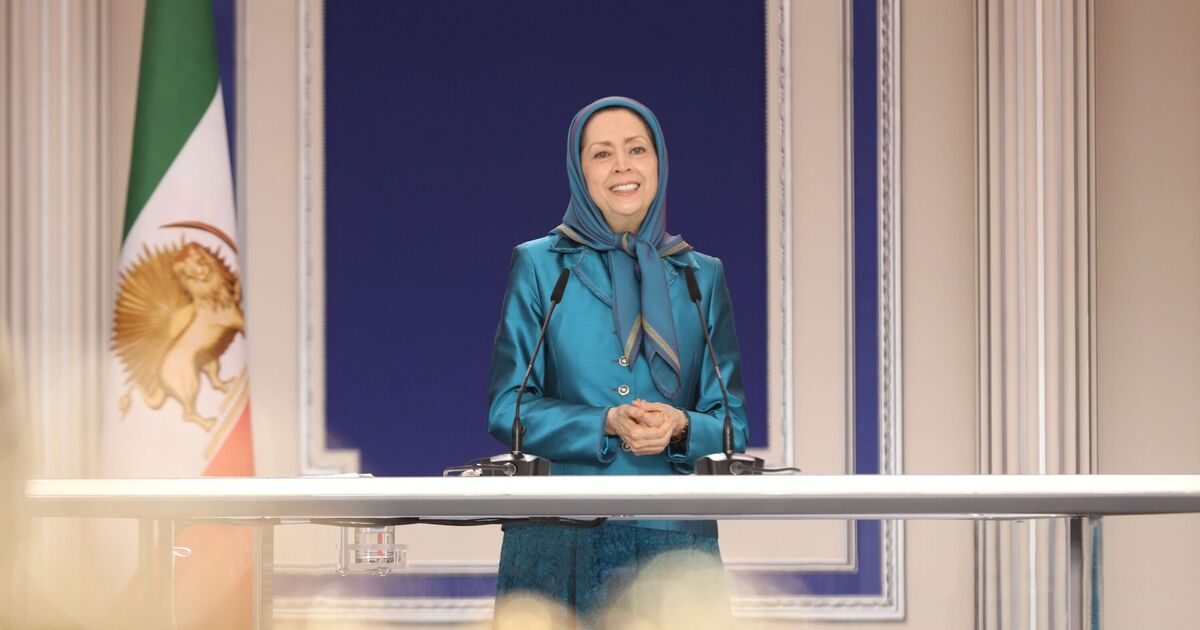
Maryam Rajavi, President-elect of the National Council of Resistance of Iran (Image: Getty)
The EU has been savaged as “weak and silent” in the face of a continued wave of atrocities inside Iran which were continuing today. In an address at the European Parliament leading dissident Marayam Rajavi told MEPs of a brutal escalation in executions of opponents of the Ayatollah’s regime and a rise in violent street-level internal repression. The President-elect of the National Council of Resistance of Iran declared that the real conflict shaping Iran’s future was not Donald Trump’s “foreign war”, but a “destiny-making” struggle on the ground between the Iranian people and the religious dictatorship over which the EU must not stay silent.
In an uncompromising speech she added 16 political prisoners – opponents of the regime – have been executed within a month, while another detainee died under torture, and said unwillingness to speak out against the horrors being perpetrated was effectively complicity.
She said: “The silence of European Union leaders and member states in the face of this wave of political executions in Iran is unjustifiable. Such silence not only emboldens the regime to continue executions, but also signals weakness, encouraging it to persist in nuclear weapons development and terrorist meddling in the region.
“It does not view foreign war as its main threat, but rather the anger of the people and the organized resistance. Since Khamenei’s death, the regime has deployed all its forces in the streets to prevent a new uprising.
“We maintain that the halt in executions, demanded by the Iranian people, must be included as a fundamental condition in any international agreement with the mullahs.”
Monday saw the execution of two members of the opposition People’s Mojahedin Organization of Iran, identified as Hamed Validi and Mohammad Massoum Shahi. On Tuesday, another young protester linked to January’s nationwide unrest was also executed.
Rajavi’s NCRI movement is demanding a democratic republic, the separation of religion and state, autonomy for oppressed nationalities, and the active and equal participation of women in the leadership of society.
In February the NCRI announced a provisional government to transfer sovereignty to the people of Iran and establish a democratic republic based on its Ten-Point Plan. This transitional government is tasked with organizing free elections within six months of the regime’s overthrow. Power would then be transferred to the elected representatives of the people.
Rajavi told delegates: “If Europe seeks to play an effective role in establishing peace and democracy in the Middle East, it must stand with the Resistance for the establishment of a democratic republic in Iran. Those who ignore the role of the people and the organized resistance only serve to prolong the survival of the dictatorship.
“The regime’s most important redline dictated on European governments has been distancing themselves from the NCRI. Compliance with this demand lies at the core of appeasement policy.
“Liberation from religious fascism, the nuclear threat, and proxy warfare is only possible through the overthrow of this regime by the Iranian people and their organized resistance.”
Her address came as the US-Iran ceasefire looked all but over.
Overnight and in recent days, tensions have intensified in the strategically critical Strait of Hormuz, with Iranian forces seizing commercial vessels and the United States maintaining a naval blockade, actions that have raised fears of renewed hostilities and further disruption to global energy supplies.
In recent days, Israeli strikes have continued in Lebanon despite a short-lived ceasefire, with civilian casualties reported, underscoring the fragility of the truce.
Diplomatic efforts continue but remain uncertain. US President Donald Trump has extended the ceasefire for several days to allow for negotiations, with talks potentially resuming, though both sides remain divided over key conditions, particularly the continuation of the US naval blockade. Analysts warn that the pause in fighting is likely to be temporary, with both Washington and Tehran signalling readiness to resume military action if talks fail.