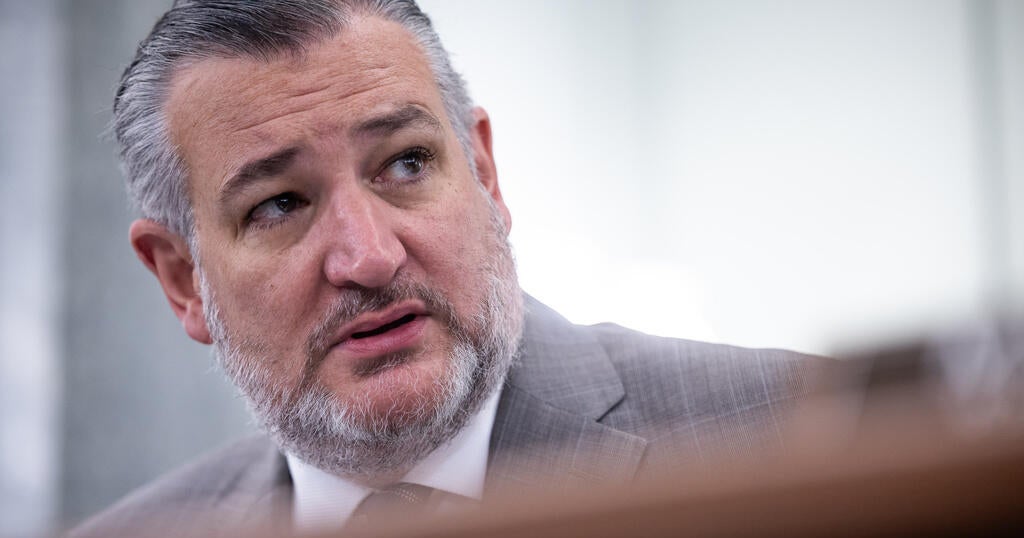
As Iran talks grind on, Sen. Cruz calls for Trump to arm Iranian protesters: “Our objective should be regime collapse”
With the U.S.-Iran conflict in its sixth month, the Trump administration is angling for a deal. But Republican Sen. Ted Cruz argues the U.S. should heap more pressure on Iran’s regime — including by arming Iranians who oppose their government.
“I think our objective should be regime collapse,” the Texas Republican told CBS News national security analyst and Free Press columnist Aaron MacLean on the “School of War” podcast.
Cruz first pushed for the U.S. to arm protesters in late January, after Iran cracked down on the country’s largest wave of demonstrations in years, killing at least 12,000 people, sources told CBS News.
A month later, the U.S. and Israel began striking Iran. The stated goal was to degrade Iran’s conventional military and nuclear program, but President Trump also urged ordinary Iranians to “take over your government” and oust the hardline clerical regime that has ruled Iran since 1979.
Since then, the U.S. and Iran have oscillated between strikes and diplomacy. The two countries struck a memorandum of understanding in June aimed at halting the conflict, restoring shipping traffic, launching negotiations over Iran’s nuclear program and eventually loosening sanctions on Iran. The agreement collapsed last month, but Iran is now inching toward a deal with Oman to allow shipping traffic in the Strait of Hormuz, which could allow U.S.-Iran talks to resume.
Cruz has criticized many of the U.S.’s diplomatic overtures toward Iran. He told MacLean the memorandum of understanding was a “disaster” and a “terrible deal,” warning it would set the stage for Iran to get billions of dollars in sanctions relief and $300 billion in economic development funds, and could let Iran assume “a permanent role with the Strait of Hormuz.”
“You’ll forgive me if I’m not terribly eager to give them $300 billion to facilitate their carrying out their stated intent of murdering us,” Cruz said. “Giving them $300 billion is an exceptionally bad idea. It was a bad idea two months ago, it’s a bad idea today and it would be a bad idea two months from now. So I hope we don’t go down that road.”
(The Trump administration said in June the $300 billion in reconstruction funds would be voluntary, and would come from Gulf states and private investors, not the U.S. government.)
Instead, Cruz argued, the U.S. should keep striking Iranian military targets and should “continue ratcheting up the economic pressure,” including by keeping in place a blockade on Iranian ports designed to choke off Iran’s ability to sell its oil.
And he called for Iranians to be armed. “What I believe we should do, what I have urged President Trump repeatedly, what I’ve urged Israel to do repeatedly, is arm the protesters, give them the guns, to let them overthrow their own government so that it’s not American boots on the ground, it’s Iranians fighting for their own country,” the senator said.
In recent months, Mr. Trump has backed off his calls for Iran’s regime to be toppled. And Cruz acknowledged that calls for “regime change” can carry negative connotations, evoking comparisons to the chaos that resulted after the U.S. toppled Iraq’s Saddam Hussein.
Cruz said he doesn’t “particularly care who comes next” if Iran’s regime were to collapse, “as long as they are not an Islamist who hates America and is actively trying to kill Americans.”
“I don’t have a dog whether it’s the son of the Shah, whether it is the [Mojahedin-e-Khalq opposition group], whether it is someone local, as long as they are not an Islamist who hates America and is actively trying to kill Americans,” Cruz said, referring to exiled crown prince Reza Pahlavi, whose father was overthrown as Iran’s shah, or king, in 1979.
Mr. Trump, for his part, said in March he wanted a role in choosing Iran’s next leader. He has expressed doubts about Pahlavi, saying earlier this year he “seems very nice,” but: “I don’t know how he’d play within his own country.”
Cruz is far from the only Republican to question the idea of striking a deal with Iran. Shortly after the U.S.-Iran memorandum of understanding was announced in mid-June, Sen. Bill Cassidy of Louisiana called it “the worst foreign policy blunder in decades,” and Sen. Tom Cotton of Arkansas warned that parts of it are a “step in the wrong direction.”
Mr. Trump called critics of the deal “fools” and “either jealous, bad people, or stupid.”
Meanwhile, a handful of Republicans — like Sen. Rand Paul of Kentucky — have criticized the president’s entire Iran strategy , arguing the war itself was a mistake.
The disagreements about Iran could expose a broader rift within the GOP between those who tend to favor expansive uses of U.S. military force and those who are more skeptical of it.
At the center of the dispute is Vice President JD Vance, a possible successor to Mr. Trump who helped lead U.S.-Iran negotiations and has historically been a skeptic of military action. In an interview last month on Joe Rogan’s podcast, Vance broadly defended the administration’s strategy and expressed frustration with Iran “hawks.”
“I’m very frustrated by the Americans and, frankly, by people in other countries who are like, ‘You cannot negotiate with the Iranians,'” he said. “Well, then, what is your proposal to get people to stop shooting at ships in the Strait of Hormuz? You can bomb them, you can take away their radar, you can take away some of their drones and some of their missiles, but it’s just too easy to fire at ships in the strait. So you’ve got to actually be willing to talk and to try to figure out the problem.”
Cruz told MacLean he doesn’t view himself as an interventionist.
“I disagree with both the interventionist and the isolationists. I think the interventionists are too quick to send the Marines. That’s their solution for everything,” he said. “But I am most definitely not an isolationist. It is a dangerous world, and it is our military’s job to prevent enemies of America from killing Americans.”