Bank of England interest rates update as expert issues Iran warning | Personal Finance | Finance

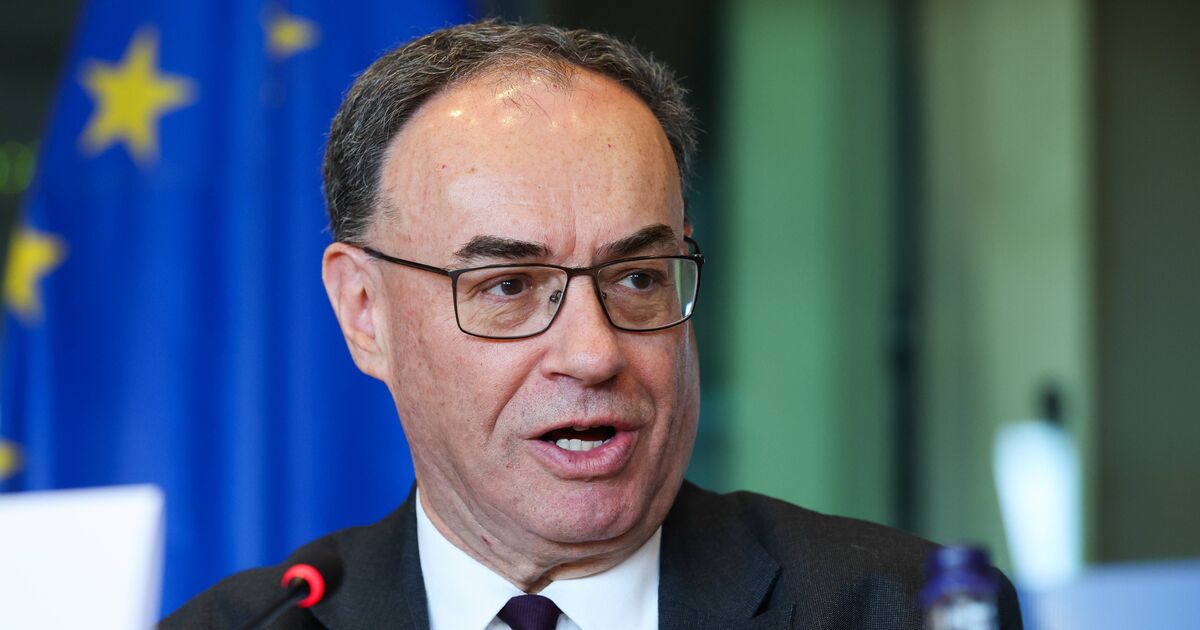
Andrew Bailey, governor of the Bank of England, at a European Parliament Committee meeting on Economic and Monetary Affairs in Brussels, Belgium, on Thursday, April 9, 2026. “We’ve obviously had a very big shock in the last month or so with the conflict breaking out in the Middle East.” Bailey said. Photographer: Omar Havana/Bloomberg via Getty Images (Image: Bloomberg, Bloomberg via Getty Images)
A senior finance expert has issued a verdict on the possible direction interest rates in the UK will take amid concerns the Bank of England may raise them due to Iran.
Peel Hunt’s chief economist Kallum Pickering has said the Bank’s Monetary Policy Committee (MPC) may be forced to take “drastic action” if the conflict drags on.
Yet he said his current expectation is that the Bank implements two interest rate cuts towards the end of this year, on the assumption that a resolution is reached for trading routes across the Middle East.
Pickering described market pricing indicating a single rate hike as “odd”, even as there was “increasing optimism” of a peace deal being struck to reopen the Strait of Hormuz, where disruption to trade has heightened the threat of fuel shortages across the globe.
He further suggested that traders had begun to factor in a “more balanced view” of inflation and growth risks by revising expectations from one hike to three, as reported by City AM.
Pickering, who sits on City AM’s Shadow Monetary Policy Committee, said: “I still find market pricing odd. One hike – what is the point in that? Chances are, this is among the least likely paths.”

Low angle view of the Bank of England, Threadneedle Street, in the City of London, UK. (Image: Tim Grist Photography via Getty Images)
Nevertheless, the Peel Hunt deputy head of research warned there were “two prevailing views” that could leave the Monetary Policy Committee (MPC) facing a dilemma over monetary policy. While reopening the Strait of Hormuz may be achievable through ongoing negotiations between Trump officials and Iranian leaders, he indicated that a prolonged conflict could compel rate-setters to “take drastic action” to prevent a surge in inflation.
“In that scenario, we could not rule out significant rate hikes,” he warned.
City giants have adopted contrasting positions on the trajectory of interest rates over the coming year. JP Morgan analysts anticipate one hike this year in June, following an earlier forecast of two hikes.
MPC members have largely refrained from making explicit statements regarding their assessment of the war’s economic impact.

Interest rate changes have major effects on businesses and UK households (Image: SEAN GLADWELL via Getty Images)
External member Megan Greene told an event in Washington on Tuesday that the Bank would need to make a “judgment call” as it would be too late to wait for “definitive data”.
She said there were both downside risks to growth, which could weaken demand in the UK economy, as well as upside risks to people’s expectations, which could push wage growth higher and lead to a spike in inflation.
President Trump has indicated that discussions between the US and Iran could occur within the next day, following the US implementation of a blockade on Iranian ports.
Vice-president JD Vance is expected to lead another round of talks with Iranian officials, according to CNN. Both US and Iranian officials, including Trump himself, have floated the idea of imposing a toll on vessels passing through the Strait, though Gulf nations and European allies have made clear their opposition to the proposed levy.
Financial markets have remained cautious over the progress of negotiations, with Brent crude oil prices wavering around $95 since the fortnight-long ceasefire was first announced last week – down on previous highs but well above the pre-war price of around $72.
Thomas Pugh, chief economist at accountancy firm RSM, has warned that there is “pressure” on the Bank of England to raise interest rates, as inflation has been running higher in the UK than in other nations, leaving the economy increasingly susceptible to a wage-price spiral.
Bank of England Governor Andrew Bailey has sought to manage expectations across financial markets regarding the prospect of further interest rate increases.
The MPC’s next gathering is scheduled for 30 April and will include the release of the Bank’s latest monetary policy report, which could shed further light on economists’ views surrounding the energy price shock and its potential consequences for the British economy.