Donald Trump issued chilling radioactive dead zone warning | World | News

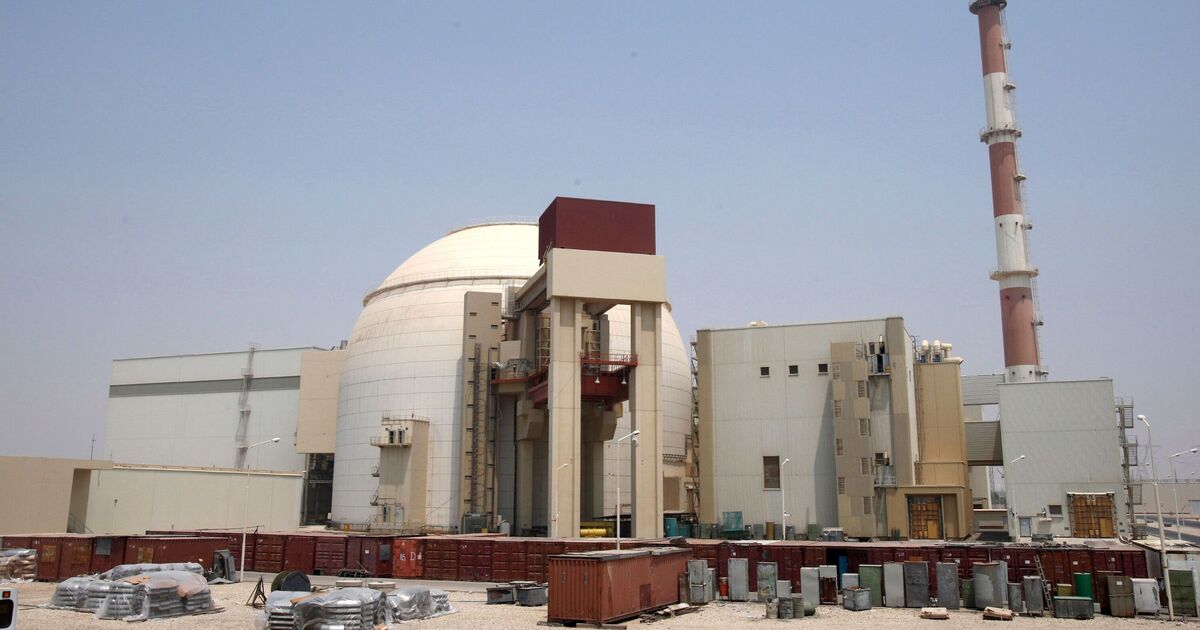
Iran’s Bushehr nuclear power plant (Image: ABEDIN TAHERKENAREH/EPA-EFE/REX)
A military strike on Iran’s nuclear sites could trigger a regional radiological disaster which contaminates the Persian Gulf, putting tens of millions of lives at risk, a leading analyst has claimed. The warning comes amid growing political pressure in Washington and escalating rhetoric from US President Donald Trump, who has repeatedly raised the prospect of force if Iran refuses to curb its nuclear programme.
Mr Trump has previously spoken about getting the “nuclear dust” out of Iran and suggested operations could, in his words, be carried out “with the co-operation of the regime”. US officials have also publicly floated more extreme options, including invading Iran and seizing nuclear material by force if Tehran refuses to comply.
READ MORE: Iran sends chilling WW3 threat to Trump – ‘An eye for an eye’
READ MORE: Trump ‘to review UK’s claim to the Falklands’ in bombshell Iran punishment

Nuclear facilities in Iran (Image: Anadolu via Getty Images)
However, nuclear policy expert Paul Ingram said the consequences of any strike on nuclear infrastructure would extend far beyond military objectives and could quickly spiral into environmental catastrophe.
Mr Ingram said: “This is a serious threat, and belligerents have shown remarkable disregard for the risks.”
Mr Ingram warned that even limited strikes could have consequences that are difficult to contain. He said: “A radiological release triggered by an attack could have serious impact on the constrained waters of the Persian Gulf and thereby the water supply for tens of millions of people, and the risk of atmospheric release threatening regional populations.”
The Persian Gulf’s geography amplifies the danger. As a semi-enclosed body of water bordered by Iran, Iraq, Kuwait, Saudi Arabia, Bahrain, Qatar, the United Arab Emirates and Oman, it has limited water exchange with the open ocean. That makes it especially vulnerable to long-lasting contamination if radioactive material enters the marine environment.
Recent strikes on Iranian nuclear-related infrastructure have heightened concerns that escalation is no longer theoretical. Mr Ingram referred to “attacks on the Bushehr complex by US/Israel in recent weeks,” warning that such actions demonstrate how quickly nuclear risks can intersect with military planning.

US President Donald Trump (Image: Getty)
The Bushehr nuclear power plant, Iran’s only operational civilian reactor, sits directly on the Gulf coast. Any serious damage to its core systems or fuel handling infrastructure could significantly increase the risk of radioactive leakage into surrounding waters.
International Atomic Energy Agency director general Rafael Grossi earlier this week warned that instability around nuclear infrastructure is pushing the global non-proliferation system towards a dangerous breaking point.
Mr Grossi told The Daily Telegraph: “There’s been a few important countries… where a public discussion is taking place about this possibility,” referring to renewed debate in several states about acquiring nuclear weapons.
He warned that such developments could undermine the entire global framework designed to prevent proliferation. Mr Grossi said: “There is talk about ‘friendly proliferation’. There are all these things which fill me with concern because I believe that a world with 20 nuclear weapon states or more would be extremely dangerous.”
Mr Grossi has also warned of systemic fragility. Mr Grossi said, “At some point, we are going to see a crack in the system. And then we’ll have a domino [effect]. It is a very, very fragile position.”

International Atomic Energy Agency director general Rafael Grossi (Image: Getty)
Those warnings come as diplomacy over Iran’s nuclear programme remains unstable. Mr Grossi has stressed that any agreement without verification would be meaningless. Mr Grossi said: “Without verification, any agreement is no agreement. It’s an illusion of an agreement, or it’s a promise, which you don’t know whether it will be complied with or not.”
He added that the IAEA would be the only body capable of providing credible oversight. Mr Grossi said: “We are the only ones who could guarantee absolute impartiality in the work.”
But Mr Ingram argued that verification debates risk missing the bigger danger: that military escalation could physically overwhelm any diplomatic framework.
Mr Ingram said: “This is a serious threat,” warning that repeated strikes on nuclear infrastructure show how little weight is being given to downstream consequences.
The strategic stakes are rising as Washington signals it is willing to consider coercive options. Mr Trump has repeatedly framed Iran’s nuclear programme as an existential threat and suggested that force may ultimately be required to prevent weaponisation.
Iranian State TV airs what it says is video of Iran’s Navy seizing vessels
However, Mr Ingram said the assumption that military action can neatly remove nuclear risk is dangerously simplistic.
He pointed to Iran’s broader strategic behaviour, arguing that it has repeatedly shown it can withstand pressure from far more powerful adversaries without collapsing. But he warned that nuclear facilities are uniquely sensitive compared to conventional military targets.
The risk, he said, is not only deliberate escalation but miscalculation—where strikes intended to degrade capability instead trigger systemic environmental failure.
Mr Grossi has also warned that conflict conditions complicate nuclear safety oversight. He noted that damaged facilities present issues of “structural stability” and require careful handling even after hostilities cease.
Mr Ingram echoed those concerns, arguing that nuclear infrastructure is not resilient in the way military planners often assume. Once compromised, he said, the systems involved can produce cascading effects that extend across borders and sectors.
The Persian Gulf is particularly exposed. It is one of the world’s most important energy corridors and also a critical source of desalinated water for Gulf states. Any contamination event could therefore become simultaneously an environmental, humanitarian and economic crisis.
Mr Ingram warned that the assumption of controllable escalation is increasingly outdated. Military superiority, he said, does not eliminate physical vulnerability in complex nuclear systems.
He also cautioned that repeated strikes risk normalising a pattern in which nuclear infrastructure becomes a routine target of warfare, raising the probability of a larger accident over time.
Mr Grossi’s broader warning reflects the same underlying concern: that the global nuclear order is becoming less stable just as geopolitical tensions rise.
Mr Grossi said: “A world with less nuclear weapons is better than a world with more,” stressing that current trends are moving in the opposite direction.
For Mr Ingram, the immediate danger is not abstract geopolitics but physical exposure. A strike on Iran’s nuclear infrastructure in or near the Persian Gulf, he warned, would not remain confined to military objectives.
It could instead create what he described as a slow-moving but far-reaching environmental disaster—one that would extend across borders, economies and generations.