Farm linked to cyclosporiasis outbreak hadn’t been inspected in 7 years as FDA lags on foreign inspection targets
The Food and Drug Administration conducted just under 1,000 foreign food safety inspections in 2025, and the farm in Mexico believed to be at the center of the ongoing cyclosporiasis outbreak in the U.S. was not one of them.
A federal law enacted to prevent diseased and dirty food from reaching Americans’ plates requires the FDA to carry out nearly 20 times that many foreign inspections each year. But the FDA hasn’t come close to meeting the congressional mandate — or even 10% of it — in the 10 years it has been in place, spanning administrations led by both political parties.
FDA officials have described the requirement as unrealistic, but have never asked Congress to revise it. A lower foreign inspection target the agency deemed necessary to safeguard foreign imports is still nearly five times higher than the number of inspections conducted last year.
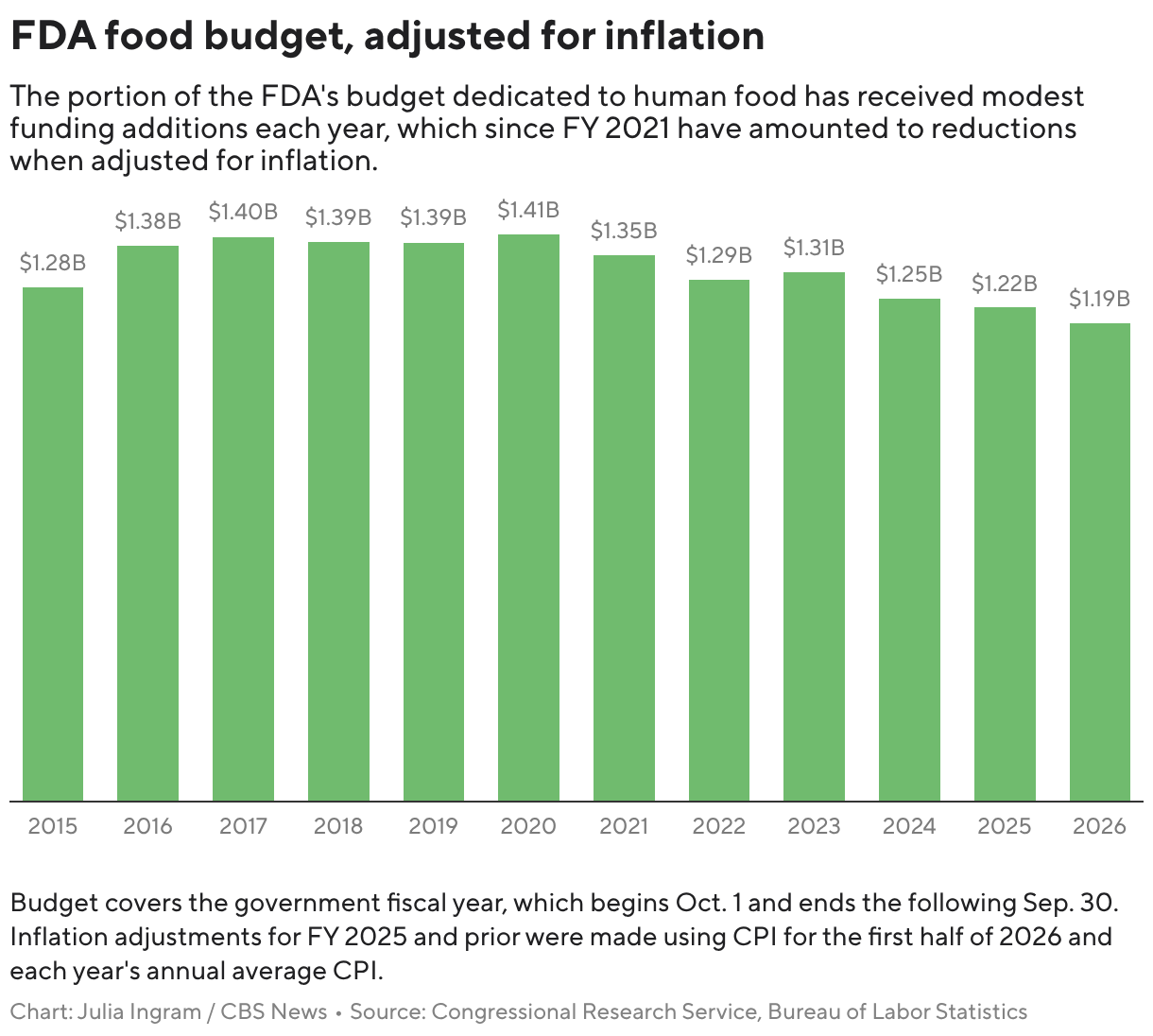
Congress, meanwhile, has not increased the agency’s food safety budget to outpace or keep up with inflation, and widespread layoffs during the first year of President Trump’s second term squeezed resources further.
The rate of inspections has gotten markedly worse amid those reductions, with foreign food safety inspections falling by 29% from 2024. Outside of the COVID-19 pandemic, last year’s inspection count was the lowest since 2011. Early numbers for 2026 show that the agency is on track to inspect a similar number this year.
“FDA inspections really are the first line of defense for mitigating outbreaks. If FDA isn’t routinely going out to food facilities, it’s just completely blind,” said Meridith Seife, the lead author on a Health and Human Services Inspector General report on FDA inspections of U.S. facilities. “It’s unable to ensure that those facilities are complying with the laws, with regulations, and that the food that they handle is safe.”
About a third of FDA inspections of foreign firms for foodborne hazards over the last decade found violations, inspection data show. Inspectors have previously found toilet paper and human feces in growing fields in Mexico and observed air conditioning units dripping onto crawfish in China. Around 2% of the time inspectors visited firms over the last 10 years, they found violations significant enough to prompt enforcement action.
Before the cyclosporiasis outbreak, the FDA last inspected its potential source, Taylor Farms de Mexico, seven years ago, records show. The FDA’s last visit before that was six years prior — to respond to another cyclosporiasis outbreak in 2013. The 2019 inspection found no violations, while the 2013 post-outbreak review found the facility was recycling wash water for salad mix, but couldn’t conclusively pinpoint the source of the outbreak.
The FDA is “actively working to expand staffing at foreign posts,” according to Emily Hilliard, senior press secretary for HHS. Public health experts say the inspection count is only one input in the whole system, and that food companies bear primary responsibility for day-to-day safety. But they also said the count still matters as an outside check regulators alone can provide.
“Suggesting that FDA’s ability to protect the food supply can be measured by a single inspection statistic ignores the agency’s comprehensive oversight system, which prioritizes resources based on risk and deploys personnel where they have the greatest public health impact,” Hilliard wrote in a statement to CBS News.
The FDA inspects producers of fruits and vegetables, dairy, processed foods and most seafood, while the U.S. Department of Agriculture is responsible for inspections of meat and poultry producers.
About 47,000 foreign manufacturers accounted for 90% of non-meat food shipments into the U.S. last year, a CBS News analysis of import data found. The FDA has inspected 4.5% of them since 2023.
The FDA employs a risk-based model to determine where to send inspectors, based on how much and how often a company sends food into the U.S. and its prior inspection and import refusal record. In addition to inspections, the FDA also uses an algorithm to assign scores to imports for screening at ports of entry, and can block any imports without examining them if they deem a shipper problematic. Federal law also puts the burden on U.S. companies importing food to ensure their suppliers follow safety standards.
An “unrealistic” target
Since 2011, federal inspectors have visited an average of about 1,300 foreign factories and farms annually (in non-pandemic years) to check for hazards that could lead to foodborne illness, federal data shows.
The FDA, state and local agencies conducted more than 10,000 inspections annually inside the U.S. in recent years, according to the HHS Inspector General.
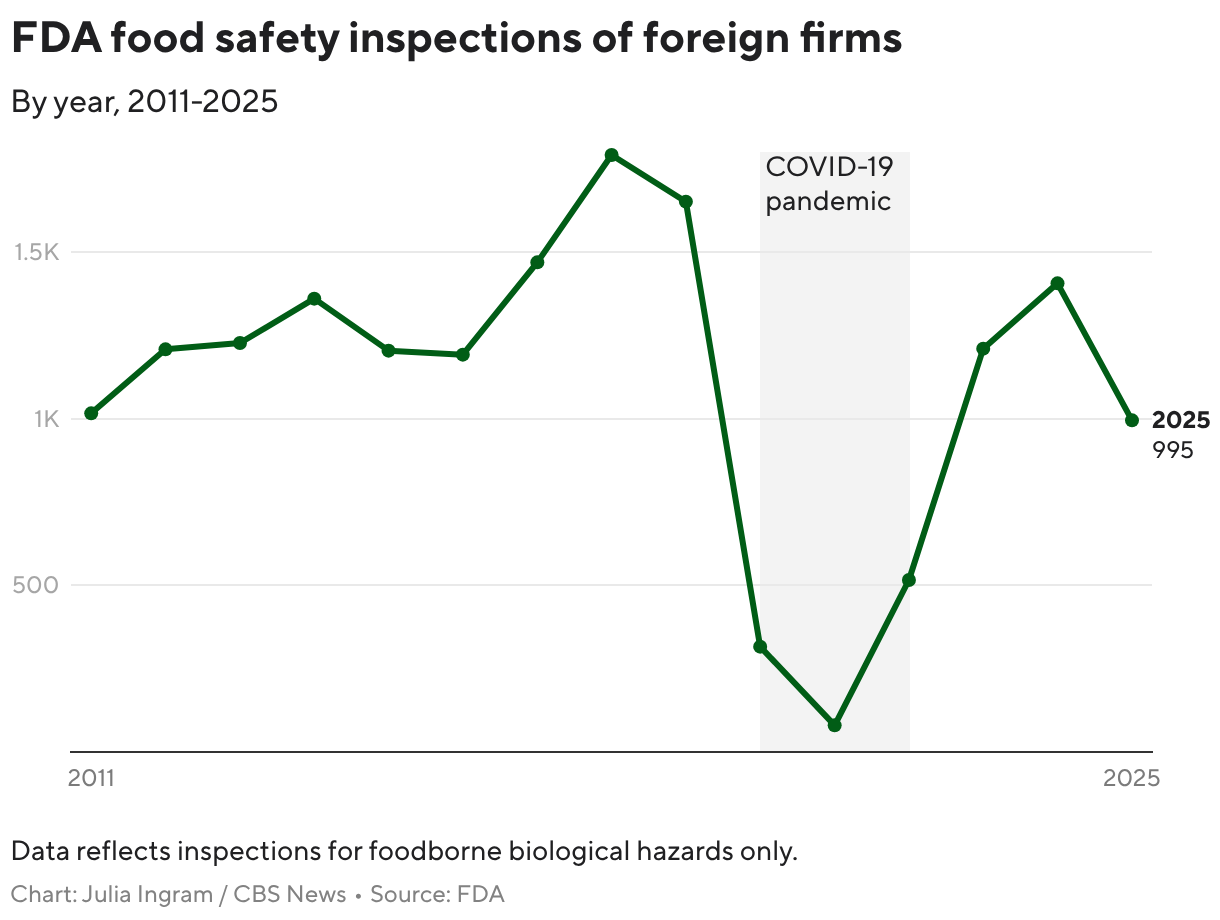
The Food Safety Modernization Act, or FSMA, set a rising annual target for foreign inspections, capping it at 19,200 in 2016. The FDA told a federal watchdog as early as 2015 that the number was unworkable, so it directed the FDA to propose an adjusted target to Congress. The agency later conducted an internal analysis pegging the needed number of inspections at 4,700, about three to five times what the FDA has managed in recent years. But the agency never brought the number to Congress.
After the Government Accountability Office urged the FDA to revisit the target again last January, the agency created a workgroup to redo the analysis.
“The GAO was right in its January report when it said that the agency is handicapped by underfunding and understaffing. It’s even more so now,” said Sen. Richard Blumenthal, a Democrat of Connecticut, who requested the more recent watchdog inquiry. “There’s clearly a need for more resources, better management, more commitment. Some of it can be legislated, but it also has to come from the administration.”
At an average of $38,700 per foreign inspection, according to the FDA’s estimates, meeting the existing Congressional mandate would cost about $743 million a year — more than 10% of the FDA’s entire budget.
Staffing challenges
The FDA had 432 inspectors in 2024, and its hiring rate has not outpaced losses, according to the GAO report. Congress directed the hiring of 5,000 inspectors under FSMA, but the agency says it has never had the budget to increase staffing that much.
“Retaining inspectors has been a challenge at the FDA for more than a decade due to the difficulty of the job,” wrote Sen. John Hoeven, a Republican of North Dakota, chair of the Senate appropriations subcommittee that drafts funding legislation for the FDA, in a written statement.
Last year’s mass government layoffs spared inspectors but slashed support staff, leaving front-line inspectors to book their own flights and translators.
With just a fraction of its inspectors — 20 in 2024 — dedicated to foreign providers, the agency often pulls from domestic inspector ranks. It sends inspectors overseas for weeks to combine multiple stops in one trip. The FDA has also worked out agreements with Canada, New Zealand and Australia to accept their food systems and inspection results as equivalent to the U.S.
The required 19,200 inspections “was an impossible number for them to meet,” said Stephen Ostroff, former FDA deputy commissioner for foods and veterinary medicine. “They have worked very hard to try to come up with alternatives to doing those foreign inspections.”
Beyond inspections
With inspections happening infrequently, “the day-to-day operations and management of food safety is really on the company rather than on the regulatory agency,” said Dr. Don Schaffner, chair of Rutgers University’s Department of Food Science.
Economic incentives reinforce that self-monitoring: sales of prepackaged lettuce dropped nearly 20% in July amid the cyclosporiasis outbreak, Reuters reported. Taylor Farms says it invests $200 million annually in food safety protocols and independent audits, including regular monitoring of water quality and worker hygiene.
“The food industry is very good in terms of food safety overall if you think of how much food we eat,” said Dr. Kali Kniel, chair of microbial food safety at the University of Delaware.
Still, inspections remain “a critical food safety and consumer protection activity,” said Sandra Eskin, CEO of the nonprofit Stop Foodborne Illness.
“We’re not in the field. We’re not in the processing plant. So, we can’t see what goes on,” she said. “We bring a food item into our house, we can’t tell if it’s contaminated.”
About the data
CBS News analyzed inspections and import data from FDA’s Data Dashboard. The analysis was limited to inspections of firms outside of the U.S. that were inspected under the “Foodborne Biological Hazards” program. To determine how many foreign manufacturers imported 90% of food into the U.S. last year, CBS News counted foreign-based manufacturers who delivered the most shipments of human food into the U.S., grouping together deliveries of multiple products on the same day by the same company as a single shipment. Meat and poultry were excluded, as they are under the purview of the U.S. Department of Agriculture, not the FDA.