
Gas prices top $4.50 a gallon, reaching highest level since July 2022
Gasoline prices across the U.S. surged to an average of $4.54 a gallon on Wednesday, the highest since July 2022, according to AAA data.
The price of regular gas has jumped 52%, or $1.56 per gallon, since the start of the Iran war in late February, as disruptions to oil flows in the Middle East drive up costs for motorists. The cost is approaching the highest point marked during the pandemic, when gasoline reached $5.02 a gallon in June 2022.
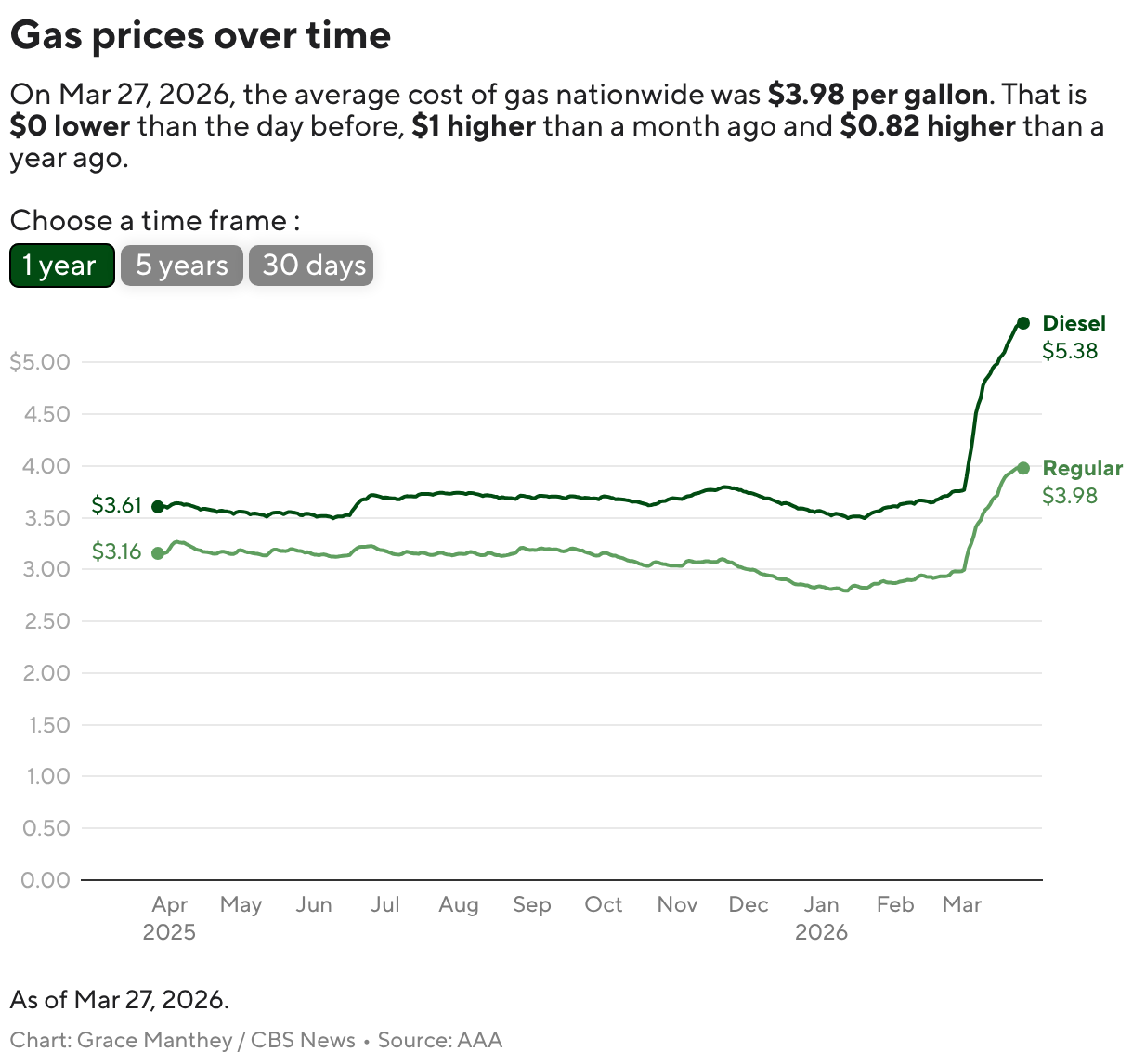
Fuel costs climbed even as oil prices edged lower Wednesday on renewed hopes for a U.S.-Iran agreement, highlighting a disconnect between crude markets and what drivers pay at the pump. Lingering worries about supply disruptions, coupled with signs of broader violence in the Middle East, have pushed fuel costs higher over the past week.
“Gasoline prices rose in every state over the last week, with some of the most significant and fastest increases concentrated in the Great Lakes, where states like Michigan, Indiana, Ohio and Illinois saw sharp spikes, while Wisconsin experienced more modest gains,” Patrick De Haan, a petroleum expert at tracking service GasBuddy, said in a report.
Brent crude, the international benchmark, dropped $7, or 6.4%, to $102.83 a barrel on Wednesday. West Texas Intermediate, the U.S. benchmark, fell 6% to $96.11. Global oil supplies are constrained as the Strait of Hormuz, which carries 20% of the world’s oil and liquefied natural gas, remains largely closed to ship traffic.
“We’re now over two months from when the conflict began,” said Dave Sekera, chief U.S. market strategist at Morningstar, in an email. “It just appears like we’re not any closer to a long-term resolution. Yes, there are some ships here and there getting through the Strait of Hormuz, but effectively, it still seems closed, and the supply of oil and natural gas is still a lot lower than pre-conflict.”
When will gas prices go down?
Even if the U.S. and Iran reach a peace deal, gas prices are likely to remain elevated for months to come, experts predict. Brent crude is likely to trade at about $80 a barrel by year-end, about $10 higher than prior to the war, according to an April estimate from Goldman Sachs.
Goldman said that estimate is based on oil supplies in the Persian Gulf normalizing by mid-May, although it noted there are “significant upside risks” to its forecast.
Global oil inventories are nearing their lowest point since 2018, raising concerns about a potential supply squeeze, according to a May 4 report by the investment bank.
“As the oil tanks go dry, as we use up the last of the inventory, that’s when the real crunch is going to start to hit,” John Quigley, a senior fellow at the Kleinman Center for Energy Policy at the University of Pennsylvania, told CBS News Philadelphia. “Prices have to go much higher.”
Gas prices are influenced by factors beyond crude oil prices, including petroleum supplies and the speed at which Middle East refineries can return to service after damage sustained in the Iran war. Seasonal demand, such as higher gasoline usage during the summer months, also tends to drive up fuel costs, according to De Haan.
“With so many moving pieces, the outlook remains highly fluid, and while some localized relief may emerge, broader price volatility is likely to persist in the near term,” De Haan said in a report.