Hantavirus ‘as contagious as Covid’ – date to know if it has spread | UK | News
Scientists are warning that 19 May could prove a critical date in the MV Hondius hantavirus outbreak – the point at which so-called “generation three” cases may begin to emerge among people who had contact with passengers who left the ship early.
The virus has not yet been detected in anyone who was not aboard the stricken vessel, but with an incubation period stretching weeks, health officials cannot rule out silent spread among the three dozen who stepped off before the danger was apparent.
Dr Steven Quay, a US physician-scientist, has crunched the numbers on the outbreak’s timeline, finding that those in the second wave of infections – individuals who fell ill after exposure to patient zero, Leo Schilperoord, 70 – took roughly 22 days on average to develop symptoms. If the same three-week window applies to the next chain of transmission, a third generation of cases could begin surfacing on or around 19 May.
“We now have 10 hantavirus cases, one apparent patient zero and nine human-to-human generation two cases,” he said. “May 19 is a good date to watch for… If cases continue beyond that point they will probably be generation two to generation three cases.”
Historical data from Andes strain outbreaks in Argentina puts the typical window for symptoms appearing at 22 to 28 days after exposure.
Who left the MV Hondius before the outbreak was identified?
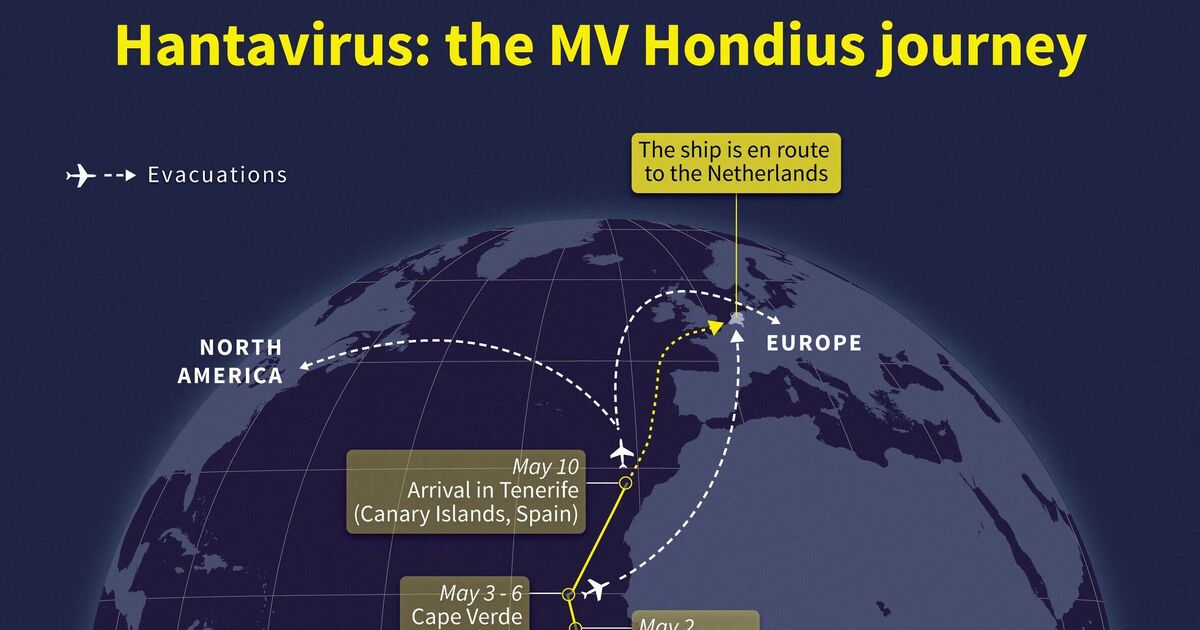
Twenty-nine passengers left the ship at Saint Helena before the outbreak was identified. Among them was Miriam Schilperoord, 69 – wife of patient zero. By the time she reached South Africa she was too unwell to board a KLM flight and subsequently died.
A flight attendant who was initially believed to have caught the virus from Mrs Schilperoord has been given the all-clear. Separately, a British national who left the ship at the South Atlantic territory of Tristan da Cunh, is under investigation as a suspected case.
All 30 people who left before the danger was recognised and are likely to have encountered hundreds of people in the weeks since.
Can hantavirus spread from person to person?
The Telegraph reports that scientific consensus has moved firmly towards person-to-person transmission via bodily fluids, though experts stress the general public faces minimal risk given that spread requires sustained close contact.
Passengers have received detailed contact-tracing questionnaires covering a wide range of potential exposure scenarios – from sexual activity and shared sleeping arrangements to shared bathroom use, cigarettes, vapes and toothbrushes, as well as any proximity to infected individuals lasting more than an hour.
However, there are growing concerns that the Andes strain may be more contagious than previously believed. Harvard professor Joseph Allen has disclosed that a doctor on board the MV Hondius raised concerns with him that several of the infected had no meaningful close contact with patient zero – merely sharing the same dining or lecture spaces.
Evidence from a previous Chubut Province outbreak is particularly alarming, with one individual reportedly caught the virus after a brief passing exchange with a symptomatic person at a social event. Several other partygoers became infected while seated at separate tables, and two hospital patients contracted the illness simply by being in rooms adjacent to infected individuals.
How contagious is the Andes strain of hantavirus?
Two further evacuees – a French citizen and an American – tested positive this week, pushing the total suspected case count to ten. If all were infected by patient zero, the virus’s reproduction number works out at nine – meaning each carrier has on average passed the illness to nine others.
If true, this puts the new outbreak on a par with Covid‘s Omicron strain – though scientists caution that the ship’s enclosed conditions will have significantly boosted transmission beyond anything likely in an open setting.
The emerging picture points to a virus that spreads more readily than scientists initially assumed – a deeply concerning finding given how many people the ship’s passengers will have encountered since coming ashore.