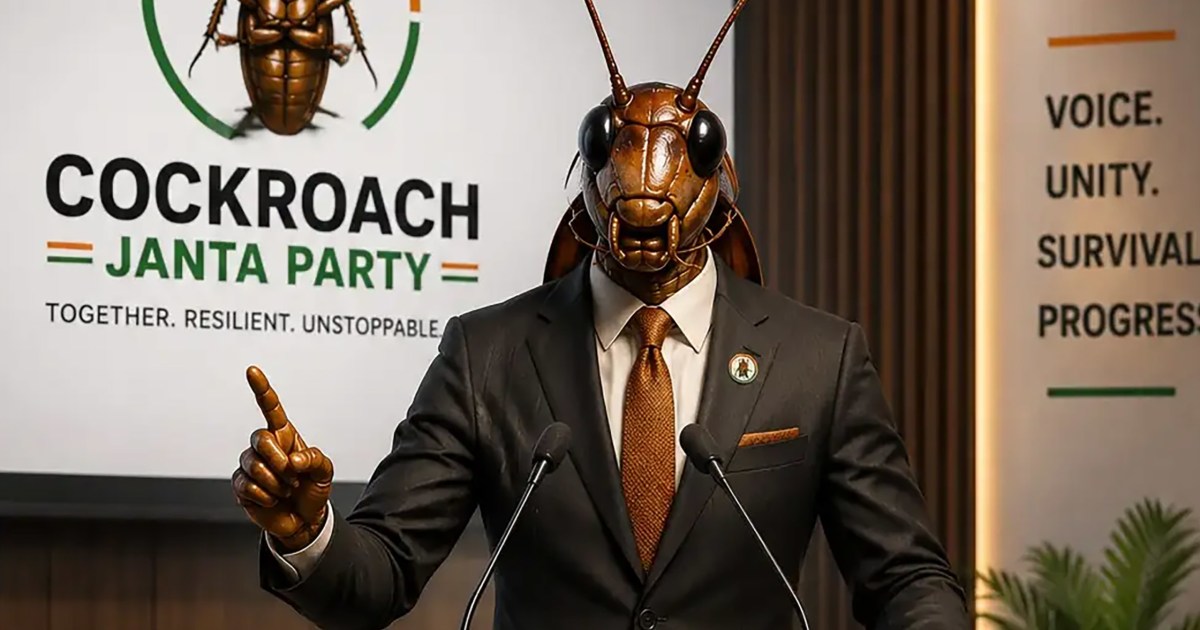
India’s ‘Cockroach Janata Party’ began as a joke. Then millions joined in.
What began as an internet punchline is turning into something more serious.
Subscribe to read this story ad-free
Get unlimited access to ad-free articles and exclusive content.

Indians online are rallying around the Cockroach Janata Party, or CJP — a parody political movement that started as online satire but has rapidly become a vehicle for venting anger over unemployment, corruption and the state of India’s democracy.
The movement, a cheeky riff on the name of Indian Prime Minister Narendra Modi’s ruling Hindu nationalist Bharatiya Janata Party (BJP), has flooded social media with memes, mock campaign messaging and jokes carrying an edge of public frustration.
“We have to understand that five years ago nobody was ready to speak up against Modi or the government,” said CJP founder Abhijeet Dipke. “The times are changing.”
Founded last month, the movement’s rise traces back to comments made by Supreme Court Justice Surya Kant, who compared some young people and critics of institutions to “cockroaches” and “parasites.”
“There are youngsters like cockroaches, who don’t get any employment or have any place in the profession,” Kant said.
The remarks quickly ricocheted across social media, drawing criticism and meme-making in equal measure. Kant later said he had not intended to insult young people and that his comments were directed at individuals with fraudulent degrees.
But by then, the internet had already done what it does best.
On Instagram, the movement has amassed roughly 19 million followers — more than double the number for the BJP, which has approximately 9 million, and Congress, India’s main opposition party, which has about 13.4 million.
“Nothing of this was intentional,” Dipke said. “It is the younger people who were actually very frustrated. They don’t have any outlet. They were really angry at the government.”
Dipke, a political communications strategist and Boston University graduate, said the movement’s popularity reflects a shift in India’s political climate.
He previously worked alongside the Aam Aadmi Party, which emerged from India’s anti-corruption movement in 2012.

The controversy over Kant’s comments has fueled growing attention around the CJP, which transformed an insult into a rallying cry.
Dipke said his social media accounts appear to have been targeted by hackers since launching the CJP. In a series of posts on X, he also posted a graph that he said showed nearly 95% of the audience was from India, responding to claims that followers were coming from neighboring Pakistan.
The CJP’s official X account later became inaccessible within India, though it remained visible elsewhere, prompting concerns among some opposition figures about freedom of expression in the world’s largest democracy.
“I understand the frustrations of the youth and see why they are resonating with it,” wrote Shashi Tharoor, a member of the Congress party, calling the account’s inaccessibility on X “disastrous” and “deeply unwise.”
“There should be an outlet for the youth to express their feelings and so, let CJP’s account function instead of shutting it down,” he wrote. “Democracies need outlets for dissent, humor, satire, and even frustration.”