Inside Leicester’s horror demise from Prem champions to League One | Football | Sport

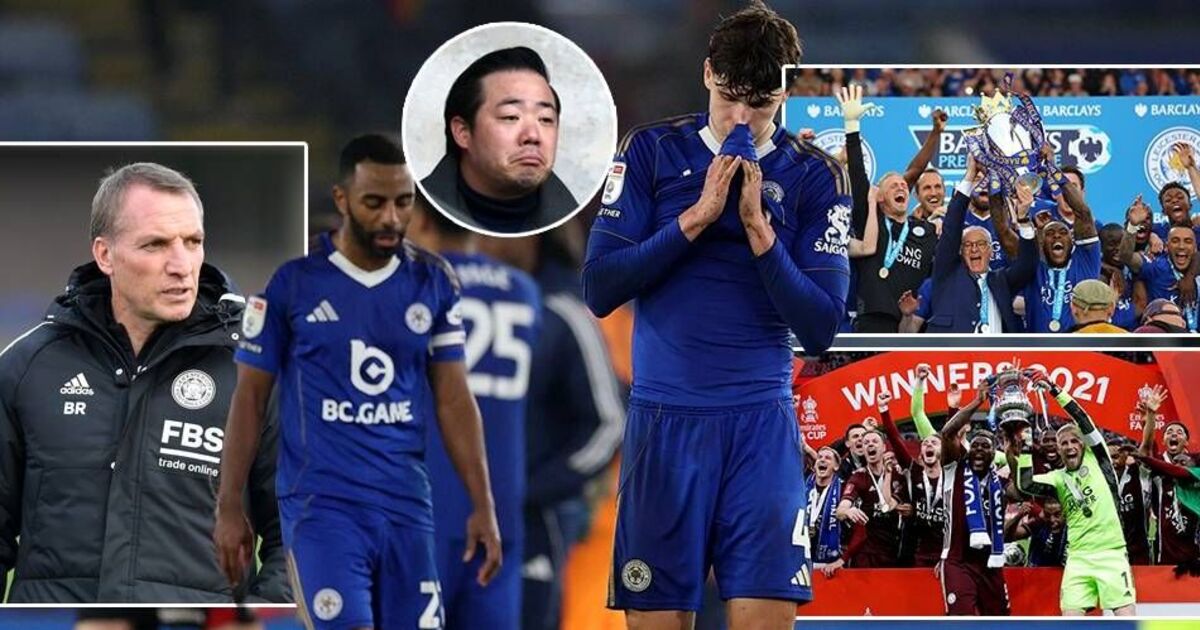
Leicester won the Premier League just 10 years ago. (Image: Getty Images)
“If you think Leicester can be in League One, then you have lost your mind.” Those were the words of midfielder Jordan James back in December when questioned about whether Leicester City could face back-to-back relegations. And to a degree, it is easy to understand where the Welsh midfielder was coming from. This is a club that just 10 years ago lifted the Premier League trophy under Claudio Ranieri.
This is a club that just five years ago claimed the FA Cup for the first time in their history under the stewardship of Brendan Rodgers. This is a club that had given others the licence to dream. That dream has rapidly descended into a nightmare, having slipped into League One following a dreadful campaign, with a draw against Hull City officially sealing their fate. Leicester now stand as a cautionary tale of how not to run a football club.
In truth, alarm bells began sounding as far back as 2020, when the Midlands outfit suffered a late-season collapse and narrowly missed out on a Champions League place, and the considerable financial rewards that accompanied it.
That shortfall in revenue, compounded by the Covid pandemic, dealt a significant blow to the Foxes’ Thai ownership. Leicester then fell agonisingly short once more the following season, yet the board remained firmly committed to Rodgers.
That glorious occasion beneath the Wembley arch against Chelsea will live long in the memory. Yet the club’s woeful decline since then will, arguably, prove an even more enduring legacy. A calamitous summer transfer window in 2021 saw the club squander vast sums on Patson Daka, Boubakary Soumare and Jannik Vestergaard, all without offloading a single key player to balance the books. Leicester are still feeling the financial repercussions of that ill-fated business to this day.
A 4-1 thrashing at the hands of local rivals Nottingham Forest in the FA Cup as holders in February 2022 stands out as a defining moment when the foundations of the King Power ownership began to fracture. Rodgers went on the defensive, warning that the squad required a ‘refresh’, while also claiming that Leicester were ‘not the same club’ just months later.
The departures of title-winning heroes Wes Morgan, Christian Fuchs and Kasper Schmeichel triggered an alarming decline in standards, a deterioration that has only deepened since.
The Foxes duly dropped out of the Premier League the following season, with Rodgers dismissed towards the tail end of that campaign in favour of Dean Smith, a decision that many would argue came far too late. Relegations occur, naturally, but rarely to a squad as gifted as Leicester’s undoubtedly was.
EXPRESS SPORT ON FB! Get all the best sports news and much more on our Facebook page
There ought to have been a thorough examination into how the club had fallen into such a predicament, particularly given the position of strength from which they had once operated. Such a review was certainly pledged by the club’s ownership, with owner Aiyawatt Srivaddhanaprabha confirming an ‘internal review’ that never actually came to fruition.
All club chiefs, including widely criticised director of football Jon Rudkin, kept their positions as though nothing had occurred. Leicester should have taken heed of the warning signs. They simply did not.

Leicester City will be playing in League One next season. (Image: Getty Images)
There was, however, a brief glimmer of hope during the 2023/24 campaign as the Foxes secured an immediate return to the Premier League under Enzo Maresca. Even that triumphant season has since been overshadowed and ultimately proved deeply damaging to Leicester in the longer term.
The club spent heavily in a bid to secure promotion, bringing in England internationals Harry Winks, Conor Coady and others on vastly inflated contracts for considerable sums of around £18m.
WORLD CUP LEGENDS: The stars who lit up football’s greatest tournament – Buy the Special Edition today
This led Leicester to breach the EFL’s PSR regulations once more. While they had previously avoided punishment on a technicality following relegation, they would not be so fortunate on this occasion (but more on that later).
Leicester continued to repeat the same grave errors upon their return to the top flight. Maresca departed for Chelsea, with former Forest manager Steve Cooper named as his successor. He was the wrong appointment from the outset, with some players making their fondness for former boss Maresca abundantly clear in a Copenhagen nightclub shortly after his arrival.
The acquisitions of Oliver Skipp, Jordan Ayew, Bobby De Cordova-Reid and Caleb Okoli did little to inspire any confidence that this was a squad capable of surviving in the top flight. Cooper was ultimately dismissed in November, paving the way for Ruud van Nistelrooy’s arrival.
The Dutchman’s tenure could hardly have been more disastrous, as he lost 18 of his 25 Premier League matches and suffered relegation. It confirmed that Leicester’s drop two campaigns earlier wasn’t an anomaly but rather a symptom of deeper-rooted problems.
It was equally evident that the former Manchester United striker had no long-term future at the King Power Stadium, yet it wasn’t until June 27, more than four weeks following the final fixture of the campaign, that Van Nistelrooy was formally dismissed from his position.
A further three weeks elapsed before his successor, Marti Cifuentes, was confirmed, 26 days ahead of the season curtain-raiser, a postponement that severely disrupted the club’s pre-season arrangements, as did the exit of club legend Jamie Vardy without a suitable replacement being secured.
Despite an encouraging beginning, Cifuentes turned out to be another underwhelming choice, managing only 10 league victories before his January dismissal. Leicester then needed almost a month to identify his successor in Gary Rowett.
During that period, Leicester suffered three straight defeats, including a 4-3 loss to Southampton in which they surrendered a three-goal advantage.
That result appears to have inflicted irreparable harm on the dressing room, as did a six-point deduction for their previous PSR breaches, the first occasion in the club’s history that points had been docked. An appeal was dismissed by an independent commission, plunging Leicester into a relegation scrap.
Those believing that off-field governance is the principal cause behind their descent into the third tier are seriously mistaken, however. Rowett has endured the same fate as many before him by failing to extract a performance from an expensively assembled squad who seem unfazed by the predicament the club faces.
The former Millwall manager has secured just one victory — a run of form that has seen Leicester slip into League One for only the second time in their history. Even without their points deduction, Leicester would remain in the relegation zone and under genuine threat of relegation to the third tier.
Considering the trajectory the club has been on for some time, anyone suggesting Leicester don’t deserve to be in League One has lost their mind.