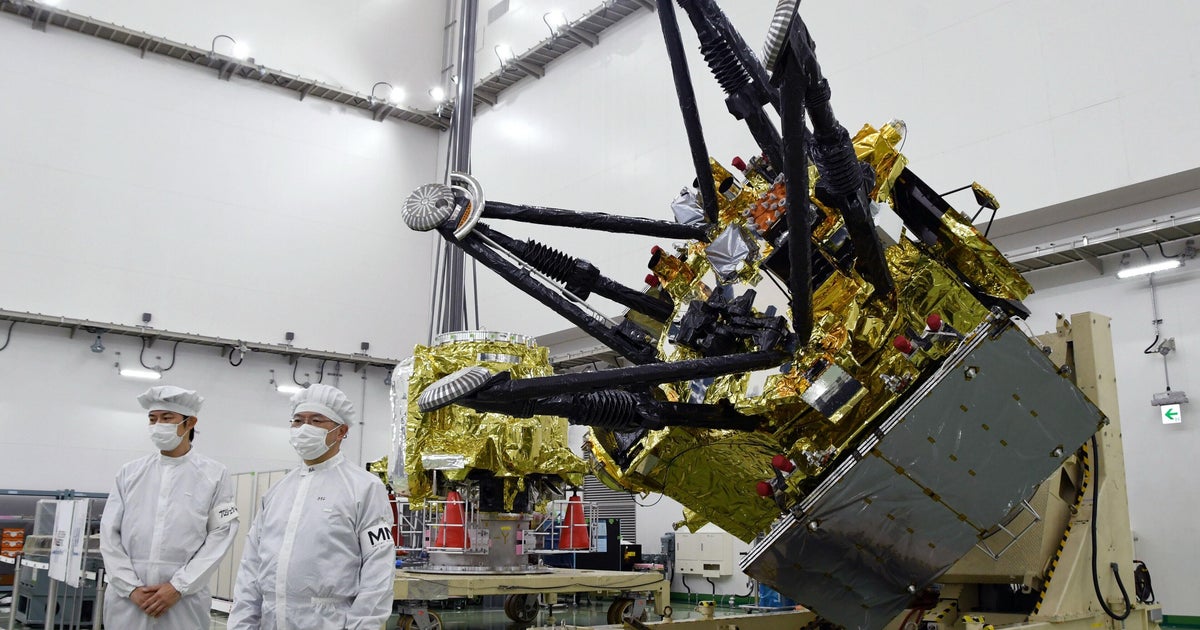
Japan launches ambitious robotic mission to land on Martian moon Phobos, return samples to Earth
Japan launched an ambitious $350 million mission to Mars on Monday to study the red planet’s two moons in unprecedented detail, dropping a small rover on the largest — Phobos — before the mothership touches down to robotically collect soil samples for return to Earth.
The primary goal of the Martian Moons Exploration mission, or MMX, is to determine whether Phobos and the smaller moon Deimos were created by the impact of a large body early in the solar system’s history or whether the two are asteroids that once passed close enough to Mars to be captured by the red planet’s gravity.
JAXA 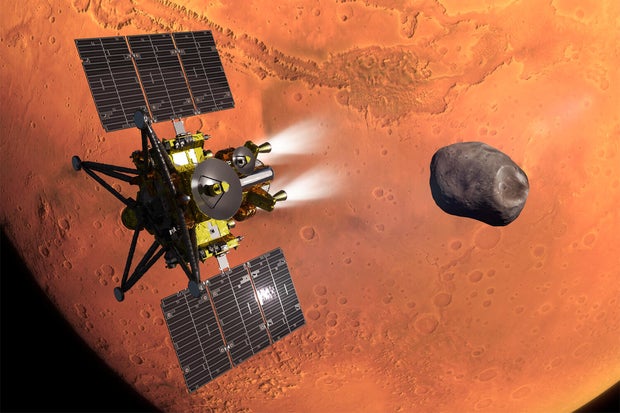
The Martian moons are much smaller than Earth’s, with Phobos measuring just 17 miles across at its widest while Deimos is less than half that size. Both are irregularly shaped and similar in appearance to asteroids. But size and shape alone are not enough to answer the question of their origin.
“One of the most intriguing questions about Phobos and Deimos is simply why these two little moons are there in the first place,” said Thomas Statler, who helped oversee development of two NASA instruments aboard the MMX spacecraft.
“In some ways, they resemble asteroids from the outer part of the asteroid belt … but there (are) other lines of evidence pointing to these moons being remnants of a giant impact early in Mars’ history.”
Jaxa 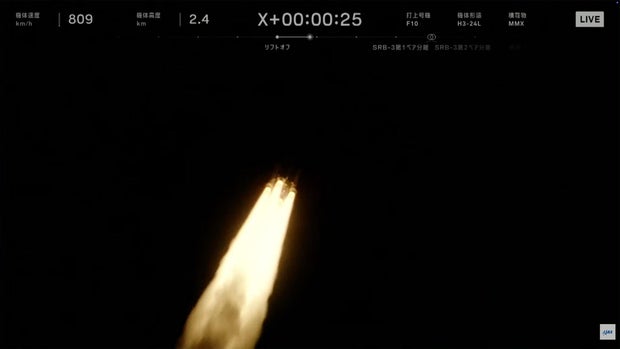
The collected samples, expected to be returned to Earth in 2031, should answer that question one way or the other.
“By going to the Martian moons, studying them up close and bringing samples back to Earth, we’ll be able to determine whether Phobos material is more consistent with an asteroid composition or with debris created by a collision involving Mars,” Statler said.
The mission got underway at 3:41 p.m. EDT (4:41 a.m. Japan time) with the sky-lighting launch of a Japanese H3 rocket from the picturesque Tanegashima Space Center operated by the Japan Aerospace Exploration Agency, or JAXA.
Four solid-propellant strap-on boosters and two hydrogen-fueled first stage engines powered the rocket out of the dense lower atmosphere before the H3’s second stage took over to continue the climb to space.
NASA 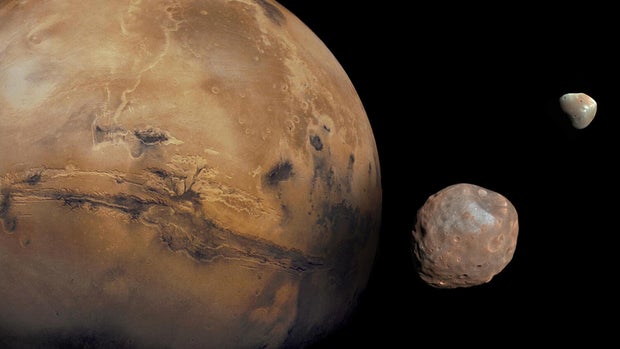
One hour and 11 minutes after liftoff, following two firings of the upper stage engine, the 9,900-pound MMX probe was released to fly on its own.
If all goes well, the spacecraft will brake into orbit around the red planet in September 2027 on a trajectory that will allow it to circle the planet in lockstep with Phobos.
MMX will spend three years in that orbit, training a battery of instruments on Phobos and its surrounding environment, studying its chemical and mineral composition, assessing its possible use as a staging base for future astronauts and dropping a small rover, supplied by the German and French space agencies, onto the moon’s surface in early 2029.
The 55-pound rover is not equipped with braking rockets or anything else to slow its descent. Given the gravity of Phobos is just 1/1,000th as strong as Earth’s, the rover is expected to bounce down on the surface, tumbling gently to a stop.
It is designed to right itself regardless of how it ends up after coming to rest and then to begin its surface exploration. It is equipped with cameras for navigation and to study the soil as it rolls about, an instrument to fire laser beams into the ground to determine what minerals might be present and another that will monitor soil temperatures.
JAXA 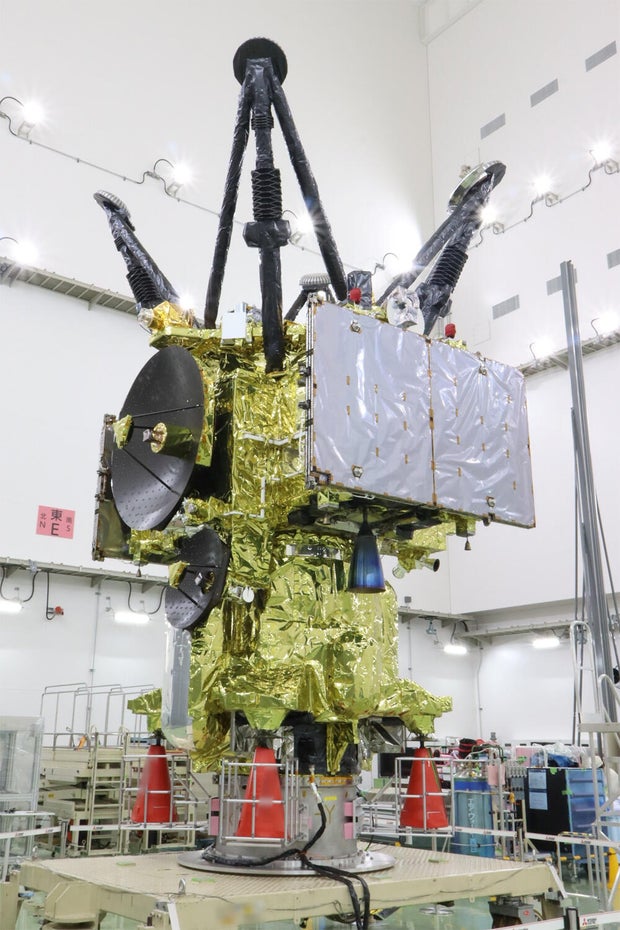
About a year after the rover’s landing, in the 2030 timeframe, the MMX spacecraft itself will touch down on Phobos once and possibly twice to collect a tiny amount of soil using two devices, one built by JAXA and the other supplied by NASA.
The official mission requirement is to capture at least 10 grams, or less than half an ounce, of material. Depending on the nature of the soil, however, the sample size could be larger.
The MMX then will lift off and, after wrapping up remote observations of Deimos, head back to Earth, putting the Phobos samples into an aerodynamic, heat-resistant capsule that will re-enter the atmosphere over Australia, where a recovery team will be standing by.
The samples will be studied by an international team of researchers.
“There’s a lot of adrenaline, a lot of excitement, and a lot of wow,” said Statler. “MMX will be the first spacecraft ever to return to Earth from the Mars system. That says a lot.”
But “the most exciting thing of all,” he said, “will be watching the sample return capsule re-enter Earth’s atmosphere and opening that capsule and seeing those materials for the first time. There is absolutely no lack of excitement and adrenaline on this mission.”