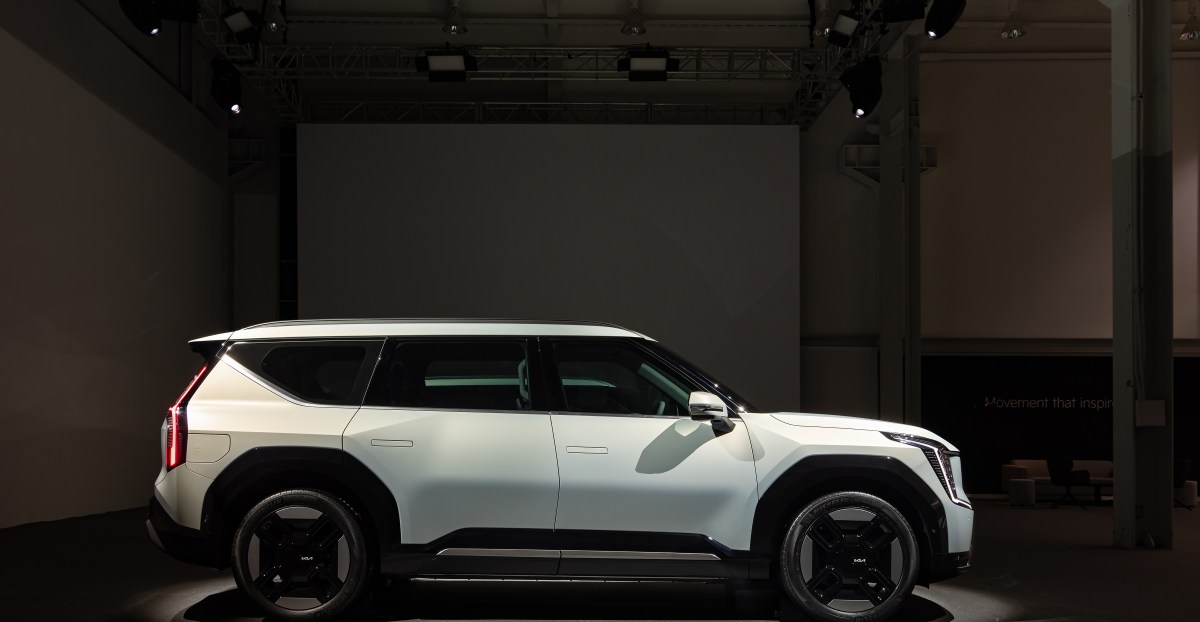
Kia’s flagship EV has a battery problem
I first realized there was an issue with Kia’s flagship EV9 when I tried to unlock my car last year. The hulking three-row SUV was sitting on my driveway completely dead. The key didn’t work, the app connection to the car was gone, and I was already late to an appointment. Luckily, I had prepared for such a scenario, after reading about widespread 12-volt battery issues with the EV9.
I managed to open the car with the manual key that Kia supplies and access the frunk to reach the 12V battery and use a booster I had purchased to jolt it back to life. Like many ICE cars, a 12V battery powers most of the low-voltage electrical systems in a vehicle, so when it dies, the vehicle is rendered useless. I called my local Kia dealership to report the problem. I was prepared for the 12V battery issues, but I wasn’t prepared for what happened next.
A few weeks after Kia had run software updates to address the 12V battery issue, I started to notice weird charging issues with my EV9. Every time I tried to charge past 80 percent, the car would jump from 82 percent to 100 percent on my home AC charger, as if it had miraculously instantly charged that last 18 percent. I also noticed the range of the car had gone down significantly at 100 percent charge, making it difficult to complete some longer journeys without having to charge again.
It seemed like a battery problem, the type of issue I’ve read so many people posting about on EV9 owner groups on Facebook. I reported the problem to Kia and they weren’t able to initially replicate it until I was able to record the issue on my phone while charging on a fast DC charger. The car would drop to a 0kW charge rate at 82 percent and take about 10 minutes to fake its way to 100 percent without the estimated range of the car ever changing.
After watching a variety of YouTube videos, I purchased an On-Board Diagnostics (OBD) scanner to plug into the car to retrieve more information about the battery. OBD II scanners let you see the amount of remaining energy in a battery pack at its current state of charge, as well as read the voltage levels across individual cells of an EV battery.
The EV9 has a modular battery pack that has been highly praised by engineering consulting firm Munro & Associates. It has 38 individual modules that can be replaced, making it easier for technicians to complete repairs. With the OBD II scanner, I could see that at 100 percent charge I only had 71kWh, whereas I should have had around 96kWh usable of the 99.8kWh battery. That meant I was missing 25 percent of the battery and in turn 25 percent of range. I could also see that some battery cells were dead and not holding a charge, but the car was still working and there were no errors or problems charging up to 82 percent.
After a couple of diagnostic sessions, my local Kia dealer eventually came to the conclusion that the main high-voltage battery pack was faulty and would need to be replaced. Instead of leaving it at the garage for a week or two, I entered into Kia’s battery repair program, which has no ETA and is part of the eight-year warranty cover that Kia provides for EV batteries in the UK.
The wait for a new battery can be as long as nine months
I soon learned after talking to more than a dozen EV9 owners in the UK that the wait could be as long as nine months for a battery fix, the amount of time it takes to create another future passenger for the back seats. Unlike some EV9 owners I’ve been speaking to, I’ve been able to continue using my car until Kia was ready to fix it. Some EV9 owners have had similar issues to mine, where the car stops charging at a certain percentage and the range nosedives. Others have had the battery pack totally fail or seen the range plummet to only 30 miles, making their cars unusable.
Kasem Saowijit described his EV9 battery failure issues as a “nightmare” in messages to The Verge. His EV9 failed in January and his local garage has provided a smaller EV6 as a courtesy car while he waits an undetermined amount of time for his car’s return. “Kia are absolutely pathetic, no update with a chase, and when I do get an update it’s a pointless update,” says Saowijit. His EV9 is only a year old, and he says he’s now wasting hundreds of pounds a month on a car lease he can’t use.
Saowijit isn’t alone with the frustrations over Kia customer service. “My car has stayed at the dealership and it’s not moved in five months,” explains EV9 owner Helen Crawforth in a message. Crawforth has also been provided a courtesy car, but it’s an ICE car that she says is “costing me a fortune.”
Blair Ogilvie first started having issues with his EV9 in September 2024. “The first issue was a 12V battery issue,” he says in a message. Months later, just like me, he started having problems with the main high-voltage battery not charging properly and the range of his EV9 dropping dramatically. The battery eventually failed further in December and dropped to around 80 miles of range, causing “other systems to fail including the crash avoidance system.” Ogilvie tells me Kia said the car was unsafe to drive, and his EV9 has been off the road since December with no ETA on a fix.
The stories of the more than a dozen EV9 owners I’ve spoken to are all very similar and point to a Kia that is struggling with battery replacements on its flagship EV. But the problems for Kia and Hyundai EVs go even deeper. The sibling brands, operating under the Hyundai Motor Group, have each suffered a variety of issues with Integrated Charging Control Unit (ICCU) failures in recent years across the Ioniq 5, EV6, and other models. An ICCU failure can cause a car to lose power while driving, which is an incredibly dangerous problem to have.
Hyundai and Kia have both started to issue warranty extensions around the world for affected vehicles in recent weeks, after remaining mostly silent on the issues for years. The change of heart came months after Consumer Reports highlighted in February that up to 10 percent of Hyundai and Kia EV owners experienced ICCU-related issues, depending on the model and model year.
Corbin, who runs The Ioniq Guy YouTube channel and goes by a singular name, has been covering the ICCU failures closely before his own Ioniq 5 had a battery issue last fall. “What you are experiencing with your car is exactly what I experienced with my Ioniq 5,” says Corbin in an email to The Verge. “They replaced the battery within two weeks, which seemed to be due to preferential treatment as others were waiting many months.” Hyundai then loaned Corbin an Ioniq 5 press car while his personal vehicle was being fixed, and it suffered the same failure. ”Hyundai knew about the issue with the cells early in 2025 and released a technical service bulletin instructing dealers to replace the failed packs that showed the related trouble code,” says Corbin. Kia hasn’t released a similar bulletin for the EV9 yet, and my local dealer struggled to find an obvious error code for the problems I’ve been experiencing.
EV9 owners in the US are also facing similar battery issues, but messages on Facebook owner groups suggest that wait times are slightly better than across the Atlantic. “Wait times might have decreased but at least anecdotally I’ve heard it can still be months,” says Corbin.
I reached out to Kia PR in the UK about the battery issues with the EV9 and general ICCU problems in late March. After initially responding in March about a potential statement, Kia UK PR ignored my repeated requests for comment earlier this month.
Two days after chasing Kia UK PR for the first time since March, my local dealer phoned to say my car was suddenly ready to be repaired. My EV9 is now sitting in an industrial unit nearly 100 miles away, and I’m still not sure when I’ll get it back. Kia has loaned me a much smaller EV3 for my growing family in the meantime, a vehicle that has also been plagued with ICCU issues over the past 18 months.
Before Kia’s ICCU issues, the brand was also hit by a pandemic-era car theft problem. Thieves calling themselves “the Kia boys” posted videos on TikTok and other social media platforms with instructions on how to steal Kia cars, often with just a USB cable. The absence of electronic immobilizers on many Hyundai and Kia vehicles manufactured between 2015 and 2019 led to both brands rolling out software updates to prevent thefts. It’s not clear if Kia and Hyundai can address its ICCU and battery problems with software this time, though.
If you’re experiencing similar issues with your Hyundai or Kia EV — whether it’s an unexplained loss of range, charging problems, or strange battery behavior — it’s worth taking the time to scan your vehicle with an OBD II reader and check the health of the high-voltage battery yourself. There are plenty of easy-to-follow guides available, and the data can reveal problems long before a dealership acknowledges them. The more owners who document these failures, the harder it becomes for Hyundai Motor Group to ignore what looks like a growing battery failure issue.