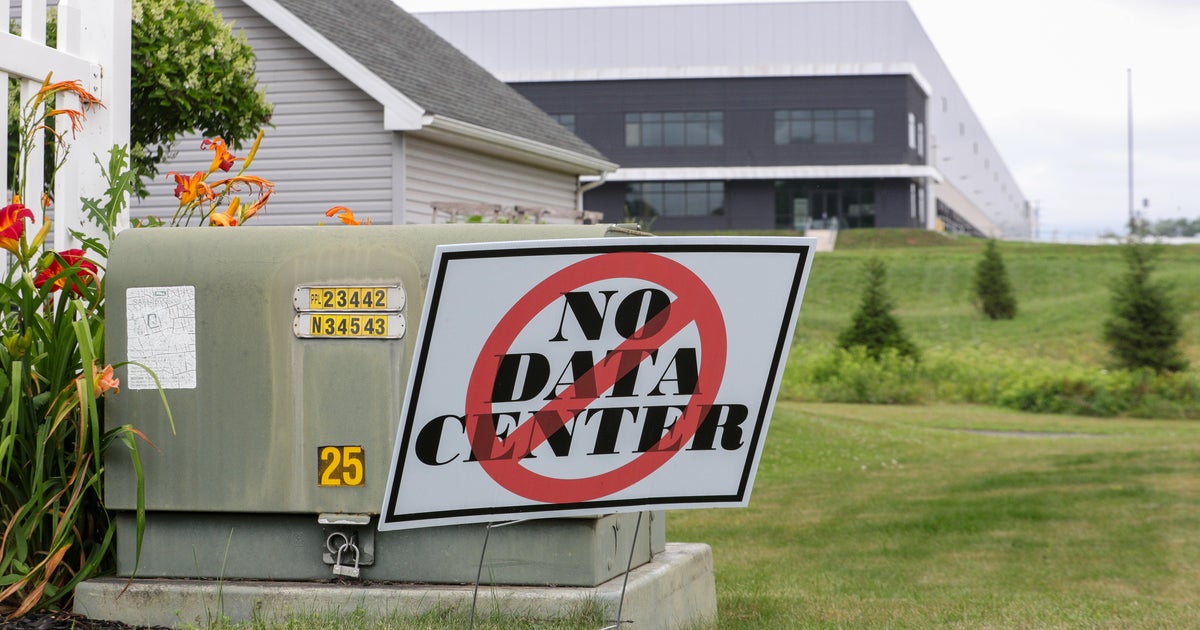
Midterm election results will slow data center buildout, experts predict
The Democrats’ sweeping victories in the midterm elections on Tuesday could buoy opponents of data centers in some parts of the U.S. and slow the spread of the controversial facilities, according to Wall Street analysts.
As of Wednesday afternoon, voters had approved 37 ballot measures restricting data centers and only one allowing them, according to an analysis from political research firm Redbud Consulting. The election also elevates a number of candidates who made stricter regulation of data centers a key part of their campaigns.
The rapid development of data centers around the U.S. to help power artificial intelligence has provoked widespread public backlash. By a margin of more than 2-to-1, more Americans oppose than favor building a new data center in their area, a CBS News poll found this summer.
Focus on Texas
Franklin Templeton chief market strategist Stephen Dover predicted that the election results will lead to a “slowdown in data centers being built,” bringing new regulations and costs for their developers.
“For tech investors, the big focus is will these midterm elections slow the pace of the planned 800 to 1,000 data centers across the U.S. fueling the AI Revolution,” Yorkville Ives & Co. technology analyst Dan Ives said in a report. “The answer in our view is a clear YES.”
Ives pointed to Texas, which accounts for 25% to 30% of the data center capacity expected to come online by 2030, as one state that could be affected. Democrat Gina Hinojosa, who defeated Republican incumbent Greg Abbott in the race for governor, proposed a temporary ban on data center construction during her campaign.
“Texas is the foundation of the AI buildout in the U.S.,” Ives told CBS News.
Hinojosa’s win over Abbott could stall the addition of 13 gigawatts of data-center power in Texas, according to Gordon Johnson, CEO and founder of the investment adviser GLJ Research.
Abbott had already suspended data center approvals, which makes it easy for Hinojosa to extend the moratorium.
“Texas already has a moratorium — Abbott built it. All the new governor has to do is keep it in place. She doesn’t need a new law to keep data center permits frozen,” Johnson told CBS News.
Keisha Lance Bottoms’ gubernatorial victory in Georgia, the third-largest data center market, also has significant implications for the infrastructure buildout.
Bottoms, who campaigned on pausing new data center construction in the state, told CBS Mornings on Wednesday that she would immediately “sign an executive order for that pause, and then we will determine what else we need to do administratively to take that pause into effect.”
Bottoms also said she plans to review tax incentives offered in Georgia that have spurred data center development.
“So, of course, we are going to have to take a look at what those agreements entail and determine what our remedies are to enact that pause, but I don’t think we’re going to get a lot of pushback across the state,” she said. “Many local governments have already taken that first step.”
Cooling an overheated sector
Massive investment in data centers and the artificial intelligence sector more broadly has helped propel U.S. economic growth and drive stock market gains. In the long term, however, a slower data center buildout is unlikely to hamstring the economy, Dover of Franklin Templeton told CBS News.
“It’s possible to argue that the AI trade and data center buildout was getting overheated, and this could dampen some of the excessive investment that might not have a good return on capital, which investors have questioned anyway,” he said. “So unbridled expansion will be tempered a bit, but probably not a lot.”
Although data center moratoriums may delay construction, they won’t torpedo capital spending on AI or switch off the boost those expenditures have provided to growth, according to economists.
“A more restrictive stance toward data centers would stretch the timelines of future projects, and slower construction in the medium to long term wouldn’t necessarily be a bad outcome for the macroeconomy,” analysts with Oxford Economics said in a report.