New drone to help Royal Navy destroy Iranian mines in Strait of Hormuz | World | News

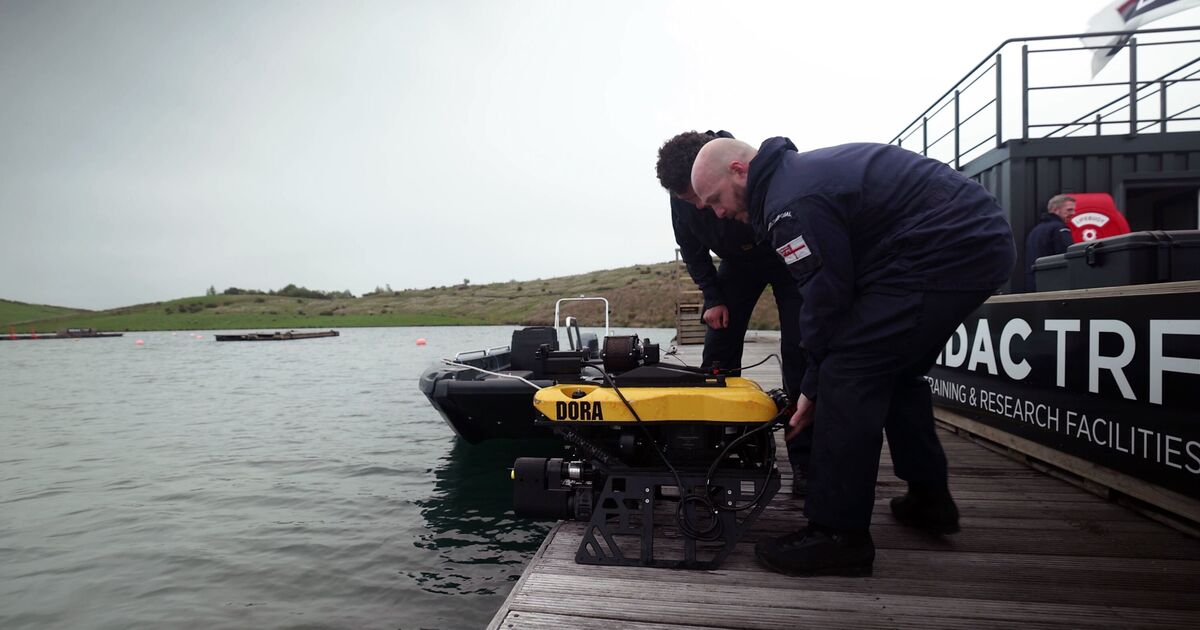
Military specialists have been training on the Defender-Viper remote controlled sumbersible (Image: MoD)
A new minehunting drone that has seen action in Ukraine will be part of the Royal Navy’s arsenal in the Strait of Hormuz. RFA Lyme Bay set sail from Gibraltar on Tuesday ahead of a potential multinational mission to safeguard shipping through the narrow waterway.
The Navy support ship has been converted to act as a mine warfare mothership, with the VideoRay Defender-Viper system just one of the drones which could be used to help clear shipping lanes. The remote-controlled submersible is capable of finding, identifying and destroying underwater devices like mines. The technology is particularly suited to neutralising buoyant mines which sit just below the water’s surface, detonating when struck by a passing ship.
READ MORE: UK defence spending impasse is awful – Labour’s rhetoric to reality is chasmic
READ MORE: RAF may have to wait until 2040s for £12bn Typhoon replacement fleet

Defender-Viper is hauled back to shore after a successful test run (Image: MoD)
There are conflicting reports over whether Iran has laid mines in the Strait of Hormuz.
The US has reportedly found no concrete evidence despite repeated searches of the strait which at its narrowest is 24 miles wide.
Despite this, the threat is being taken seriously by nations — including the UK — attempting to reopen the key trade route.

Two Defender-Viper systems are on board RFA Lyme Bay which left Gibraltar last week (Image: MoD)
The portable Defender-Viper system has undergone a series of tests in European waters and has also been used by Ukrainian forces.
Navy specialists from the Diving Threat and Exploitation Group completed a crash course in recent weeks and will be tasked with disposing of suspected mines identified by another unit using sonar in the Strait of Hormuz, if the mission goes ahead.
Defender-Viper is named after two pieces of kit; the Defender submersible from US firm VideoRay and Viper — which nails a demolition charge to a mine — from Weymouth-based manufacturer Special Projects.
It is controlled from a laptop on a small boat or from a command centre inside a shipping container or on board a ship.
It can either be steered manually or travel to a target independently by following pre-set coordinates.
The drone provides a constant video and sonar feed back to the operator and once in position, Viper is fired and attached to the mine while Defender retreats and unravels a firing cable as it goes.
Once Defender reaches a safe distance away, the charge is then detonated.
The charge is powerful enough to go through more than one metre of steel, according to the Ministry of Defence.
After the detonation is completed, Defender then returns to the mother vessel, ready to be used again.
Able Seaman (Diver) Charlie Rich, who is among those to have trained on Defender-Viper, said it is particularly useful in low-visibility conditions.
He said: “There are occasions when it is so dark, visibility is so bad that you’re literally hoping to bump into something. With this, the sonar is fantastic, so we can ‘see’ through the darkness and murkiness
“The system has the potential to be phenomenal – and we still possess our fundamental skills to fall back upon if it doesn’t work for some reason and get in the water.”
Further training with Defender-Viper is expected to be carried out before a 12-strong ‘mission team’ joins RFA Lyme Bay.
Two Defender-Vipers are on board the ship as part of a range of minehunting and disposal systems, including other autonomous equipment.
Britain will also send anti-drone systems and Typhoon fighter jets for air patrols as part of a mission in the Strait of Hormuz, while Type 45 destroyer HMS Dragon will be involved too.
Iran has effectively closed the Strait of Hormuz since early March in response to US-Israel strikes on the country.
Iran’s chokehold on the waterway — through which 20% of the world’s oil supply usually passes through — has sparked a global energy crisis with prices skyrocketing.
More than 40 nations — led by the UK and France — are working on reopening the Strait of Hormuz, while Donald Trump has announced that a US blockade of Iranian shipping through the waters will be lifted as he looks to end the war with Iran.
A mission to secure the strait will only go ahead “when conditions allow”, the MoD has insisted.
Around 2,000 ships are believed to have been stranded in the region due to the closure of the channel.